Various types of non-starting, non-heating, slow heating (i. E. Insufficient fire), unturning wheel, intermittent work, open fire and irreconcilable fire are described below。
N. B. When a microwave is to be removed for inspection and repair during maintenance, the 220v power source voltage, except for otherwise specified and checked for “no-start” failure, is to be repaired after the removal of the power plug and subsequent discharge of the high-voltage capacity。
Microwave working principles:
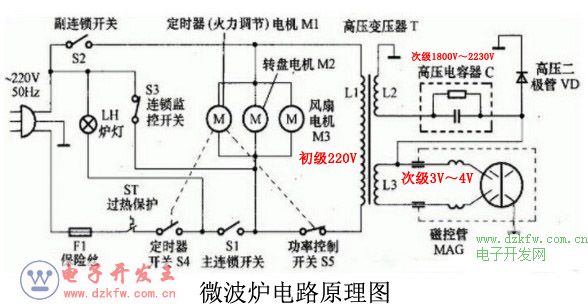
F1: insurance, the main function of which is to limit the entire electrical current. When the microwave s1 and s2 switches are damaged, it is short-linked and the s3 switches are connected。
St: thermal protection. The main function of st is temperature protection. One of the heat protectors is typically installed on the shell of the magnetic tube to prevent damage to the magnetic tube by monitoring its temperature。
S4: time switch. Time switches are the total power switches that determine whether the entire microwave is working。
S1, s2: door lock and monitor switches. In the microwave matrix, the role of the microwave is primarily to prevent leakage from the microwave. The microwave component will not work when the microwave doors are closed or the microwave doors are blocked。
S4, s5:s4 and s5 are two independent switches in power controllers that are separately controlled in the course of their work and work in a chain during power control。
M1: fire-regulating power. M1 and s4 and s5 form the sum of microwave power control, with a slotting control expected to form a whole in the package。
L1, l2, l3: l1, l2 and l3 form a high power booster, l1 high power transformer primary 220v exchange, l2 high power transformer secondary output around 2000v exchange high pressure, l3 high power transformer sub-group, output of exchange voltage around 4v。
No start
Non-start failure means that when the microwave is plugged into the power source, when the furnace door is closed, the spin time knob does not sound, the wheel does not turn and the stove cannot start. Non-starting is one of the most visible failures of the microwave and involves a wide spectrum of electrical circuits and a relatively difficult failure to judge. To facilitate a faster understanding and mastery of the methods and techniques for judging and repairing such failures, the author, using as an example the typical circuits shown in figure 1, carefully summarizes practical experience as a detailed flowchart for the maintenance of failure judgement as shown in figure 2. In maintenance, you can check in an orderly manner by tuso, and usually quickly you can find the fault. The figure also serves as a tactile and thought-provoking tool for repairing other failures。
The main common causes of non-starter failure are:
The fuse pipe f1 melted, the superheated st. Breaker, power circuit failure and security chain switch s1 ~s3 or damaged. Of these, f1, st and power circuits are easier to diagnose and process and, as will be mentioned below, mainly refer to the failure of the security switch. Most of the problems with s1, s2 resulted in failure to activate, and the failure of the security chain switch 3 resulted mainly in failure to burn the fuse pipe f1 (which could not be activated after the fuse was broken). For example, the main chain switch s1 should be connected when the furnace door is closed, and if the s1 opening road is damaged, whether the furnace door is open or closed, the microwave is not able to access the power source and activate。
Usually, s1, s2 and s3 are installed on engineering plastic slabs, where the position is fixed in manufacture and generally does not shift except for rigid variations or loose screws of fixed plastic slabs, so that failure to activate or burn fuses caused by shift is less common. It is more common in practice to see a chain switch and switch trigger pole (i. E. Two hook-like poles on the stove door, also known as door hooks) and a switch bump on a plastic stand that is damaged or bad. When these parts are checked, they can be seen clearly by removing the cover of the microwave, opening and closing the doors while observing their movements and, if they are all normal, checking whether the switches themselves are normal。
Since s1-s3 is designed for safety and is highly mobile, most manufacturers choose to use more durable, reliable, dedicated micro-switches, which can normally be used for long periods of time, but if the switch itself is of poor quality or in poor working conditions (e. G. Excessive contact), the useful life is significantly reduced. If the switch is damaged because of its age of use or for the reasons stated above, the test works may be removed and if the damage is seriously unrepairable, new items shall be replaced. Note that it would be preferable to have a prototype or direct replacement, if it were to be selected, that the outer size would be appropriate, which would not be suitable for the plastic stub inside the machine, and would be difficult or even impossible to replace. In addition, sl, s2 and s3 have essentially the same shape, but the switch function is different, so the selection and installation must not be mistaken. Many switches have electrical symbols on their casings, which make it easy to distinguish; in the absence of symbols, they can be measured on a universal scale, and it is sufficient to determine whether they are frequent or often closed switches and their corresponding source ends。
No heat
This failure means that the food is not hot after the microwave has been powered, but the general stove light is lit and the wheel rotates. Unhot failure is mainly due to the lack of microwave output in the microwave. The stove lights are lit and the wheel turns, indicating that the circuit before the high voltage transformer is generally normal, and if the power control switch is also normal, the failure range is in the high voltage transformer t and subsequent circuits for two main reasons: the magnetic pipe power supply circuit is not working and the magnetic tube is in poor or damaged contact。
Care should not be confused with non-starting failure in cases of unhot failure. Once the shell has been removed, the power control switch 5 breakout should be ruled out, usually measured by a universal meter, or judged by the power control switch 5 after a temporary short link. The parts and components of the high-voltage circuits and their connection end are then checked. Since this part of the circuit consists of a total of 4 and 5 parts, even on a case-by-case basis, it is usually possible to check first for looseness or poor contact between the thrust and relay plugs of the magnetic tube mag, and then, if it is normal, then for high-pressure diode vd, high-voltage capacitorsc, high-voltage transformers t, magnetic tubes and their associated relay plugs and welding points, it is usually possible to find the fault site very quickly. Practice has shown that high pressure diodes and high pressure transformers are usually the main cause of damage, especially in the past, so that when such failure occurs, the tube can be examined first, often with a multiplier effect。
Insufficient heating
Inadequate heating, also known as slow heating, means that microwave stoves use the same firepower to prevent the same food from cooking compared to normal times, but the cooking time is significantly longer than normal, even making it impossible for some of the foods requiring high-fired cooking to cook properly. This failure is an expression of a reduced microwave output power. In the case of normal municipal power supply, the main cause of the failure is the ageing of the magnetic tube or the low electrical voltage of the magnetic tube light or the anode。
Magnetic tube aging is of two kinds, one being natural aging because of the length of its use. The design of a magnetic tube usually has a service life of 2,000 hours, with an average of 30 minutes per day for microwaves, and a life of 4,000 days, or 11 years, but even at this time, the output power of the magnetic tube is not immediately and significantly diminished, but is ageing, so it is generally less likely to encounter a natural ageing magnetic tube. The other is premature failure, which is often due mainly to the poor quality of the magnetic controls themselves or to the fact that they have been used for longer periods in bad circumstances. As a result, maintenance failure with heating can usually be preceded by a check of the electrical voltage of the magnetic or anode lamps (checking their power circuits and connections at the end of the line at the time of power outage), focusing on the contact at the end of the connection of the magnetic tube fuses, especially when the use of a long microwave oven is more likely to cause poor exposure。
Dismantling the shell of such microwave furnaces tends to reveal a large amount of oil and dust accumulated in such components as magnetic tubes and in many parts of the case, and to view the magnetic tube lightlights and their cavities. They often reveal the erosion of the lead foot and the oily green stains. If the plugs are loosely connected to the light wires, exposure to electrical resistance increases significantly, resulting in a low light wire voltage, which reduces microwave output significantly. In repairing such a failure, it is only necessary to draw the light to the ground, then to use the alcoholic cotton ball, and then to use the tip of the plier to flatten the tip of the foot, so that it can be inserted and in good contact with the light。
If there's no problem with the power supply, it's basically an ageing magnetic tube. This can be done by switching the magnetic control tester and by measuring the normality of the filamental resistance of the magnetic control and by checking whether the magnet is fractured. For poor heating failures due to the ageing of the magnetic tube, it is usually the replacement of the tube that is the perfect solution. In addition, if the capacity of high voltage capacity is significantly reduced, the magnetic controlled tube anode voltage and output power are significantly reduced, and there is also a lack of heating, although this is usually less common, with most of the failure of high voltage caps being either punctuated or broken。
It should be noted, in particular, that, in practice, underheating failures are often associated with 220 v power voltages, often with some confusion that municipal voltages are normal, but because of greater internal or exposure to electrical resistance on the power lines, the large currents that flow through the microwave work create greater pressure reduction on the wires or on the trunks, which makes the stoves physically work with power voltage significantly inadequate, thus causing the heating to slow. Large-scale internal resistance to power lines usually occurs on power panels, fuses, power lines or power lines, and although it is significant, empty measured voltage tends to be normal and therefore obscure. In many households, the problem must be addressed and addressed first and foremost in maintenance, given the varying degrees of poor usage or connectivity of indoor power lines and the poor quality of power lines, power panels or outlets used. The measurement of municipal voltage requires the measurement of the charge load, and should not be judged solely by empty voltage。
4. No rotation
Such failure refers to microwave work, except for the failure of the wheel, which tends to heat up the food. The main cause of the failure was damage to or failure of the switch. During maintenance, only 220v voltage on the switch engine was checked and, if normal, the power was damaged. If not, check the breakpoint of the power supply line. If you do not want to carry an electron survey, you can also check whether the circuits are normal and if the rotors are stuck or not, and if not, the corresponding power lines. Practice has shown that electrical damage is common. Microwave ovens mostly use small-power synchronized power machines at speeds of 4 and ~ 8 and repair the next reference article. There's three main reasons for the switch
The first is the burning of the microwave ovens by short circuits or damage to gears caused by spills, such as boiled milk, and the flow of liquids into electric generators
Second is that the microwave is permanently operating in a high-wet environment and the electrical circuits or fuses are corroded
Thirdly, the microwave wheel is often blocked and damaged by overloading, for example, because of over-cooked food. For both maintenance staff and users, microwave stoves are used to avoid such occurrences as much as possible。
It is most convenient to check the microwave circuits, and for most microwaves, the machines can be seen and tested or repaired by taking out live objects such as the wheel and wheel racks inside the oven, then turning the stove over to the bottom, moving it up, then wringing the screws of the panel or plate that corresponds to the position of the transformer。
5. Intersessional work
Spacing is when the microwave is activated, when the power is automatically cut off for a period of time, and then automatically activated over a period of time, so that the cycle is repeated many times until the scheduled time is reached, and when the time is shorter, the automatic power is not activated. The main cause of such failure was the failure of the magnetic tube overheating protections st or the freezing of fans. When the magnetic tube superheat protection action is too low or cooling fans are stopped, the magnetic tube warms up to the action temperature of the ultraheat protection after a period of operation, the protection cuts the microwave power, after which the magnetic tube temperature falls to the protected self-recovered value, and the microwave power is connected to work, so that the cycle becomes intermittent. It is easier to judge this failure: if the cooling fan is rotated normally, the failure is caused by the overheating protection, which is the failure of the fan, and its failure may cause failure such as the failure to stop immediately。
Thermal protectors are usually small in size and have a sealed structure, which can be removed for trial repair, but re-assembly is more difficult and, if restoration is less likely, new versions of the same size should be replaced. It should be noted that some microwaves use two or more ultraheat protections, which are generally the same size and similar in size, and some are marked differently and difficult to detect without looking closely, so some lovers tend to confuse them and consider them interchangeable, and those who have seen maintenance articles that will apply to the magnetic tube at 145°c action temperature erroneously consider them to be superheat protections at an action temperature of around 80°c, which is clearly wrong and loses protection or breaks the microwave oven. So it's important to look at the markings on the heat protection, the numbers of which generally indicate the temperature of the movement, with the magnetic tube using more than 145°c and a few around 130°c; and the cavity overheating protections having more than 80°c variety
There's an open fire
This refers to a fire in the use of the microwave. Lighter fires can only be seen inside the furnace, most of which are self-activated or can be extinguished when power is out. In the face of a severe open fire that can emit stoves and cause accidents such as fires, the power supply must be cut off immediately and the fire extinguished with dry powder and carbon dioxide extinguishers. If the fire is larger and it is difficult to extinguish itself, the police should be called immediately。
Most of this failure was due to the barbecue heating tube of the barbecue microwave and the accumulation of more oil around it. During maintenance, a bowl of water could be used to enter the microwave, then to open the barbeque, to put the stove on hold for a while, to wipe out the heating tube and the oil from its vicinity, and to keep an eye on the oil trail and remove it in a timely manner. Fire failure in a small number of microwaves is caused by overheating of components such as magnetic tubes, usually in cases of failure of superheating protections, etc., and the flame retardation of certain elemental elements in such microwaves is mostly poor. The solution would be to replace the overheating protection and overheating damaged components such as magnetic tubes, and to completely remove potential fire hazards。
7. Non-regulated power
This failure is essentially caused by a power controller, which is required only to perform a power control check on the shredder. Power controller damage often occurs in two cases, one in which the power-reconciliating knob cannot be rotated and remains on a block, but functions such as heating are normal. This is usually the result of the holding of parts such as plastic rods for power controllers by foreign objects, which can be removed from the functional control/time integration components and then re-assembled. The second is that, although the power-regulating knobs can be rotated and modulated at random, the microwave fire does not change and is always working on a fixed fire shield (usually the highest). This is the result of the failure of the power controller function, which removes the power control, the time component, checking the power control switch, the time machine, etc. If significant damage is identified, it should be replaced。
8. Microcomputer control partial failure
Compared to ordinary microwave circuits, the essence of the microcomputer microwave is the replacement of timers and power controllers in figure i with several relays controlled by microprocess chips. Owing to the relatively rare failure of microcomputer panels, the focus of repairs remains mostly on the main circuit. Indeed, the maintenance of microcomputer microwaves is no more difficult than that of ordinary microwaves, and so long as they are considered as “large parts” for repair, many problems will be solved. This "large parts" is more likely to occur. The fault areas and components are relays, thin membranes with critical disks, control plate power circuits, and much easier to judge and maintain. Among these, failure of power control relay contact or exposure caused failure of time control relay contact, such as unheated, or of exposure caused failure of power supply circuits, such as failure to activate, often caused failure of non-activation of fail-functioning microwave-manufacturing controls, most of which resulted from leaks of critical discs, breakwires or poor contact。