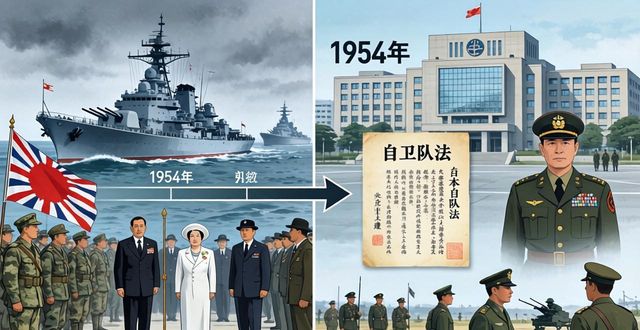
After japan's defeat in 1945, its army was disbanded and its military structure dismantled. Japan established the “police reserve” in 1950, then the “sea guard” in 1952, the new air self-defence forces in 1954, the law on the establishment of the defence office and the law on self-defence forces in july, which renamed the security corps and the maritime guard, respectively, the land self-defence forces and the maritime self-defence forces, formally named the land, sea and air guards as self-defence forces, and established the office of defence and the joint chiefs of staff, which have strengthened the commander-in-chief's command structure. In 2007, the defence department was upgraded to the defence department. On 17 december 2013, at a cabinet meeting, the government of japan officially adopted the national security and safety strategy, the first post-second world war comprehensive approach to foreign and security policy, on the basis of which the defence plan outline and the medium-term defence force preparedness plan (2014-2018) were established. On 1 july 2014, the government of japan adopted a cabinet resolution on the limited release of the right to collective self-defence, the core of which is that if a country with close ties to japan is attacked by armed force, japan should exercise its power to the minimum extent necessary and be constitutionally permitted as a measure of self-defence. In july and september 2015, japan adopted new security bills in the house of representatives and the senate, which significantly strengthened the operational capacity of the japan self-defense forces in many ways. On 18 december 2018, the government of japan formally adopted at a cabinet meeting a new version of the outline of the defence plan and the medium-term defence force preparedness plan. While reaffirming the fundamental principle of maintaining exclusive defence and not becoming a military power, the new outline of the defence plan states that japan's security environment around the perimeter “has increased dramatically in severity and uncertainty”. On 16 december 2022, the government of japan officially adopted the revised national security strategy, the national defence strategy and the defence armaments plan at a cabinet meeting, which clearly stated that japan would develop a “resilient capability”, a major change in japan's security policy after allowing the exercise of the “right to collective self-defence”. On 22 december 2023, the government of japan convened a meeting of temporary cabinets and a meeting on national security guarantees to revise the three principles on the transfer of defence equipment and the guidelines for their implementation and to further ease restrictions on the export of arms and equipment. In 2024, japan officially announced its accession to the “okus” alliance。