The people's army must grasp the major trends in world military development and speed up the construction of advanced combat forces that meet the requirements of modern warfare. Land
Advancing the modernization of military governance through, in essence, reform and innovation to build a modern system of military governance commensurate with the demands of modern warfare and commensurate with our mission
Consolidation of the enhanced national strategic system and capacity for integration as a new requirement for the party centre, centred on comrade xi, to take ownership of the new situation facing the powerful forces, with a view to a better integration of development and security, economic and defence construction
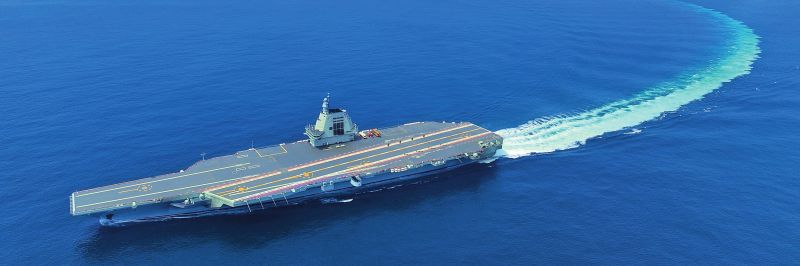
The first test of our first national electromagnetic missile carrier, the fujian ship, was taken on may 7, 2024
The consolidation of national defence and a strong army is the strategic underpinning of modern chinese style. The 20th 4th plenum of the party accurately grasps the importance of the 15th and 5th period in the process of essentially modernizing socialism, conducting an in-depth analysis of the situation at home and abroad, and carrying out scientific drawings and strategic deployments “to achieve the 100-year goal of building up the army as scheduled and to promote the defence and modernization of the army with high quality”。
In his note on the proposal of the central committee of the communist party for the formulation of the fifteenth five-year plan for the economic and social development of the country, the general secretary of xi stated that the modernization of the defence and military forces was based on a high-quality approach, with a view to accelerating advanced combat capacity-building, modernizing military governance and consolidating the national strategic system and capacity for integration。
It is time to take a high level of integrated development and security, to ensure that ideas are integrated into the plenary, to learn more from the xi jinping military doctrine, to focus on the theme of high-quality development, to strengthen a sense of urgency in its implementation, to accelerate the process of modernization of the defence and military forces and to continuously improve strategic capacities to safeguard the sovereignty, security and interests of the nation。
Accelerated advanced combat capability
In this era, the new technological revolution, centred on information intelligence, is developing further, and the pattern of war is accelerating the evolution towards information intelligence. The people's army must grasp the general trends in world military development and speed up the construction of advanced combat forces that meet the requirements of modern warfare, where strategic games and international military competition by major powers are neutral。
• advancing the scale, operationalization and systematization of new quality combat forces. New qualitative combat forces represent the front-line direction and strategic high-point of military development, are a central expression of advanced combat power and are characterized by innovative dynamism, technological intensity, high-value and high-performance, and are important factors influencing the success of modern warfare。
In the new journey, the building of new quality combat forces in the new frontier is being accelerated, with the fundamental direction and philosophy of scale, realism and systemic development. The development of scale requires a strategic configuration, greater investment of resources and a sufficient level of force; real-world development, which requires close combat tasks, deeper study of war and combat issues, innovative concepts of warfare and methods of combat law; and systemic development, which requires organic integration of new qualitative forces into the joint combat system, bringing together the strengths and effectiveness of all kinds of forces。
• strengthening the upgrading of traditional combat forces. Modern warfare is a systemic confrontation, and no single force can stand alone, and it is necessary to achieve an organic combination of old and new forces and complementary strengths。
The basic approach in the new journey is to strengthen the upgrading of traditional combat forces by strengthening the orientation of issues and objectives, maintaining the orientation of information and intelligence, embedding advanced technologies, optimizing structures and innovative operational applications. In the process of upgrading, it is necessary to highlight the need to strengthen institutional thinking and integrate traditional combat forces into the joint operational system in accordance with the principles of information-led, system-backed, best-armed and united。
The twenty-fourth plenary session of the party, which highlighted “marginal struggles, preparations, border construction”, provided methodological guidance to advance the upgrading of traditional combat forces, which called for the testing of transformational gains during the preparation of the war, optimizing the course of transformation in the struggle and creating a virtuous circle of war, construction and mutual reinforcement。
• to step up defence science, technology and innovation and the transformation of advanced technologies. Throughout the recent history of military development in the world, every major scientific and technological innovation has led to profound changes in the patterns and methods of warfare。
In the new journey, the scientific landscape was further optimized and original innovations were vigorously promoted. In keeping with the “four orientations”, focusing on strategic frontier areas such as artificial intelligence and quantum information, a number of priority projects in defence science and technology are being carried out, and institutions of higher learning and scientific research are being encouraged to undertake forward-looking and exploratory research and to build a whole chain of innovation systems “basic research + applied research + technology development + transformation of results”。
Reforming the transformational mechanism to reach the “last kilometre”. Explore technology maturity level management methods, establish dedicated conversion mechanisms, access “laboratory” to “drainground” conversion channels, and reduce the time cycle from technological breakthrough to equipment loading。
Improved incentive policies to stimulate innovation. Deepening the reform of the defence intellectual property system, actively exploring more flexible and precise incentives to increase the share of the benefits of transforming the results of researchers; and creating a good ecological environment that encourages innovation and tolerance for failure by creating fault-tolerant mechanisms that allow long-term examination of highly exploratory and risky projects without short-term success or failure。
• create a new military cadre of highly qualified and specialized personnel. High-quality and specialized military personnel must be able to understand not only technology, but also war; they must not only be professional, but must be united。
In the new process, it is essential to further implement the new age's strategy of strong talent, to innovate the model of talent development and to improve the mechanisms for the introduction, use and motivation of talent. • reshaping the brain drain and developing more strategic scientific and technological skills, science and technology leaders, complex commands and applied military talent, as well as a system of well-defined, professional and closely connected talent。
The training of military academies requires the full use of the country's largest system of higher education in the world to promote military education and the coordinated development of national higher education。
Increased emphasis has been placed on hands-on training, based on practical platforms at local research institutes and on training at large enterprises, regular selection of personnel for learning and training, joint training, upgrading of professional skills and advanced scientific and technological skills。
It has further focused on “ensuring that the people's army remains the best of men”, breaking the traditional perception of the use of human beings, broadening the scope of the choice of people and really bringing together the best men who know technology and can fight under the banner of the strong army。
Modernizing military governance
The modernization of military governance is an important element in the modernization of the defence and army, and it is a matter of the quality of our military-building effectiveness and the level of combat power. To advance the modernization of military governance is essentially to build a modern system of military governance that is commensurate with the requirements of modern warfare and commensurate with the mission of our military。
• strengthening and improving strategic management to improve the operational effectiveness of military systems and the efficiency of the use of defence resources. The complexity, relevance and dynamic nature of modern military systems are increasing, and are characterized by technological, knowledge-intensive and capital-intensive characteristics. It is only through the strategic management of science that the harmonious development of elements, areas and links can be achieved。
Further refinement of the strategic planning system in the new process. The “fifty-five” plan was drawn up, guided by the 100-year goal of building the army, to refine the objectives, priorities and implementation path of the various sectors and to develop a coherent, coherent planning system。
Further optimization of implementation mechanisms for the strategy. Accelerate the planning and implementation of a tracking, dynamic adjustment and appraisal system, making full use of technology such as big data and artificial intelligence, and strengthen the process-specific controls in the areas of military human resources, weapons development and equipment development and logistics。
Increased efficiency in resource allocation. (c) to uphold the principles of demand-drivenness, precision and efficiency in their allocation, to optimize the investment of defence resources, to focus on key areas such as advanced combat capacity-building and the development of new types of military personnel, to establish a system for evaluating the effectiveness of the use of defence resources and to ensure that each component of the investment is translated into combat power。
• full implementation of the timid approach to building the army, with a sustained commitment to efficient, cost-effective and sustainable development. At present, as the world's military competition has intensified and the prices of high-technology weapons and equipment have risen, the contradiction between the shortage of defence resources and the growth of construction needs has become even more acute, and it is of great relevance to persevere in building a hard-working army。
In the new process, the timid approach to building the army is being fully implemented, with emphasis on maximizing benefits and optimizing costs through scientific management and fine operation。
Through the development of a “closing day” concept and a greater sense of cost-effectiveness, limited resources are directed to the most urgently needed, critical and vulnerable areas through the establishment of sound, cost-effective resource allocation mechanisms that integrate economy into construction, training and security. To insist on the intensive use of resources, to break the ranks and sectoral boundaries, to integrate the sharing of resources, such as military infrastructure, equipment and supplies, and to establish mechanisms for cross-military and cross-regional resource allocation to avoid duplication of construction and waste of resources. Innovative construction models that actively explore low-consumption, high-output development paths are good at using civilian technologies and resources to reduce construction costs. Strengthen process-wide controls, in particular full-life cost controls for major projects, rigorous audit oversight and prevention of over-budgeting and over-standard construction。
• deepening the development of the rule of law in the army and continuously improving the chinese-style military rule of law system. In reality, as the process of modernization of our forces accelerates, the building blocks become more systematic and complex. Relying on the rule of law to regulate the functioning of power, clarify the boundaries of responsibility and resolve disputes would ensure the orderly advancement of a strong military industry。
The chinese military rule of law system is constantly being improved in the new process, provided that military legislation is strengthened. The areas of focus will be closely addressed, with a view to accelerating the legislative process and the timely consolidation of mature experience and effective practices into a regulatory system that ensures compliance in all areas and links of military activities. There is an urgent need to tighten the practice of war preparedness, defence science and technology innovation, and military governance, to speed up the filling of legislative gaps, to amend outdated legislation and to create a comprehensive and scientifically sound system of military regulations and regulations。
To strengthen the implementation of laws and regulations, to improve monitoring mechanisms for their enforcement, to intensify the investigation and prosecution of violations, to put an end to impunity, lack of enforcement and impunity and to uphold the authority of military laws and regulations. The rule of law continues to be promoted by promoting awareness of the rule of law and fostering its spirit, integrating it into the army's education and training system, carrying out extensive regular rule of law education throughout the army, leading to the development of legal and professional behaviour。
Consolidation of national strategic systems and capacities for integration
The proposal of the central committee of the communist party for the formulation of the fifteenth five-year plan for the economic and social development of the country, adopted at the twenty-fourth plenary session of the party, “consolidation of the national strategic system and capacity for integration”. The consolidation of the national strategic system and capacity for integration is a new requirement of the new mandate of the central party, centred on comrade xi jinping, to manage the new situation facing the powerful and powerful forces. The strategic deployments aimed at better integration of development and security, economic and defence construction must be implemented in depth。
• accelerate strategic capacity-building in emerging areas. At present, with increasing competition in the fields of space, networks and artificial intelligence, the major countries of the world have increased their distribution and investment in new and emerging areas in order to compete for future ownership of development. During the “fifty-fifth” period, the strategic capacity of the people's army in the emerging areas must be built at an accelerated pace。
First, strengthen top-level design. To further develop and refine strategic development planning in emerging areas, identifying strategic objectives, building priorities and development paths in each area, and creating cross-sectoral and cross-cutting mechanisms for synergistic advancement。
Secondly, comprehensive development should be combined with a focus breakthrough. Comprehensive development means targeting emerging areas such as the deep sea, space, networks, biology and polar regions, focusing on global advanced technologies and capabilities, and making every effort to avoid exclusion; a breakthrough means taking full advantage of its strengths, following the principle of symmetry in confrontation mechanisms and accelerating the development of asymmetrical strategic checks and balances in emerging areas。
Thirdly, we must make full use of the new institutional strengths of the nation, breaking the boundaries of the civil-military, sectoral and territorial sectors, bringing together the forces and resources of all parties to create a synergy of thrusts, facilitating the free flow and efficient allocation of the elements of innovation and creating an innovative environment of open integration。
• building an advanced defence technology industrial system. At the present time, our national industrial system is a comprehensive one, based on which our advanced defence science and technology industrial system is being built. The “key step” is to deepen the reform of the defence science and technology industry and to optimize its structure。
The “fifty five” period should take advantage of the opportunity to further deepen and deepen the reform process by creating a new industrial paradigm of “small cores, big collaborations” and improving the resilience and security of the industrial chain; significantly boosting the capacity for autonomous innovation, strengthening basic and frontier research, focusing on key core technological challenges and improving the level of development and manufacturing of defence equipment; improving mechanisms for synergy and innovation in defence science and technology and creating an integrated innovation system for productive research and development; and making full use of the innovative backbone of national laboratories, research institutes and institutions of higher learning to stimulate the dynamism of various kinds of innovation subjects。
• accelerate capacity-building for defence mobilization. The complexity and diversity of the security threats facing our country today, the increasing burden of emergency preparedness and emergency response tasks, and the acceleration of capacity-building for defence mobilization are important in addressing risk challenges and safeguarding national security。
As part of the new process, capacity-building for defence mobilization will need to be accelerated and continuously upgraded, from the army to the army, from a quantitative to qualitative, from broad-based management to precise management and from administrative to legal mobilization. Focusing on future information-smart war demands and strengthening capacity-building for defence mobilization in emerging areas, the focus has shifted from traditional “push” to “high-precision” “smart”。
The key to accelerating capacity-building for defence mobilization is implementation. In-depth methodological research, systematic training on the subject and rigorous evaluation should be carried out, taking into account mission experience. Through simulation, networking and confrontational training tools, a solid field-based training environment has been created to mobilize forces under almost operational conditions to ensure that critical moments can be drawn, used and put into effect。
• consolidation of civil-military unity. Since the beginning of the new era, there has been a wide-ranging campaign to create “two-size-fits-all” cities (countys) throughout the country, deepening cooperation between the military and the military in the areas of infrastructure development, emergency relief and rural rehabilitation, strengthening the foundations of civil-military unity and providing strong moral and material support for defence and army modernization。
The consolidation of civil-military unity under new historical conditions should be further strengthened, national defence education should be integrated into the national education system and the overall plan for the construction of spiritual civilization, innovative forms of education should be developed, education should be enriched and the concept of national defence should be strengthened. Taking full advantage of the important times such as the military-building festival and the national day, various forms of defence education are organized, heroic model stories are given and patriotism is promoted。
The development of joint civil-military mechanisms, the deepening of civil-military activities in the spirit of socialism, the promotion of the open sharing of military resources at the local level, the support of local economic and social development, and the resolution of the problems of the population. It has continued to improve its policy of military superiority, strengthen its safeguards for military and former servicemen, properly address practical issues such as job placement, children's education and medical care, create an atmosphere of “advantage and love” and consolidate the development of civil-military relations with the rest of the population。