In the first quarter of 2026, the global market for new energy vehicles was marked by regional fragmentation and retrenchment. According to statistics published on the clean technica website, in march 2026, the global volume of electric cars was approximately 1. 7 million, an increase of 5 per cent over the same period last year. Among them, the market pattern between pure electric vehicles and interpolated hybrid vehicles shows a marked division: the sales of pure electric vehicles increased by 12 per cent over the same period, returning to double-digit growth zones over several months, while the sales of plug-in hybrid vehicles decreased by 8 per cent over the same period. In terms of overall performance in the first quarter, global sales of electric vehicles declined by 2 per cent per year, with the main drag factor arising from the interpolation model — a 10 per cent decline in quarterly sales of this type of vehicle — compared to the 2 per cent positive growth in pure electric vehicles. It is noteworthy that for the first time since the outbreak, the number of plug-in hybrid vehicles has increased by a single year。
After the short-term shock of the subsidy downturn, global sales of electric vehicles have shown a steady trend towards a dynamic transformation. Among them, the chinese brand, with its product matrix and technological advantages, dominates the global sales list; the european market has a mixed-led and purely electric-speed-extraction pluralistic structure; and the united states market enters a competitive phase with its product power at its core after federal subsidies are terminated。

For the post-car market, particularly for independent maintenance enterprises, the trends revealed by these macro-data, such as changes in the tenure structure, increased car-type concentration and the fragmentation of technical routes, are profoundly affecting the maintenance business structure, technical capacity requirements, spare parts inventory strategies and business survival models. This paper will systematically analyse the industry logic behind the above-mentioned data from the professional perspective of maintenance practitioners and propose a response path for post-market enterprises。
01
New energy vehicle penetration in the country exceeded 42 per cent: deep restructuring of maintenance operations
Data from the chinese association of automotive industries show that the penetration rate of new energy vehicles reached 42 per cent in the first quarter of 2026, with domestic sales falling 23. 8 per cent in the first quarter of the year as a result of the policy switch, but in march sales rebounded to 1,252,000 vehicles per month, with penetration rates rising to 43. 2 per cent, with clear signs of market warming. From the point of view of the maintenance industry, this level of penetration means that the share of new energy vehicles in stock vehicles has entered a period of rapid escalation and that the business structure of the maintenance enterprise is undergoing irreversible transformation。
“cross-down” effect of conventional maintenance operations
The maintenance cycle of the traditional incendiary vehicles usually ranges from 5,000 to 8,000 kilometres, and the core items include oil, re-filtering and engine system checks, which are high frequency, low unit cost operations that provide a stable source of cash flows for independent repair shops. In contrast, pure electric vehicles eliminated engines and gear transformers, the maintenance project was reduced to a three-power system status check, high-pressure insulation check, air-conditioning core replacement, brake fluid and gear oil replacement, and the frequency of maintenance was significantly reduced. In the case of tesla model 3, official recommended maintenance breaks of 20,000 kilometres or 12 months and single maintenance costs of approximately $500 to $800; the average annual maintenance cost for fuel trucks at the same price is approximately $1,500 to $2,000. It is therefore estimated that when the share of new energy vehicles is 40 per cent, the number of routine maintenance units in independent repair shops will decrease by about 15 to 20 per cent。
At the same time, new items such as battery health testing, high-pressure system insulation resistance testing, thermal management system performance assessment, although at a single charge of $300 to $500, have a low frequency of service and require specialized equipment (e. G., battery detector, insulation resistance test, high-pressure safety protection tools) and technicians with high-pressure qualifications. The profit structure of the maintenance enterprise is shifting from a “high-frequency low-passenger list” to a “low-frequency medium-passenger list”, a trend that poses a clear operating pressure on community outlets that rely on fast-track repairs。
Technical threshold and cost re-engineering for accident vehicle maintenance
The data show a steady growth in the demand for new energy vehicles at level b and above, while the demand for mini-vehicles at level a00 has declined significantly. This means that the new energy vehicles in circulation in the market are dominated by medium- and high-end vehicles, whose maintenance complexity and single-maintenance costs are significantly higher than that of low-end vehicles. Of these, the integrated design of the chassis battery pack became the core difficulty for accident vehicle maintenance。
In the case of biadihan, for example, in a maintenance case, the vehicle had deformed the shell of the battery as a result of the undercarriage, but the internal module and the core had not been damaged. According to the post-sale standards, such cases would have to be replaced by a total battery package at a price of $48,000, while maintenance costs for a similar level of chassis damage to conventional fuel trucks would be only several hundred dollars. This difference forces the maintenance enterprise to face a dilemma: without the capacity to dismantle, test, model balance and repair the shell, the operation would be completely lost to the 4s store or brand-mandated service centre; and hundreds of thousands of dollars in battery maintenance equipment, the purchase of specialized diagnostic devices and the completion of high-pressure qualification training for technicians would be at risk of rapid technological overlap, closure of information on plant maintenance and limited supply of spare parts。
3. Indirect effects of high export growth on domestic stock markets
In the first quarter of 2026, 954,000 new energy vehicles were exported, representing a 120 per cent increase over the same period, of which 371,000 were exported in march alone, a record high. The rapid growth of exports meant that the increase in domestic new energy sales had not been fully translated into domestic stock holdings, and the competitive pressure on the post-market was largely due to the willingness of stock vehicles to maintain their consumption. The residual value of second-hand vehicles in new energy vehicles is highly volatile, and some owners tend to reduce non-essential maintenance costs, further reducing the operating space of independent maintenance stores。
02
European mixed-led and diverse structures: technical route requirements for maintenance capacity
Data from the european association of automobile manufacturers (acea) show that the european market in the first quarter of 2026 was marked by “mixing dominance, pure electric boosting, fuel contraction”. Of these, the oil and electricity hybrids had a 38. 5 per cent share, the net electric vehicle share was 20. 55 per cent and the plug-in hybrid vehicle share was 10. 1 per cent. This structure has important technological reference value for the domestic servicing industry。
In maintenance practice, there are significant differences in the requirements for maintenance capacity between the models of different technical routes:
• pure electric vehicles: the most stringent security standards. Maintenance operations must strictly enforce power outage processes and operators must wear insulation gloves, insulation shoes and use insulation tools. At the same time, the application of integrated casting processes (e. G. Tesla model y's rear) makes maintenance costs for some structural damages extremely high and insurance companies tend to treat total damage。
• power-plugged hybrid vehicles: engines, speedboxes, exhaust systems and batteries, electric machines, electrical controls, high-voltage wire beams, with more than double the number of failure points compared to pure electric or fuel vehicle types. The engine module is extremely compact and poorly maintained. For example, the replacement of spark plugs may require the removal of high pressure wire beams and controllers for a significant length of operation。
• oil and power hybrid vehicles (non-interpolated): systems represented by toyota ths, honda i-mmd are highly reliable and difficult to repair. However, the replacement cost of the age of the power cell is higher (about $15,000 to $25,000), and some owners have opted for early disposal of the vehicle。
The experience of the european market shows that even in regions with the fastest electricization process, mixing technologies will continue to hold a significant share over the longer term. Domestic maintenance enterprises should not over-focus on pure electricity technology in their resource allocation, but should simultaneously establish integrated diagnostic capabilities for mixing systems. The maintenance of hybrid vehicles places greater demands on the ability of technicians to perform cross-system failure screening in the areas of motor and high voltage electrical controls。
03
Market adjustment after the fall of united states subsidies: second-hand car flows and opportunities for independent repair plants
According to the kelly blue book, under the umbrella of cox motor consulting, united states pure electric car sales declined by 27 per cent in the first quarter of 2026, mainly because the federal government's $7,500 car tax credit policy expired and was not renewed on 30 september 2025. It is worth noting that the interest in second-hand electric vehicles increased significantly during the same period as a result of higher oil prices driven by the middle east conflict, with mixed and interpolated car-type consumer shopping indices above the benchmark。
This phenomenon is relevant for the domestic servicing market. As new domestic energy vehicles gradually graduate from the original plant's quality insurance period (or beyond the three-power system coverage), the demand for higher value versus independent maintenance services is increasing. For example, one insured tesla model s replaced its control arm with a price of approximately $3,800 at the tesla service centre, while an independent maintenance plant purchased brands or re-manufacturing items (at a price of about $1,200) and charged an hourly fee of $600, at a total cost of $1,800, which was more than 50 per cent less than the original plant。
However, independent repair plants face two major structural obstacles:
1. Barriers to information maintenance: underground diagnostic data are generally not accessible to third parties by new brands. Maintenance enterprises can only obtain limited failure codes through third-party diagnostic equipment (e. G., troughs, metallites, etc.) and are restricted by deep data stream analysis and high pressure system isolation tests。
Safety and qualification thresholds: the maintenance of high-pressure systems requires specialized protective equipment, insulation detection equipment and certified technicians. There is currently a lack of a unified training and certification system within the industry, and most technicians have not yet systematically mastered high-pressure safety protocols。
Data from the united states market also reveal a long-term trend: only high-yield brands can maintain market shares after subsidies have fallen. In the chinese market, this means that the head brands of biadi, tesla, jily and ideal will be absolutely dominant. The spare parts inventory and technical training of the maintenance enterprise should focus on these high-premise vehicle types. For example, in response to common malfunctions, such as wear and tear on the front-controlled armballs of tesla model y, half-axis wear and tear resulting in accelerated shaking, independent maintenance plants have established standardized maintenance processes and procured bulk by-products to achieve efficient and low-cost service delivery。
04
Structural features of model sales lists: basis for decision-making on maintenance spare parts and technical inputs
In the first quarter of 2026, clean technica issued a list of top 20 global sales of electric cars, showing that the chinese brand holds 16 seats, of which biadi alone holds 10. Teslamodel y is at the top of the list with 24. 24 million vehicles, model 3 is at the second end of the list with 99. 5 million, gilly is at the third end with 9. 37 million vehicles, millimetre yu 7 is at the sixth place with more than 70,000, and ideal i6 is at the eighth with 571 thousand。
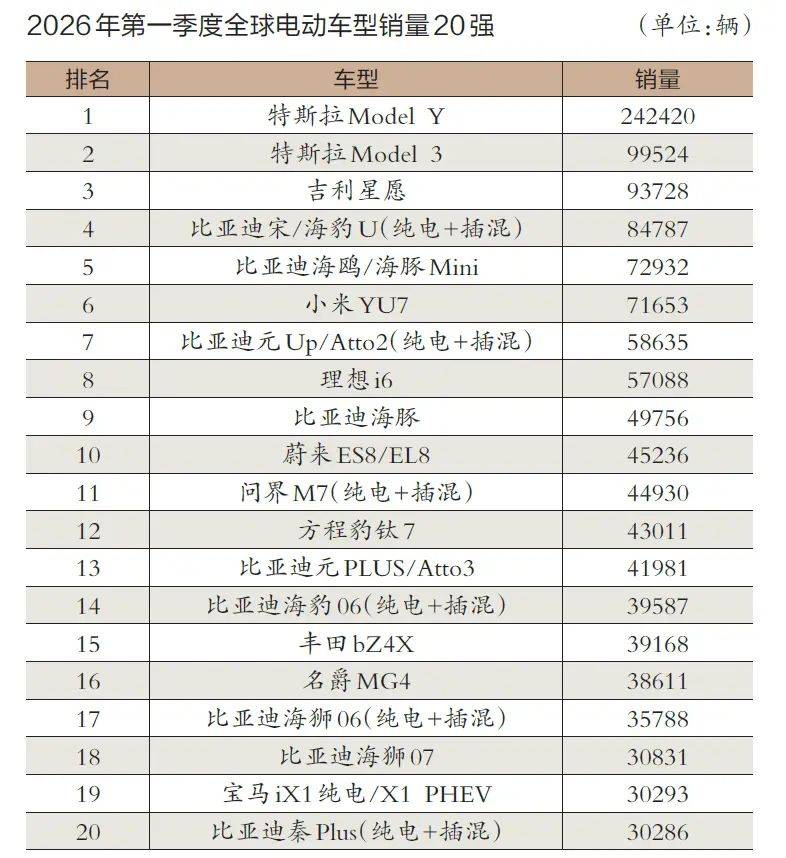
Figure : chinese automobile
This highly concentrated vehicle-type sales structure provides clear direction for the maintenance of the enterprise's spare parts inventory and skills training:
• common failure patterns for high-preservative vehicle models: teslamodel y's front-line control armballs were loose, half-axis oil seals were leaking, heat pump air conditioning acoustic; the 12v battery management system of the biadi seagulls was abnormally inoperable; and the cavity of the cavity system of the biadizon series of plug-in high-pressure relays, etc. In response to these common diseases, the maintenance enterprise could establish a standardized maintenance programme, storage of associated accessories and specialized tools to achieve efficient trouble diagnosis and repair。
• the service gap for the new-emergence explosive car: in the case of mi-yu7, which sells more than 70,000 vehicles in the first quarter of the year, the branded self-run service centre is of limited density, especially in the clear service-blind areas in the three- and four-line cities. An independent maintenance enterprise that procures a specialized diagnostic interface in advance, masters high-pressure power outage processes and establishes a supply channel for spare parts (e. G., accident car dismantling or brand cooperation) can obtain a pre-emptive advantage over the 6 to 12 month period of demand release。
• prudent input of the long tail: only a small number of the traditional transnational companies, such as toyota bz4x, bmwix1, entered the 20-plus list. These brands of new energy vehicles have lower domestic holdings and are less economical for repair firms to invest in specialized tools, diagnostic equipment and training resources, and should be subject to a limited service strategy or referral。
05
Evolution of brand competition patterns: “living space” for independent maintenance systems and strategic adjustments
The chinese brand holds 11 of the top 20 global electric automobile brands in the first quarter. Biadi led tesla by a significant advantage, gilly by a third, zero by a sixth, and the brands of new powers such as ideas, ullai, mi, and quiz entered the list. This pattern has both profound implications for the post-car market。
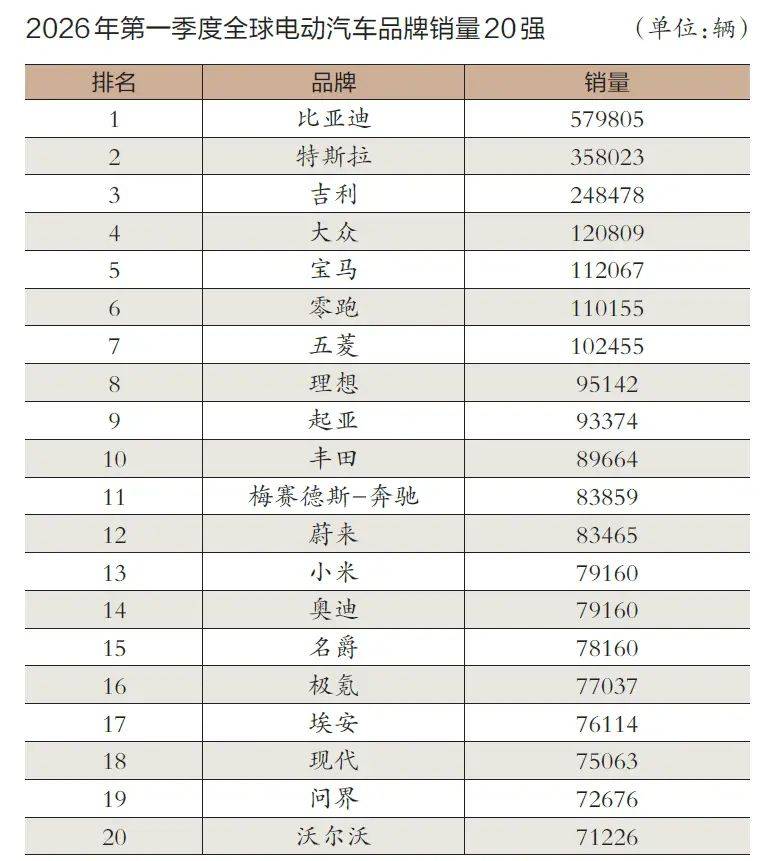
Figure : chinese automobile
1. Trends in vertical integration of maintenance resources at mainframe plants
2. Alternative opportunities arising from inadequate service network coverage
Despite the rapid growth of the brands of the new forces, their service points are much less dense than traditional joint ventures and autonomous brands such as biadi and jili. In the case of zero-run vehicles, for example, global sales ranked sixth in the quarter, but the number of service centres in the country's three- and four-line cities was limited, and some of the owners required long distances to authorized shops for basic maintenance. Independent maintenance enterprises can fill regional service blind areas by purchasing brand-authorized diagnostic equipment (such as a zero-run specialized diagnostic device) and working with third-party accessories platforms. In practical cases, maintenance enterprises have established “zero-run specialized” operations to cover large demand for maintenance in surrounding cities through community operations, with an average of over 30 maintenance units per month。
Traditional autonomous brands such as gigi, biadi, are not realistic to be completely detached from the independent after-sale system, under conditions of large holdings and wide-ranging models. Some of the independent repair businesses have established business collaboration with 4s stores to sustain the flow of passengers and gain return earnings by undertaking referral maintenance and primary maintenance of accident vehicles during peak periods after sale. This “complementary” business model, although low in profitability, has an important cash flow guarantee in the transition period。
06
Adaptive change in the maintenance industry: transition from general maintenance to specialized technical services
Combining global data for the first quarter of 2026, the spread of new energy vehicles is driving a deep shift in the post-car market from “general maintenance” to “specialization, branding, technology”. The maintenance enterprise needs to make systematic adjustments from the dimensions of technological capability and qualification building, re-engineering of the spare parts supply chain, precision acquisition and brand positioning, and focus on subdivision areas。
Global data on new energy vehicles in the first quarter of 2026 is not just a material for macro narratives, but a “operational map” of micro-operated post-car markets. The 42 per cent penetration rate implies a fundamental change in the client structure of an independent maintenance enterprise; the absolute dominance of the chinese brand in the car-type 20 list, which requires that spare parts stocks and technical resources be concentrated in a small number of head brands; and a much faster increase in exports than domestic sales, prompting markets to rely on the service viscosity and technology premium of stock vehicles rather than waiting for natural flows from new vehicle increases。
New energy vehicles will not eliminate the car repair industry, but will completely phase out low-end capacity with only basic maintenance and simple replacement capacity. Future maintenance operators must master high pressure safety protocols, master data stream diagnostics, and be able to analyse battery pressure differentials and heat management system logic. This technological change has no bystanders. Only through sustained technological investment and capacity upgrading can maintenance enterprises and individual technicians be able to create new professional moats in the age of electricization。
The data point the way, and action and transformation are the only answers。
The layout
I'm sorry
Check