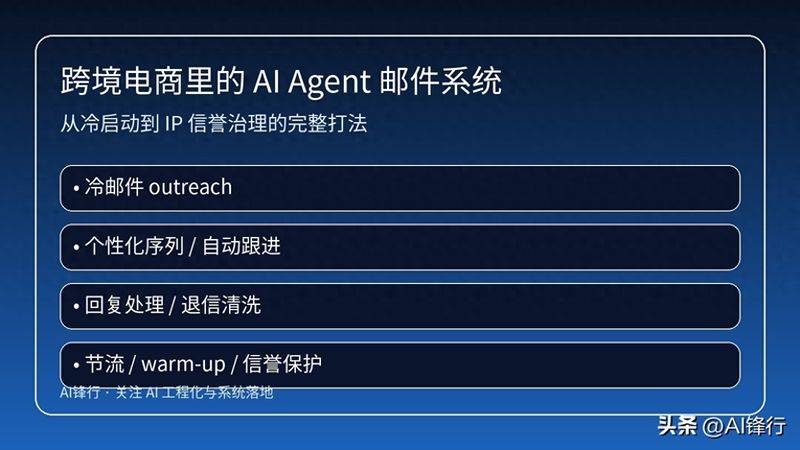
Cross-border electricians e-mail, and many teams begin to understand the problem as “how to get more”。
After a real round, it turns out that the most scarce thing in the e-mail scene is not dispatch, but steady delivery, sustainable touch and controlled domain/ip credibility. If sent as a pure growth action, it does have short-term impulses, but will soon be stepped on hard thresholds such as spam filtering, abdication rate, an increase in complaints and a decrease in domain name weights。
So such systems should not be seen only as “a mass tool”, but rather as an automated enforcement chain with constraints: ai agent is responsible for understanding, generating, judging and diverting; the mail infrastructure is responsible for thrift, retreat, surveillance and reputation protection; and people only deal with high-risk and high-value border cases。
Conclusion: the mail system is not a growth tool, but a risk-based budget implementation system
Ai agent is suitable for the mail scene, provided it is placed in a status machine, door control and rollback mechanism. Mail is naturally a semi-structured task: object stability, feedback is traceable, action is layered, so it is more suitable for agentization than many operations。
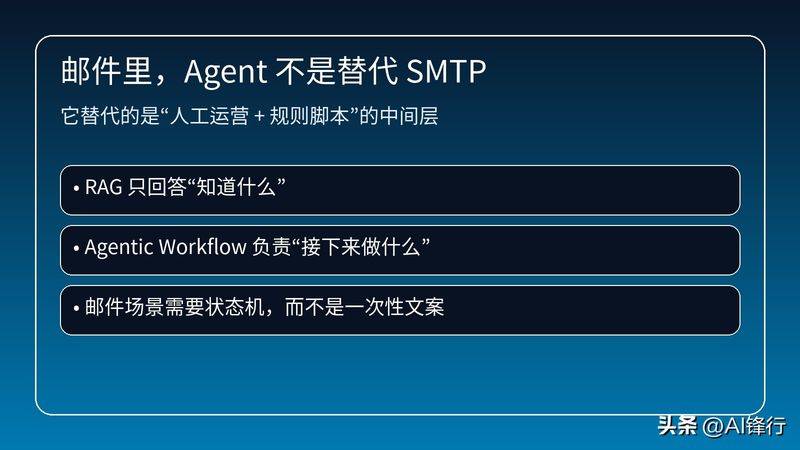
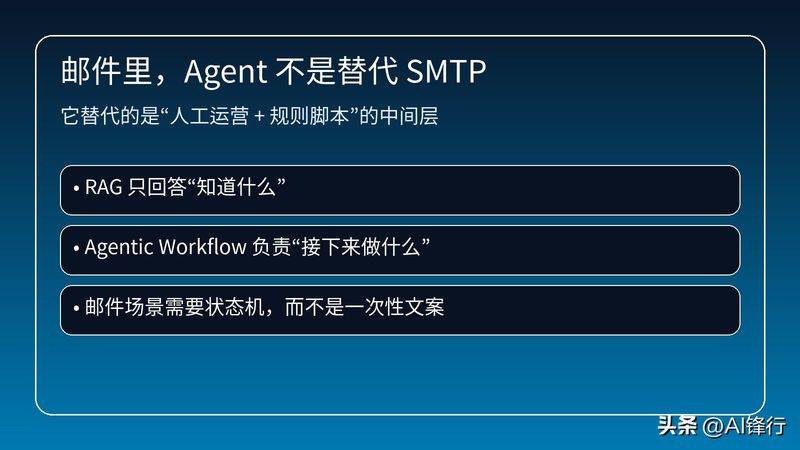
In other words, agent is not a substitute for the mail system, but a substitute for the "manual operation + rule script" middle layer; it is responsible for decision-making and generation, and the system is responsible for discipline and enforcement。
But mail is a very credible scene. Ai is also strong, and the credibility of ip and domain names is quickly broken as long as the pace of transmission is out of control, content drifts, the rate of rebuff increases and the rate of complaints increases. The centrepiece here is not “teaching models more like people”, but “pressing the freedom of models within manageable limits”。
So the right goal is not to "let agent do it as he pleases," but to "let agent do it within verifiable constraints."。
Ii. Why is the e-mail scene so appropriate? Ai agent: because it's a state machine
Mail is essentially a semi-structured communication: it has fixed objects, fixed carriers, traceable feedback, but content and strategy are highly dependent on context. In other words, it is neither a purely text-based nor a purely rule-based route, but rather a “human synergetic limited-state process”。
This determines the three capabilities that fit agent:
1. Planning: transforming a single dispatch into a sequence instead of a single action
A cold e-mail is often not the end, but the first jump of the whole sequence. A truly effective process is usually:
Identify the target client; build persona; generate the first mail; observe the opening/ clicking/ reply; decide to follow the rhythm and content; identify the artificial intervention point; and terminate, cool or transfer the sale to take over。
It's actually a status machine. It's not like "mailing." the value of a status machine is that each step has a clear import, export, transfer and termination condition。
2. Tool use:agent needs tools, but tools must be graded
A truly valuable agent mail system will be connected to the tool, but it must be graded:
Without tools, agent is just a file generator; with tools but no door control, it becomes an automated source of risk. The real design goal is to increase the capacity of the tool to swallow the system, rather than to magnify the system risk。
3. Memoory: not knowledge, but business and risk history
The memory of the e-mail scene is not a generalization of knowledge, but business memory and risk memory:
This type of memory, once it's landed, will change from "can write mail" to "can run a list." the key here is not the ability to generate capacity, but the capacity to govern the life cycle of the list。
Iii. E-mail scenes are most important not for dispatch, but for governance and risk budgeting
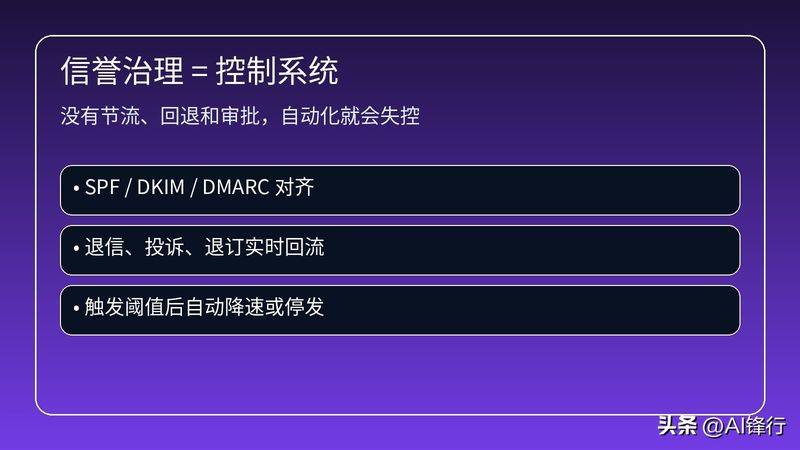
To untangle the mail process, it is not the text that really needs to be addressed, but the state, the threshold and the regression path。
I usually split it into four floors:
1. Touchdown: who can be sent to whom
What is resolved here is the quality of the list and the compliance boundary。
It's not working well, and all the optimizations behind it are magnifying the noise。
2. Transmitting layer: how does it work
It's about rhythm and resource segregation:
Feedback level: what happened
These feedbacks must be received in real time:
Without feedback, agent cannot learn, and ip cannot be protected。
4. Decision-making level: what next come on
This is agent's most valuable place。
Iv. Enhancing the credibility of ip, the core is not “technological”, but rather a control system that can be observed, protected and rolled back
A lot of people understand ip credibility as "a multiplicity, multi-domain name, a few more." it's dangerous。
In essence, credibility is the statistical result of the behaviour you send to you by the recipient and the mail service provider, and it comes from long-term behavioural characteristics rather than a configuration. In other words, credibility is not a `participatory outcome' but a `operational result'。
1. Infrastructure stratification first
It is recommended that at least three layers be split:
Don't mix. Mixing can contaminate high-value flows by high-risk behaviour。
2. Identification must be complete
At least make sure:
Many of the problems of “failure” are not of a poor nature, but of a precarious relationship between identity and alignment。
Warm-up is not a hysteric, it's rhythm control
The new ip / new domain name should follow the climb rule:
This is not a question of growth, but of risk budgeting。
4. The content must be stable and the model must not be free
Agent can write, but not indefinitely。
Three layers of restraint:
In the mail system, content drift directly affects the complaint rate and the garbage rating。
Sending throttle is more important than “smarter”
A mature agent mail system with automatic brake capability:
The first principle of credibility protection is not to send mail, but not to break up the system。
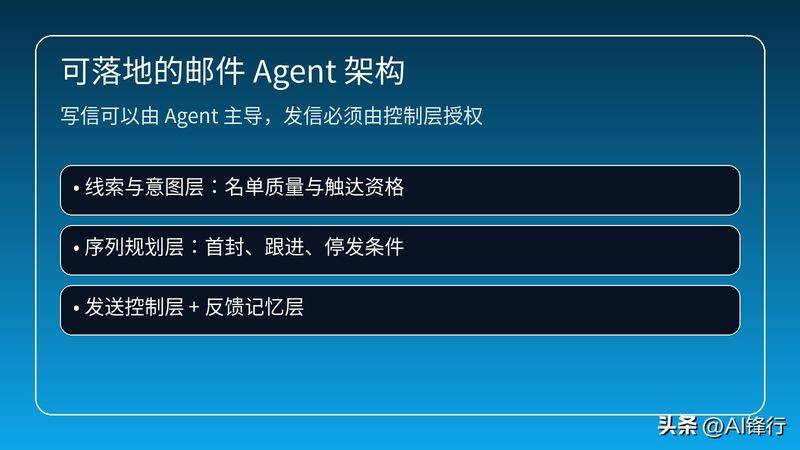
V. A landable ai agent e-mail structure: unblocking capacity and cutting responsibility
I suggest that the system be split into five components. The purpose of this break-up is not to draw a good picture, but to give authority, status, flow and audit separate boundaries:
1. Threads and intent layers
Enter: client information, behavioural signals, product matching, historical touch record。
Output: client hierarchy, intent judgement, priority, access allowed。
2. Sequence planning layers
Enter: client hierarchy, historical feedback, activity objectives, risk budget。
Output: first e-mail, follow-up sequence, suspension conditions, manual takeover conditions。
3. Case generation layer
Enter: persona, trade, language, value point, disabled word。
Output: structured mail drafts, not a freely available long text。
4. Transmission control layer
Input: send plan, domain name/ip load, queue status, health indicators。
Output: batch delivery, delay, suspension, retry, cut。
5. Feedback and memory layers
Input:
Open/click/reply/bouch/unsubscribbe/complaint。
Output: update persona, update list quality, update rhythm strategy, update risk label。
A key principle: the need to separate generation from implementation
Writing can be led by agent and must be authorized by the control。
Otherwise, what you get is not automation, but control。
The most vulnerable places to step on: “automation” as “scalable”
High opening rates do not mean health. In many cases, short-term data were drawn by the title party, followed by complaints and a decline in credibility。
2. Shared infrastructure for cold and service mail
This is the most common disaster. A high-risk outreach to drag business mail together at a very high cost。
3. Let the model directly determine the object to be sent
Object selection should be determined primarily by the rules and the quality of the list, with the model making the most supporting judgement. Otherwise, it would expand the “looks like a potential customer” target and eventually pollute the list。
4. No cessation mechanism
The absence of a system for a decommissioning mechanism can only prove that it will continue to be problematic。
5. Generating only, not learning
The value of mail, agent, is not “written as a human being”, but “remember feedback, change strategy, hold borders”。
Vii. Factual landing paths for cross-border electricians ' teams: consolidation before scaling up
If you do it now, it's suggested in that order:
Dissociate domain name / sub-domain / service mail; complete spf, dkim, dmarrc; create a list cleansing and blacklist system; minimize the serial engine; make agent responsible only for drafts and follow-up recommendations; hand over dispatch and throttle to the rule engine; access complaints, write-backs and returns categories; then gradually open up more autonomy。
Don't go looking for full auto. The most scary thing about the mail system is, "looking smart, actually no brakes." a truly scalable system, with constraints before automation; borders before size。
Conclusion: the competitiveness of mail agent is ultimately reflected in the ability to govern rather than the ability to document
The real competitiveness of the ai agent mail system in a cross-border electrician is not to write human mail, but to put personalization, automation, delivery, complaint rate, credibility protection in the same loop, and to keep the ring stable under high pressure。
And if you can make this ring steady, agent can be part of the growth system; if you don't, it can only be a new risk amplifier. For the mail system, stability is more valuable than smartness。
So the right sort of thing is:
Control, automation; credibility, scale; boundaries, intelligence。