In the last two years, friends who work on websites and content have come together, and one of the most important things to talk about is, "now that we don't search the search engine, ask ai, what's the point of our hard work, seo?" there's even a very scary idea, called geo. A lot of people are asking, is geo a substitute for seo
In fact, if we're going to figure this out, we can't just look at the big names, we have to see how we usually get online. We used to want to buy a ground-cleaning robot. We'd put it in the search engine. Then come out a bunch of pages and we'll go in one at a time. And now? A lot of people opened the dialogue box and asked, "i want to buy home a mosaic-sweeping robot with a budget of about 3,000 and a few recommendations。
This change in search habits has led directly to the so-called geo. But if you think geo's out to get the seo out, it's really easy. This is more like an upgrade and a supplement。
The search logic has changed
The search engine used to be like a librarian. You told it the keyword, it pointed to the shelf. You have to read, read, summarize. Now these smart models are more like an expert who's read all the books. Ask it the question, and it'll tell you what it looks like by summarizing the answer and by putting a few little footnotes behind it。
At this point, we have to change the way we do things. We were looking for the first page of the search results, preferably the first three, so that others could see us. Now, our goal has changed, not only to let the search engine catch us, but also to let the intelligent robots think that our content is good enough to take our point as part of its answer, or even to quote us directly。
This process is at the heart of geo. It is no longer simply a multiplicity of keywords, but rather an attempt to turn your content into an “authoritarian evidence”. If a smart robot answers a user question and always mentions your name, or quotes your experimental data, then your flow is steady。
There's no such thing as conflict
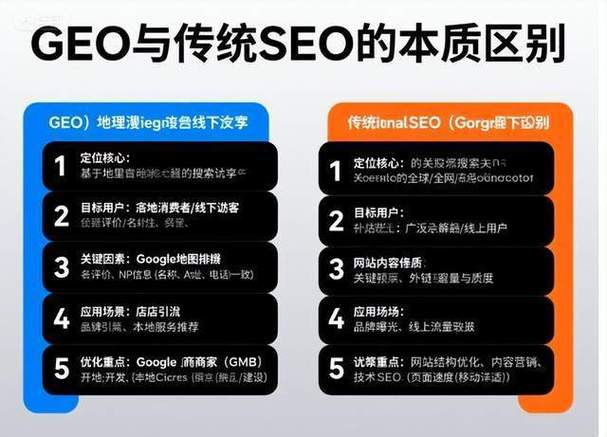
A lot of people are afraid to do geo to give up seo, or think it's not okay. Actually, they're a couple of brothers. Seo is the foundation, and if you can't get a site technically, you can't load it, or you can't get a robot in here, don't say geo, you don't even have a basic ticket。
Seo solves the problem of "letting robots find you," and geo solves the problem of "let robots like you, trust you." if you compare your website to a restaurant, seo is setting up a sign at the intersection to show that there's a shop; geo is making food commentators, big v, say hello, and people say "what's good?"。
In the current flow environment, we cannot do only one. Just keeping the old keywords on the list, you'll find fewer people entering the store, because you're leaving at the intersection. But if you only make so-called smart recommendations and ignore the infrastructure and authority of web pages, robots can't find your source and dare not quote you。
Ai, how do you choose
Now smart models actually have their own logic when they filter content. According to some publicly available research and test data, those elements that can be cited as priorities usually have very visible characteristics. They are often not the kind of mouth-to-mouth hype, but rather deep articles containing a wealth of facts, data and unique insights。
For example, you write an article on how to select a camera. The traditional seos might teach you how many times you're going to make a full picture, a microgram. But to meet the geo criteria, you have to produce measured data. For example, the contrast parameters you've taken under different light, or the exact number of minutes you've had to continue with a camera battery. These hard-core data are smart robots' favorite food。
When producing answers, robots seek accuracy and objectivity. When you provide more specific and documented content than others, it increases the probability of citing you. Studies have shown that the inclusion of quotations, statistics and authoritative expert transcripts in content can increase the visibility of the website by about 30 per cent of smart responses。
The reference rate is central
In the geo context, while the hit rate is important, the reference rate is a new windmark. What we had in the past valued was how many people have been placed on our web page, and now we look at how many conversations have resulted in our brand name or content source。
This is a very profound change. This means that we are not fighting just for a hit, but for a brand. When the user consults on a particular area of specialization, the smart assistant is well placed in the user's mind if he has repeatedly mentioned that the brand is based on a professional assessment of a particular platform or on the advice of an expert。
To increase the reference rate, content must be unique and authoritative. That's what we used to call eeat. Are you really good at this? Is the information you've given is not the first-hand information you've never written? Does your website have credibility in the industry? These things, in the age of intelligent search, become real flow codes。
Don't just stare at the rankings
We're gonna jump out of the first-ranked myth. In the interface of smart searches, sometimes there is no so-called first place and there is only one comprehensive answer. We're fighting for the weight of that answer。
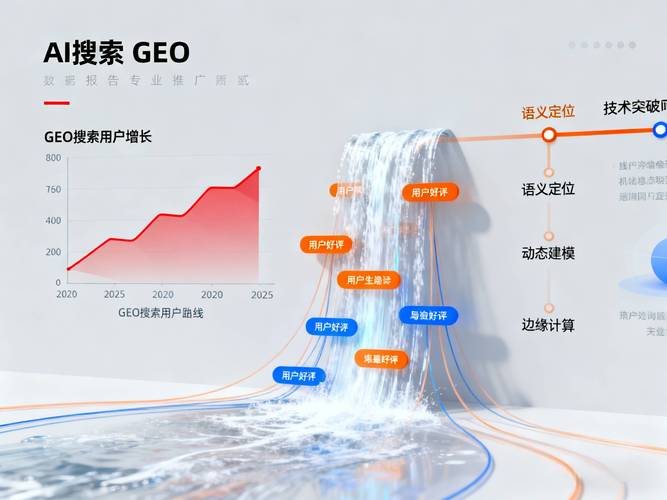
If you look at it carefully, the answers given by the smart assistant are usually from several sources. Some sources provide core definitions, others provide comparative data and others provide user evaluations. All you have to do is make the most indispensable piece of the puzzle。
This requires a more detailed breakdown of our content layout. Don't keep thinking about doing a big, complete encyclopedia, which probably won't work with wikipedia. You're supposed to plow a broken track and study the details of this track. Even if you're specializing in corrosiveness of a particular material, if you're deep enough, professional enough, and when people ask questions about it, ai will never get away from you。
Real dry stuff
Just don't write nonsense. Readers are smart and smarter. The article, which starts three circles and ends without conclusions, has no space in the future search environment。
What we would like to applaud is conclusions first. Each paragraph addresses a specific issue. For example, instead of writing “a few options for sunscreen protection”, it is written that “one or three sunscreens under high-intensity ultraviolet light on the seaside are really untangled”. And then you're going to give an experimental comparison, for example, with the redness of the skin after section a and the body temperature after section b。
The more details, the more power. These details include, but are not limited to, specific models, precise prices, real feedback times, detailed operational steps. When you're filled with real stuff, users think you're good, and ai thinks you're a good source of information. This confidence-building cannot be replaced by any technical means。
Details determine success or failure
Some of the details of geo optimization are easily ignored by many. For example, content structured expression. Although we don't use one, two, three of these rigid subheadings, the logic must be clear。
A complex issue is to be broken up through a combination of paragraphs. Each paragraph focuses on a small focus. So that robots can easily judge when they capture information that this is an explanation, that it is a solution. This machine-friendly layout of content can greatly increase the efficiency of the cited。
The frequency and accuracy of content updates are also crucial. Obsolete information is automatically filtered by smart models. If you're still talking about technical parameters a few years ago, then ai will soon abandon you. Keeping the content alive and constantly correcting the data that have changed is a stupid and most effective way of maintaining traffic。
Trust is the rule
After all, both seo and geo are fighting for two words: trust。
The search engine trusts you, so it gives you rank; the smart model trusts you, so it quotes you; the user trusts you, so it ends up buying your stuff. If we are to build that trust, we must be realistic. Do not write anything that seems to be wrong for the sake of heat, let alone move people's content for so-called traffic。
The original content, with personal thinking or practical experience, is scarce in this era. When you actually write from the point of view of solving user problems, when you share your many years of experience without reservation, the sense of professionalism is felt across the screen. This authority, based on real experience, is at the heart of the eeat standard。
The response now
What do we do with this search change? First, don't worry, let alone think that the old set is completely useless. The basis of the website should be completed with title labels, and the mobile end of the work should not be lost。
Secondly, focus on the creation of quality content. Study the real needs of users and see what they are asking on social platforms and in question and answer communities. These specific questions are answered in the most professional manner. Don't be afraid of long articles. If every word makes sense, it is easier for two or three thousand words to gain a high weight in intelligence searches。
Finally, learn to work with ai. You can try to search your keywords with all sorts of smart assistants, see which websites they're quoting now, what the features are. Watch, copy, cross. This process is not about forgery, but about learning how to speak better in this new context。
Geo is definitely not a substitute for seo, it's a gorgeous transformation of seo in the intellectual age. Together they form the twin wings of modern digital marketing. As long as we insist on doing valuable content, telling the truth and saying useful words, however the form of the search changes, the flow always flows to those truly trustworthy places。
The search market in the coming years must be for those who know both the logic of technology and the heart of content. We do not need those cold machine languages, we need warm, professional communication that can solve real problems. That's the ultimate meaning of what we do and what we do。
Which one is more easily selected and quoted by ai in the current search environment, making a professional subdivision of the site and making a comprehensive site with a wide range of coverage? We can talk in depth about this particular direction。