Not all people can see the same depth with the bills and the bills hanging on the trade. The normal bulk opens the software, and the default is a five-tier line. Buy one to five, sell one to five, 10 places. These ten price positions are not available at all. Those who pay for the level-2 data service see the 10th grade. Buy one to ten, sell one to ten, double the length。
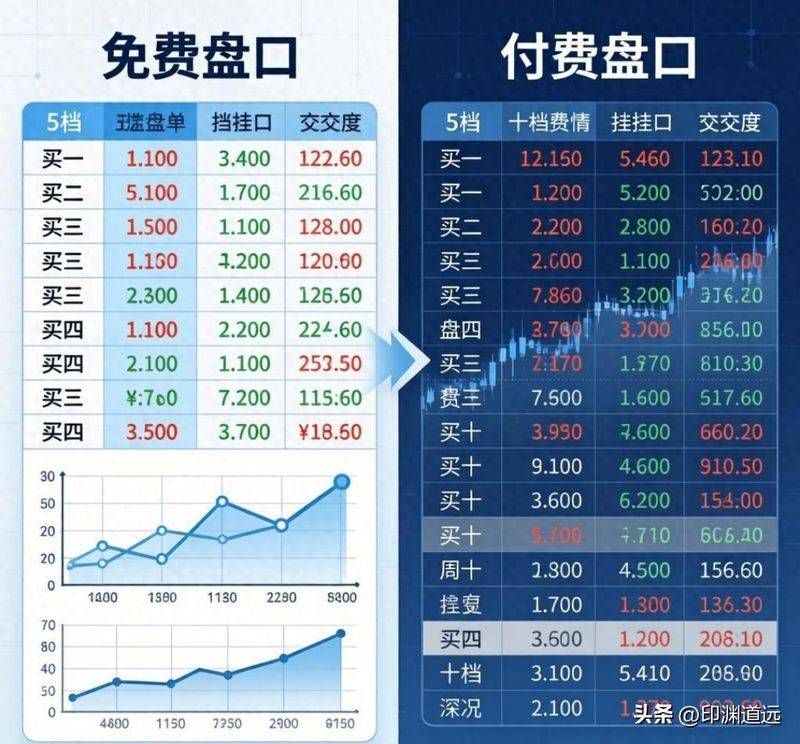
The fifth category is a standard one that is provided free of charge by the exchange. It shows five buyer and five sellers ' quotations closest to the current offer. In this price zone, you can see how many hands are waiting for a deal. There's something out there. Free users can't see. If a major source of funds is trying to build up a large amount of single disks in six to ten locations, the first five tranches will cover the real intent with a small number of sales orders, which is completely invisible in the free trade。
The 10th row shows a deeper queue. Buy from six to ten, sell from six to ten, all in front. The true intent of the main force is more difficult to hide in the 10th grade. It is also possible to see more clearly the overall strength of the market. Buying one-to-fives on the side looks weak, but buying six-to-ten piles of real money is a lot more solid than the bottom five shows. This information is clearly visible in the 10th tranche, while the 5th tranche users are blindfolded。
The 10th grade is also used to watch the master's list strategy. Travel money is raised using a step-by-step approach, with one-to-five-by-five rankings of funds, creating a rising trend. However, these techniques would be more transparent in the context of the 10th grade, and hidden follow-up funding plans would be compromised. Many professional travelers use algorithms to break orders in order to circumvent surveillance of the 10th tranches and to divide the large bills into countless small pieces at more price。
The level-2 data service usually has other high-level features, in addition to the 10-series stand-alone depth. It's one of the core things. The general situation is a few seconds of joint delivery, and the level-2 is a real-time delivery of each transaction and clearly marks the direction of the sale. The accelerator cartrix is an aid to transactional and large-scale monitoring, allowing for faster identification of financial entry and exits。
However, the tenth tranche continues to be the most visible upgrade to level-2. For ordinary medium- and long-term investors, the fifth tranche is fully adequate. There was no need to pay for the additional five sets of tabs, and long-term investments did not require such a sophisticated set of data. The 10th tranche is a necessary tool for investors trading in ultra-short lines, boardboarding, and t+0. The magnitude of the funds in each of the tranches directly determines the location and timing of the operation, and the information advantages of the additional five attachments are magnified in short-line games。
It is also important to avoid miscalculation when using the 10th grade. The tenth tranche still has the potential to be falsely declared and withdrawn orders, which cannot be supported and pressured by simple judgement in static sheets. The tabling is dynamic, and the main force can create false tabs for the movement of funds between markets. The tenth tranche would also need to be judged by a combination of the details and time sheets, and the large amounts of the sheets that would be outstanding there might be true or false declarations that would be withdrawn at any time. The tenth set of level-2 events only increased the dimension and visibility of the information and did not eliminate the complexity of the game itself。