Last month, he helped a friend to watch the renovation of the open kitchen, and he selected the smoker model, the beautiful ak7 pro, 28m3 wind, 1100 pa still pressure, with no problem with the parameters. I asked him, "did you measure your pipe?" where's the pipe? How far is the pipe? How many bends
And he's like, "the pipe is empty."
This is the path for most of the candidates: first look at the brand and the parameters, then flip the recommendation, and then the last order. The flue conditions are at the end of the line, not even at all。
However, open kitchens are difficult to smoke and closed kitchens are not at all a quantitative level. You pick a model without even knowing the pipe, and it's possible to buy the parameters for nothing。
I. What's so hard about an open kitchen
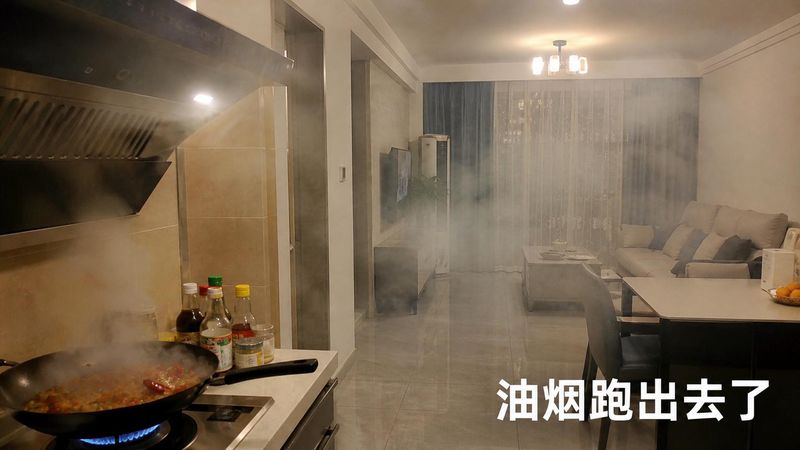
In the closed kitchen, there was a push-pull door, the door closed when cooking, the smoker built negative pressure in a few cubic metres of space and the smoke could not run away. This door is not available in the open kitchen, which is linked to the guest restaurant, and the space extends directly from 15 cubic metres to more than 100 cubic metres。
A smoker can't build an effective negative field in such a space. As soon as you make a chili, as soon as the smoke rises, as soon as the air-conditioning in the living room blows, people move up, the smoke breaks. Spread out easy, suck back hard。
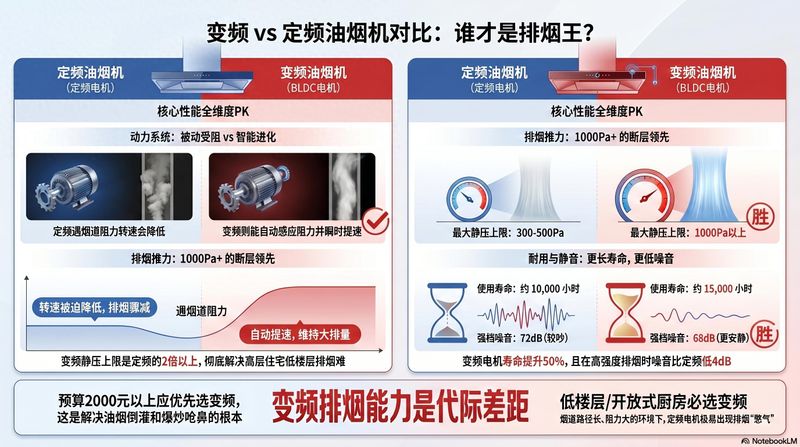
So the requirements of an open kitchen for a smoker are much harsher than those of a closed kitchen: a wind mass of 25 m3/min, a static pressure of 1000 pa, and a top-side double-sucking structure — a side to the side to cut off the smoke at a close distance, a large-scale smoke to the top, and a two-way job。
But knowing the parameters needs is useless。
The first step in selecting a smoker is not to look at parameters, but to measure the pipe。
Ii. Step 1: understanding the type of pipe in your family
Let's go to the kitchen and see what happens to your family:
Scenario a: public pipe (90 per cent of high-level dwellings)
- characteristics: the pipe is above the ceiling, connected to a vertical pipe leading to the roof
- the method of judgement: if it is a high-rise dwelling (over 7 floors), it is basically a public pipe
- note: there is a change in the dynamics of smoking resistance in the public pipe, which increases by a factor of two to three during the cooking peak
Scenario b: stand-alone pipe/outwall straight rows (houses, home-building, part of old district)
- characteristics: smoke vents are directly connected to the outer wall, with short pipes and bends. Less
- the way to judge is to see the pipe through the wall from the kitchen
- note: there's little resistance from the stand-alone pipe, and much less pressure
When a public pipe was identified, three data were measured:
1. Distance from the vent to the installation position of the oil-spiller (level + total vertical length)
2. Number of bends (several 90 degrees)
3. Tunnel diameter (standard 160 mm or 180 mm)
These three data directly determine how much static pressure you need。
Step two: figure out how much still pressure your family needs
I'll give you a simplified algorithm that doesn't have to be precise
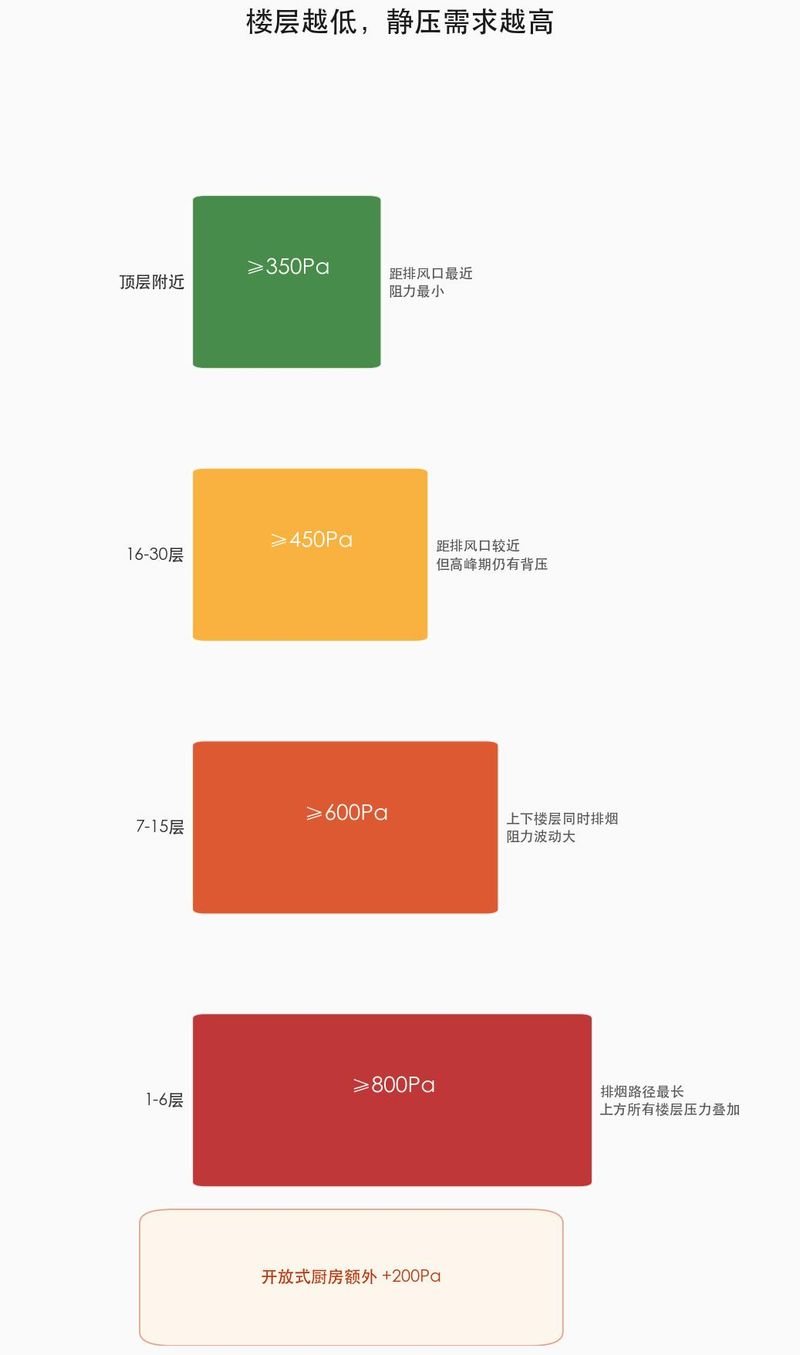
Basic static pressure needs (the lower the floor, the lower the floor, the higher the pressure):
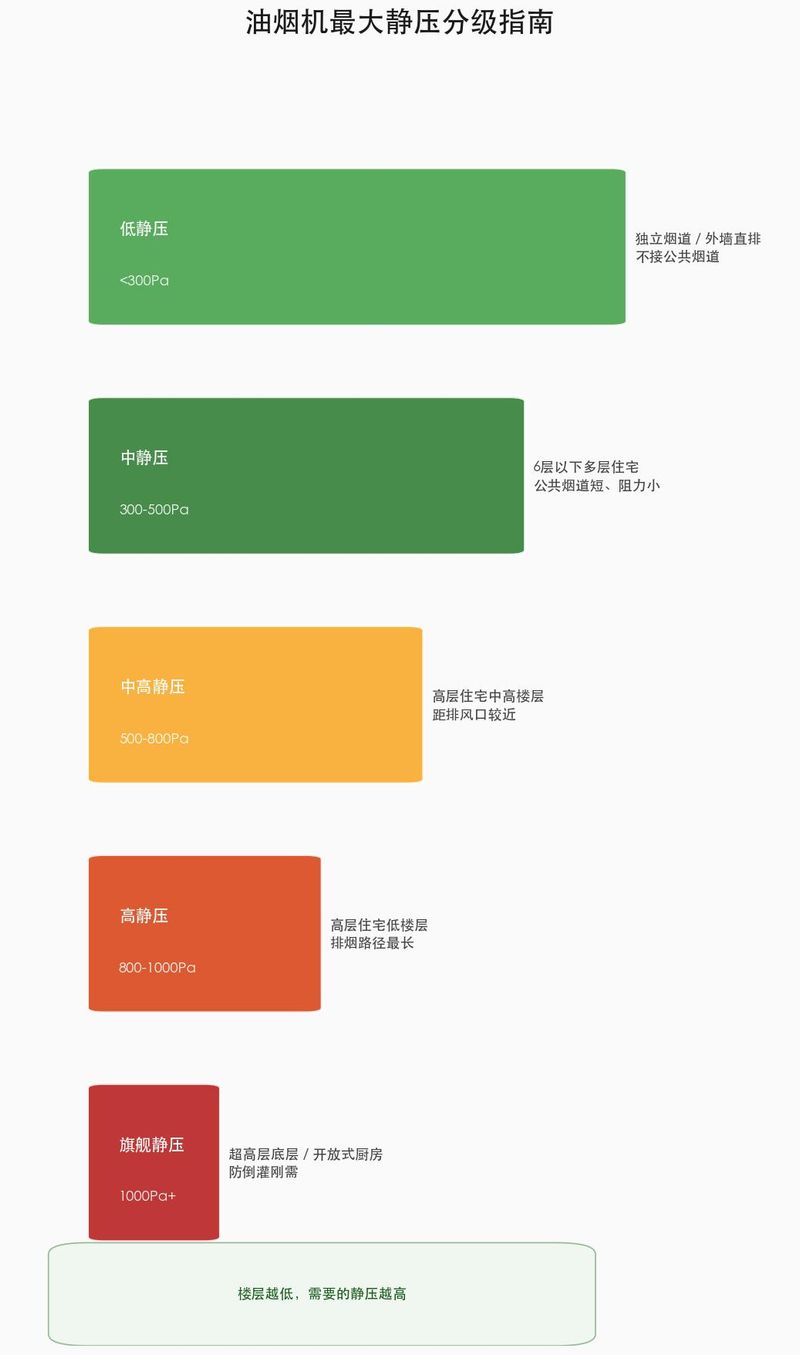
Additional amendments (subject to pipe conditions):
- drains exceeding 3 m: still pressure requirement + 200 pa
- more than two bends: still pressure requirement + 100 pa
- open kitchen (unseparated): still pressure requirement + 200pa
For example, you live on the fifth floor of a 30-storey high-rise house, with a pipe of 4 metres, two bends, open kitchen。
Basic requirement 800pa + chief + 200pa + open + 200pa = actual need for approximately 1,200 pa static pressure。
If you live on the 30th floor of the upper floor, open kitchen, and the pipe is still long, then still pressure may reach 1200-1300 pa. On the other hand, if you live on the 28th floor of the 30th floor, close to the wind, 400-500 pa may be enough。
It's okay not to remember the formula. One principle: open kitchen + public pipe, starting with at least 1000 pa. Can get to 1200 pa more solid。
Iv. Third step: choosing models by static demand
I've looked at parameters and prices for each of the following recommended models. Only those who reach the standard by static pressure are recommended, and the false frequency with good parameters is not included。
Approximately $2,000 budget: us$a's ak5pro upgrade (approximately 1999)
25m3/min + 1000pa static pressure + steam wash + top side integration. 2000 open kitchens. The steam wash function is useful for families who cook daily, and regular run-off keeps their suction constant. 1000 pa is enough, but frankly not rich。
The budget is 2500 to 3000: the owner of the small black wing d1u (approximately 2879)
28m3/min + 1350pa static pressure + double-suction at the top. This is a real value-for-money bomb — 1350 pa can hardly find a second one under $3,000. The top-side double-suction structure is particularly suitable for open kitchens, with the side-sniffing of the smoke at close range and large-scale smoke in the upper negative zone. If your silent pressure needs 1000-1200 pa and the budget doesn't want to exceed 3,000, pick it。
Budget 3000-4000: us$ ak7 pro (approximately us$ 3199)
28m3/min + 1100pa static pressure + steam wash. Single sales volume of 100,000+, market certified model. The combination of steam wash + frequency transformer machines, which have been used for long periods of time, is much slower than the normal amount. It's for a family who's been fired every day, but is lazy。
Budget more than $4,000:
Boss l3+d2 (approximately 4238): 27m3/min + 1200pa + stove suit. Performance is balanced and fit for one step。
Fanta v1s-g (approximately 5798): 28m3/min + 1450pa + stoves. 1450 pa, civilian level static ceiling. The most difficult scenario, open kitchen + super-high ground floor, does not make mistakes。
Selective priority:
- limited budget but high pressure
- it's gonna blow up every day
- budget adequacy + pursuit of extremes
Five, four large pits at installation, more serious than the wrong model
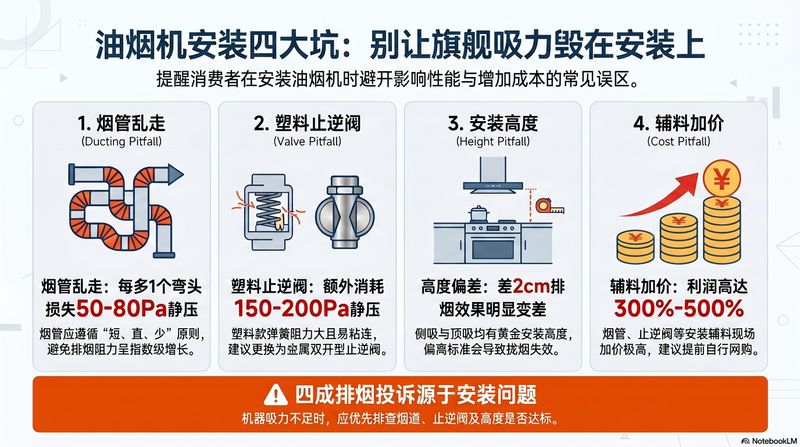
The model was right, the installation was messed up and the result was a discount. I've seen too many holes:
Pipe 1: the pipe's moving
For the sake of the beauty of the ceiling, the renovation company put the pipe around several bends into the ceiling. In hydrodynamics, smoke resistance increases non-linearly for every 90 degrees greater (not simply folding, but indexing). There are three words to go: short, straight and small. It is the shortest distance, the smallest bend, and the smallest pipe。
If the tube is more than three metres or more than two bends due to household restrictions, save the money and go directly to the high-pressure variant (1200 pa) model。
Pipe 2: deretrovalved by the developer
The public pipe proposes to contain the reversible valves and to replace them with dual metal. The developer's own plastic anti-reversory valves have two fatal problems: first, the spring is too hard, and the oil-smoking machine consumes 150-200 pa's additional static pressure to remove it; and second, the leaves are susceptible to oil stains, the hours are tight, and the neighbor's soot is pouring into your house。
During the renovation, the master was asked to smash the original and replace a $100-200 metal anti-reversity valve. It's a big deal。
Pit 3: a few centimetres below installation altitude
Side-smoking smoker base 35-45 cm from stove and 65-75 cm from stove. Don't underestimate the margin range of a few centimeters. Feedback from users was measured, smokers were installed two centimetres higher, smoke discharges became significantly worse and improved immediately upon return to standard heights。
Two centimeters. Almost there。
Pit 4: installation of auxiliary material plus price
The smoke machine price is now transparent for the electrician, and the profits are already low. But it's the installation chain that makes a big profit. Pyrotechnics, anti-reversary valves and decorative masks may be added 300-500 per cent to the site. It is recommended that standard metal anti-reversible valves and thicker aluminum pipe be purchased early in the construction materials market, with only a few dozen pieces of installation fees charged to the master。
Vi. Selection of self-cleaning functions
The high frequency of the use of smokers in open kitchens and the rapid accumulation of oil pollution merit consideration for self-cleaning functions. But have a reasonable expectation:
- beautiful steam wash: 110°c high-temperature steam soluble oil from a leaf tanker and then dry at high speed. It slows down, but it doesn't mean no washing. It is recommended that this be used every 1-2 months. Heavy smoke families chose this。
- boss/fanger is too un sticky with oil coatings: the internal cavity is coated with tarcrete, which is not easily attached. Light use does reduce the frequency of washing. There's plenty of light smoke。
- high-temperature thermal melting (wadi et al). The principle is like steam wash, but the temperature is higher。
Put it straight: self-cleaning slows down, but it is not a substitute for deep distillation. A smoke machine was used for more than three years and it is recommended that at least one professional depth be removed, which is the most effective way to restore the plant's static pressure and to eliminate noise。
Vii. The ultimate purchase process for an open kitchen smoker
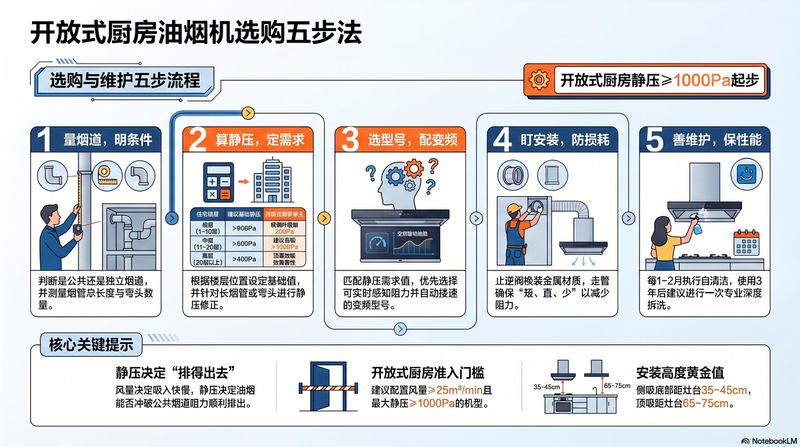
Enrich the contents of the front into an operating process:
First step: measuring the pipe, determining whether the public or independent pipe, the pipe length and the number of bends
Step 2: calculated static pressure
Step three: select the model, select the corresponding frequency model based on static demand and budget
Step four: focus on installation, reversible valves for metal, short and low walker, installation of high card standards
Step five: good maintenance
Don't turn it around. It's cheaper to measure a pipe before pick a model; it's cheaper to pick a model before thinking about a pipe。
The friend at the beginning, and then i asked him to take a sample of the pipe. Public pipe, with three and a half metres of pipes, two bends and 10 floors. We've got about 1,000 pas. The owner, d1u, 1350 pa, was finally chosen, and four dishes were fired that day。
You can do three things now:
1. Go to the kitchen and take a look at the pipe and judge whether the public or the independent pipe, measuring the length of the pipe and the bend with a roller
2. To calculate the lower limit of your house's static pressure by comparing the pressure table above the floor
Take this value against the recommended model table, where static compliance is at the heart of the priority, and wind and brands are behind it