The concept of securitization of financial assets in the supply chain
Vendors upstream in the supply chain are highly dependent on core firms, have a weak bargaining position and engage in transactions on credit to obtain long-term business cooperation, creating large amounts of receivables and strong liquidity requirements。
The securitization of financial assets in the supply chain around the reverse extension of core enterprise credit, the issuance of securitization products based on core enterprise accounts payable (receivable from the respective supplier), is an innovative model of supply chain financing based on vendor-centred securitization of receivable assets. This innovative model allows for the “non-bidding” of high-quality receivable assets。
Ii. Advantages of issuing financial asset securitization products in the supply chain
The credit of the supplier is affected by its own solvency, the amount of direct financing is limited and the financing is difficult to finance. By transferring the financing of accounts payable from the core enterprise, suppliers can leverage funds to make them more efficient。
2. Through financial asset securitization arrangements in the supply chain, core enterprises may delay payments and relieve financial pressures。
Repository issuances can be “one declaration, multiple issues” and financial statements can be optimized by flexibility in choosing the timing and size of each issue, and by rationalizing the financing tempo of core firms to minimize the cost of funding。
4. The securitization of financial assets in the supply chain, as a generic product, depends on the credit issuance of the core enterprise and the lower cost of financing, which can reduce the cost of capital for the core enterprise and supplier, balance the benefits between up and down the supply chain and promote the virtuous development of the chain of closed industries。
Iii. Place of transaction and mode of issuance
Asset securitization products are issued in the interbank bond market by abn (assets support instruments) and asset securitization products are issued in the deep stock exchange by abs (assets support special scheme)。
Cnabs data show that the first list of financial asset securitization products in the supply chain was issued in july 2016 to 29 march 2020, with a total of 760 copies with a circulation of 497. 638 billion. Of these, 27 were raised in the inter-bank bond market, 733 in private (688 in deep stock exchanges and 14 in inter-agency private offer and service systems)。
As a result, financial asset securitization products in the supply chain are currently being issued, with private distribution being considered as a first priority and being placed on a deep-seated exchange。
Iv. Transaction flow and structure
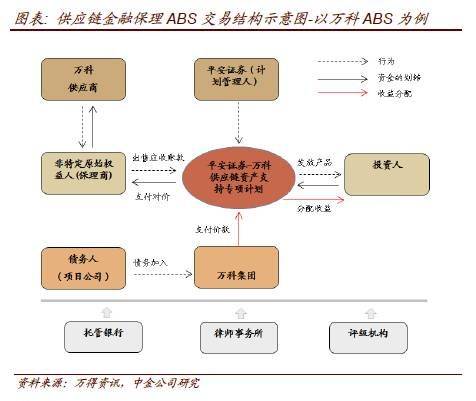
(i) a typical supply chain financial assets-support program transaction process:
Creditors are entitled to an unexpired receivable claim against a company that is affiliated to the core enterprise for the provision of underlying transactions such as the sale of goods or the provision of in-country engineering services to a subsidiary of the core enterprise, which enters into payment commitments as due by issuing a confirmation of payment and becomes a joint debtor with a subsidiary of the core enterprise。
The original equity person (the factoror) enters into a factoring agreement with the creditor to provide factoring services in respect of the creditor's claim in respect of the receivable of a subsidiary of the core business and to be granted the outstanding receivable claim, which may be assigned by the original equity person to a special plan。
In order to avoid problems such as the entry of assets into the pool, the transfer of cash flows or confusion in the supervision of asset services, the special plan normally provides that each phase of the special plan transfers the underlying assets from a single original owner (the factoror) who is the asset service provider of the current special plan。
4. The plan manager raises funds from investors in asset support securities through the establishment of a special scheme, enters into a basic asset purchase agreement with the original owner and uses the special plan to raise funds to purchase the outstanding receivables claims that the original owner has been granted from the supplier, and manages, operates and disposes of the special plan assets as agreed in the special plan document。
5. The plan administrator enters into a service agreement with the original equityr, entrusting the original equityr as an asset service provider to provide the underlying asset management services for the specific plan, including, but not limited to, the underlying asset screening, the preservation of the underlying asset document, the urging of the original equityr to fulfil, either on his own or on behalf of the original interest, the duty to notify the debtor of the transfer of the claim, the monitoring of the base asset pool, the collection of the underlying asset claims, the recovery of the underlying asset, etc。
6. The plan manager enters into a trust agreement with the trust bank to open a special plan account with the trust bank to keep the funds of the special plan。
Upon the establishment of a special scheme, the asset-support securities will be registered and held in the central certificate. During the life of the special plan, asset-support securities will be transferred and traded on the exchange's comprehensive agreement trading platform。
8. After the debtor is due and payable on time, the plan manager issues a distribution order to the custodian bank, as agreed in the standard clauses of the plan statement, the trusteeship agreement and related documents: in accordance with the distribution order issued by the administrator, the custodian bank transfers the corresponding special plan assets, net of deductible expenses, such as special plan costs and special plan taxes, to the designated account of the registered trustee to pay the principal and investment returns of the investor in asset support securities。
(ii) a typical supply chain financial assets support plan transaction structure:
Characteristics of financial asset securitization products in the supply chain
(i) reverse factoring, usually dominated by core firms, and by factorors。
Inverse factoring is usually dominated by the debtor (the core enterprise), relying on the credit of the core enterprise and in the reverse direction of the chain of transactions, providing factoring services to suppliers with long-term, stable business dealings with the core enterprise (including subsidiaries, down the same line). Typically, the “1+n” model, which is a core enterprise with a higher credit rating and greater solvency, and the “n” which is a supplier with a supply relationship with the core enterprise, are essentially based on genuine business transactions that translate the credit of the core enterprise into its own credit and thus achieve lower-cost financing。
In theory, a reverse factoror may, based on an understanding of the core enterprise, select the accounts payable claim for which the core firm recognizes payment as the underlying asset and issue securitized products of financial assets in the supply chain for financing。
In fact, the issue of financial asset securitization products in the supply chain is usually dominated by the core enterprise, and the factoror, although the original owner, has the same role as a gateway and has the task of subsuming accounts receivable. The factoror often takes various forms of security, does not buy receivables, does not take interest on bridge funds and is not exposed to debt risk。
(ii) the investment logic is similar to that of credit bonds based on the main credit issue of the core enterprise。
In the construction phase of a project, when the project company is normally established to manage the integrated development of a particular real estate project, the accounts receivable are for most of the transactions between the project company and the supplier, that is, the direct debtor being the project company, but, given the low credit rating of the project company itself, the core enterprise tends to embed its own credit in the product, for example, by entering debt as a co-debtor or providing a margin payment commitment, thereby enabling the supply chain financial asset securitization product to reflect the credit rating of the core enterprise. Project organizers or final payers of the supply chain securitized products are core enterprises, and it can be said that the product is issued on the basis of core business credit. Investors are also primarily concerned with core enterprise qualifications and repayment capacity, and supply chain financial asset securitization products are, in their view, a typical type of credit debt。
(iii) base structure, which does not normally involve credit enhancement。
Supply chain financial asset securitization core enterprises have a high threshold of access, and securities repayments depend heavily on the repayment capacity and willingness of core firms. The main product issued by aaa does not generally require credit enhancement through the priority/sub-tiered structure. With the exception of a small number of high-quality aa+ main items, which are added by setting a smaller proportion of sub-instruments, the vast majority of them use a horizontal structure。
(iv) generally issued on a shelf。
Repository issue, “one declaration, series of issues”。
According to question and answer (iii) on asset securitization at the shanghai stock exchange, the asset securitization project “one declaration, one issue in one issue” is subject to the following conditions:
1 the underlying assets are of a high level of homogeneity, the legal definition and business pattern are of the same type and the risk characteristics do not differ significantly
(a) the issues of issue in two instalments to support securities using the same trading structure and credit enhancement arrangements, setting the same basic asset eligibility criteria, which include relatively clear underlying asset quality control provisions such as asset pool fragmentation, debtor shadow rating distribution, etc.
The original equity holder can continuously generate a base asset size commensurate with the size of the issue
4 the original owner or the main person of the special scheme is well qualified and, in principle, the principal person is rated aa or above
The plan managers and associated participants of the securitization project have good performance and more extensive business experience in asset securitization。
The association of dealers ' asset support instrument business response provides that, in principle, for products that are subject to a single registration and series of issues, the structure of the transactions should be the same and the underlying assets are of a high level of homogeneity. The registration documents shall reasonably be based on such factors as the enterprise's reasonable development planning, the size of the transaction, the average accounting period, and the turnover of assets。
Repository distribution models can increase the efficiency of distribution and meet the flexible financing needs of core enterprises, and can be leveraged by various underwriters and factorors through shelf issuances, which are currently the preferred mode of distribution of supply chain asset securitization products。
(v) asset pools are usually identified twice during the issuance of securities。
The issuer submits the simulated asset pool to the regulatory authority when filing its application for prior approval; the base asset pool is again identified when the product is issued。
In the case of quick repayments of capital assets and uncertainty as to the date of issuance, such a mechanism would, on the one hand, allow the original owner to use the assets at the declaration stage for other financing (e. G. Repurchase of the base asset as another asset securitized product) during the pre-issuance period, and, on the other hand, where market liquidity is tight and the cost of the funds is higher, a special scheme could be deferred until the right time for interest rates, both to meet regulatory requirements, to secure the size of the financing and to exercise flexibility in controlling the cost of financing。
(vi) securities ratings are difficult to surpass core corporate ratings。
As noted earlier, the strong dependence of supply chain finance abs securities on the repayment capacity and willingness of core firms and the evident characteristics of credit debt also determine the difficulty of rating priority asset-support securities above the core firm's corporate rating。