Many offshore brands are making four budget submissions for four abbreviations, which are in fact four levels of the same system。
Over the past two years, it has been observed that the terminology used to describe the maritime marketing community has suddenly changed. First seo, then someone said to be aeo, then llmo became popular and then geo appeared. Every new word emerges behind it a group of new service providers, new methodological approaches, new indications that the “last approach has become obsolete”。
If the perspective is returned to the overseas platform ecology itself, these concepts are not substitutes for each other, but are named at different stages of the same cognitive path. What is discussed here is how, in the context of overseas platforms, search systems, answer systems and generation systems together constitute structural changes in brand visibility。
Many business owners are saying, "i don't know what to do, i feel like i have to do everything, but i don't know if it works."
The article wants to do one thing: to make the relationship between these four terms clear。
First, they are not four tracks, but four levels of the same system. The appearance of a short board on any one level limits the effect on the other。
Why so many terms
Each term corresponds to a change in the technological environment。
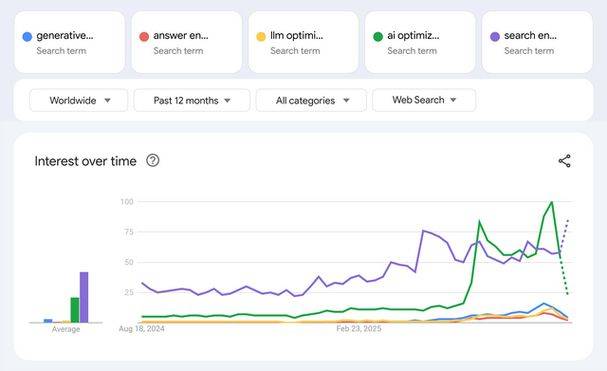
Seo (search engine optimization): the search engine is the age of the information portal, and the core logic is “to allow content to be recorded, ranked and clicked”。
Aeo (answer engine optimization): users start not to click but to get the answer directly. Google's selection summary, the “people's still asking” module, and the voice search are the shape of the answer engine. The first line no longer equals being seen, but is directly quoted。
Geo (generating engine optimization): concepts that emerged after large models such as chatgpt, gemini, claude became the mainstream information interface. Users directly ask ai which brand is more reliable, a question that is not indexed at all, and the answer is that models are generated from training data. Geo is the logical way to influence this outcome。
Llmo (big language model optimization): essentially, and geo addresses the same problem, but with a more technical perspective, attention is given to semantic density of content, clarity of definition, consistency of information across platforms to enable large models to understand and quote brand content accurately。
The four words capture four real changes. The question is not what is right or wrong, but what is alternative rather than a hierarchy of interdependence。
Three common cognitive errors
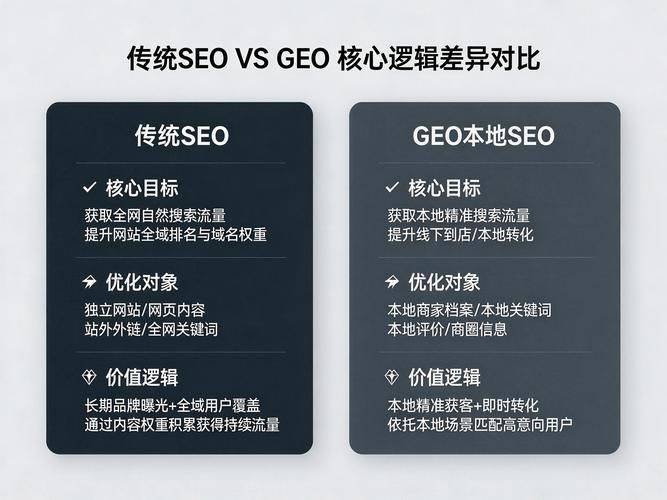
Mistake i: consider geo only as complementary optimization in the seo system and not included in the core distribution mechanism
The current resource allocation logic for many teams is to have seo as the main input and geo as the additional optimization. This can lead to a structural problem: content has entered the indexing system, but there is insufficient call rate in the generation system. The reason is that there are different levels of impact: seos play a role in discoverability, and geos play a role in generating probability。
When more and more user decisions occur in ai generation outcomes, the key variables that affect the frequency of brand appearance are no longer just whether they are recorded, but rather priorities and stability in the generation results. If geo stays at the executive rather than the strategic level for a long time, it emerges: content exists but frequency is unstable; searchable but unpredictable. This is not a lack of seos, but rather a lack of reconciliation in the distribution mechanism。
The real error was therefore not whether it was necessary to invest in geo, but whether it was still being positioned as a subsidiary optimization rather than integrated into the core resource allocation system。
Zone 2: aeo is a voice search optimization。
Voice search is just an application for aeo. At the heart of aeo is the need to structure the content to be drawn directly from any answer engine, including google's ai overview, selected summary, question-and-answer modules, and an increasing number of aai assistants ' retrieval enhancement systems。
For the b2b brand, buyers ask very specific questions of comparison and evaluation when making decisions. Those who can be the “quoted answers” to these questions have gained confidence just before entering the procurement shortlist。
Miss 3: llmo is a technical team, not a market。
On the contrary. The accuracy of a large model's understanding, reliable summary and self-confidence in recommending a brand depends on three things: consistency of brand descriptions in third-party channels, precision in the language of core value claims, and mutual corroboration of external authoritative voices with the brand's self-statement. All three things are within the scope of market and brand team decision-making. Llmo is only a technical expression of the problem, but the problem itself belongs to the market team。
Unified perception: four layers of architecture, one system
In combing the structure, i became aware of a problem: most of the discussions in the market on seo, aeo, geo, llmo are fragmented. There were those who spoke only of the upgrade of seo, those who emphasized only the geo dividend, those who viewed aeo as a subsidiary module of seo, and those who discussed separately the suitability of the large model. But few people understand them in the same vertical structure. In the context of offshore generation, these four elements are not a substitute but a progressive one. They comprise not four service modules, but a cognitive path。
In an attempt to validate this judgement, i spoke to several overseas ai visible teams. Most enterprises would emphasize one of these layers of capabilities, but not much of the logical relationship between the four. However, in an in-depth communication with the futune cloud team, i found that they defined the four capability modules as a vertical stacking structure and named: ai vision fRamework (ai visibility framework)。
It is not important in itself, but rather structural logic, that they view the index, extraction, understanding and generation of the four tiers as a complete link, rather than an alternative concept. This is very much in line with my earlier judgement。
In my interaction with the delivery team, i focused on three issues:
That is the criterion by which i judge whether a team has long-term value。
First tier: index layer (seo)
Platform: google, bing, etc
Role: to allow content to be recorded, ranked and discovered and to solve problems
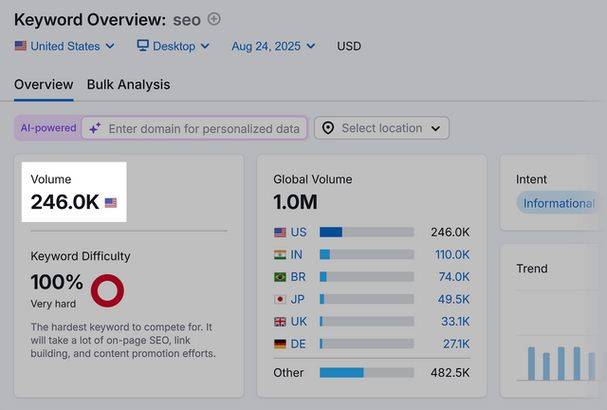
The index layer solves the most fundamental problem, and content is in the public information system and can be captured and structured for storage. In overseas languages, the bottom of both traditional search engines and generating systems relies on indexing structures of open networks. If branding, product or technical content cannot be effectively captured by search engines, subsequent extraction, understanding and generation cannot take place。
Personal observation: some say that seo is the geo, or that geo is useless, but only under the guise of a service provider who “cuts herbs”. However, from the perspective of the evolution of information technology, each upgrade of the distribution structure would lead to a reorganization of the methodology. In particular, the early seos also evolved from an extremely rough phase to a highly structured structure today. The emergence of a new optimisation direction is a natural result rather than a substitute logic. The point is not “is it new”, but is there a clear logical path。
Second floor: answer layer (aeo)
Platform: google select summary, paa module, ai overview, voice search
Effect: make what has been recorded a retrievable answer to call problems
If the index layer resolves whether it exists, the answer layer resolves whether it can be called directly. Aeo emphasizes the extractability of the content structure, i. E. Structured expression. The goal is no longer a mere ranking, but a standard answer to a question unit. Clear structure, semantic precision, accurate information and easy extraction of automated systems。
Personal observation: when i was a seo in the past, i did not deliberately emphasize the concept of “aeo”. The paa module on the serp page is more used as a choice extension and keyword mining tool than as a " target that can be drawn from the system " . However, looking back at the past, many of the structured expressions actually had the conditions for automatic extraction, but were unaware of them。
This points to a problem: perhaps technological evolution is redefining what we are already doing。
Serp: all result pages shown in search engine results pages, google / 100 degrees, etc., after user searches for keywords. Paa: people also askThird level: modelling understanding level (llmo)
Platforms: chatgpt, gemini, claude, perplexity, etc
Role: correctly and steadily understood, addressing semantic understanding
If the first two tiers address whether “are there” and “are there to be a call”, the third tier addresses whether the model is stable and understands a given cognitive object accurately. (this can be: brand, product, technology concept, industry role positioning)
Llmo is not an optimisation of channels, but a synonym of governance, concerned with:
When content enters the public index and answer system, large models start learning and compressing that information. If semantic conflicts exist between different sources, the model creates uncertainty when integrated. Uncertainty usually results in vague formulations, conservatism and even avoidance of strong judgement. Therefore, llmo does not address the issue of exposure, but rather: to reduce model misperceptions and improve semantic stability。
Personal watch: having interacted with a number of overseas ai-visible service providers, i found that there are not many teams that really systematically speak about the model understanding level. Reconfirming intellectual clouds, defining this continuous semantic unity and structural governance as “cognitive assets”. The concept has a long-term logic, as it emphasizes that cognitive objects are not only exposed, but are settling into a stable cognitive structure that can be used by models over time. This layer is more strategic than short-term exposure from a long-term value perspective。
4th layer: generation layer (geo)
Impact: prioritized integration into decision-making and resolution of emerging issues
The logic of the generation layer is different from the first three. The model does not refer to a single source, but integrates all accessible signals: industry media, third-party assessments, distributor discussions, comparative platforms, technology communities, official content, etc。
The core of geo is not “control a page”, but the overall weight structure that influences the signal. More precisely: llmo decides whether the model is stable enough to understand you and whether the geo impact model tends to be included in your generation. This overlap will affect the distribution of the results generated. Thus, geo does not simply pursue “probability”, but influences the default tendency of the generating system in decision-making issues。
Personal observation: in the past, when i asked gpt questions, i rarely clicked on the source. Subsequently, a conscious look at the source of the index found a wide range of references involving multi-platform, multi-dimensional information。
This made me realize that the perception of the generation system was not from a single source, but rather a signal aggregation. The business model of a future platform may change and advertising weights may increase, but at this stage, real third-party volume may even affect the outcome much more than advertising. Whether the future platform will enhance business weights is a variable. However, as long as the logic of generation is based on the integration of multiple-source signals, signal structure management is always valuable。
Real validation of the four-layer relationship
They told me a typical case
A procurement manager asked chatgpt, "a and b brands, which brand is more reliable
In the generation system, the logic of answering such questions often calls at the same time four layers of signals:
If any of these layers are missing, the result of the generation may be biased:
These four layers are not a substitute relationship, but a progressive relationship: found and extracted, understood, presented
Concluding remarks
And here, by in-depth discussion with the people who really did it, i know one thing even better: from being "searched" to "recommended," the brand is not facing a single-channel change, but a cognitive path that is moving。
Seos, aeos, geos, llmos are not understood as alternative concepts, but rather as different levels of capability in the same system. Their relationship is not simply “who replaces whom”. If a structured expression:
Under this structure, the build-up of network weights, historical content, industry exposure and brand volume by seo constitutes input signals that the model may be exposed to. However, seo itself is not equivalent to geo, but is a learning mark left by brands in public cyberspace。
It is not simply a question of ranking, but rather:
This is not so much a flow problem as a cognitive distribution under the generation mechanism. Thus, rather than describing the four-person relationship as “ground-based” or “replacement”, it is understood that seo, aeo, llmo are capacity-building dimensions and that geo is a strategic perspective for the directional integration of these capacities. It is not a substitute for seo, aeo, or lmo, but rather when the generation portal is becoming the decision-making field
These capabilities are managed in a conscious and synergistic manner。
As ai gradually begins to take on the role of “the answer portal”, the differences between brands may no longer be reflected solely in ranking positions, but in frequency and expression stability in the generation of results. The ranking does not necessarily disappear, but the referral mechanism has become a new variable。
The ranking is not necessarily the end of the previous era. However, recommendations have been the beginning of this era。
A few questions i would like to hear from everyone:
What do you think about being a seo? The ceo's brand is now on the four floors, which is the weakest? Or what floor? If ai has begun to replace the search engine as the first information portal for buyers, has the working methods of the content team changed
Welcome to the comment section: now, how does everyone allocate budgets and energy to seo and geo