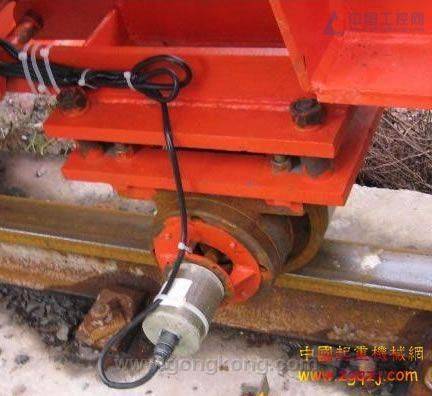
The graft analysis and treatment of trajectories is the fact that in the course of the operation, the motor vehicles or cars have frictions and bites on the inner edge of the wheel and on the side of the steel track, and even if grafts can result in trajectories or derailments. 0y: $nq i; e. T2 b; j) y5 f# t-car wheels and mini-wheels are likely to gnaw in the process. And because the cycling is basically the same as the cycling, we're here to analyze only one kind of cycling. The underlying causes of gnawing are essentially two parts: (n) ? 8 o4 |? 4 j part i is a problem of congenital origin, i. E., created during manufacturing and assembly. It includes the unequal length of the wheel; the parallels of the axes of the active wheel and the passive wheel; the difference of the diagonal lines of the wheel; and the fact that the point of contact at the bottom of the four wheels is not within a horizontal surface, which is what we call the three legs. In addition, there are two different arches in small cars, and the problem in large cars is that the parallels of the two large tracks are not up to standard, and the straightness and horizontality of the individual tracks are not up to standard. The existence of these problems leads to the occurrence of gnawing. This problem that arises in the manufacturing process can be solved in the course of its use, and some cannot be solved. In terms of our actual use, we have a large proportion of the calibration of congenital problems, reaching over 80 per cent, which is the problem that we should focus on. The second part is the problem of congenitality, which arises in the course of use and overhaul. (b) the main, passive wheel's axis is not parallel; and then, in the course of its use, the big car is gnawing around the wheel because of the linearity, parallelity, horizontal deviation of the orbit due to the loose bolt. The deformation of the car tracks is due to the lack of effective handling of the vehicle, which generally occurs only in the early stages of use. And in terms of our actual use, the problem of congenitality, which is small, less than 20 percent, is a problem that we should focus on when we address the problem of gnawing. From the above analysis, we can see that the root causes of the gnawing are the unequal cycling; the axis is not parallel; the diagonal is not equal; and the wheel is not on the same level. After a few years of searching, i think it's only possible to solve the problem of car chewing, starting with adjusting the wheel and the track. In any case, accurate measurement of data is a prerequisite, and the right adjustment is a guarantee that the end will be achieved. The rounding adjustment shall consist of the following four elements: 1. Adjusting the length of the wheel to make it equal. Adjustments are mainly made by changing the position of the wheel bearings. This method should first remove the locator welding point from the wheel, keep the locator free and then adjust it, base it on initiative, adjust the passive wheel and weld the locator after it is finished. 2. Align the axes of the active and passive wheels to parallel them. Adjustments are mainly made by changing the thickness of the side pads of the axle bearing. The adjustment points for this method are eight, with two points for each wheel, and the adjustment points can be selected from the measurement results, and the adjustment points are fine-tuned to select the active wheel, and the passive wheel should be selected when the adjustment is large. ... M z* {8 j6 'c! F9 d+ i$
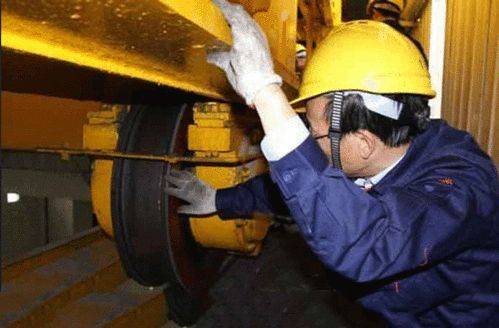
, v3, adjust the two diagonal lines of the wheel to make them equal. Adjustments are made by altering the thickness of the pads on the side of the axle bearing. Unlike the axis adjustment, the two corresponding points on the same side are adjusted by the reverse equivalent, taking into account the impact on the axis. So, the adjustments to the angles are a combination of adjustments, and normally the adjustments to the angles and axes should be considered at the same time, so that they are less time-consuming and more efficient. %r
:e; f3 {0 w'^b4 ~