Sometimes, when the news opens, we see: “the renminbi has broken seven against the dollar” and the yen has depreciated”。
A lot of people wonder who is deciding the exchange rate
Did the governor do that in his office? Or was it negotiated by our leaders
Actually, the exchange rate is not so mysterious. In short, the exchange rate is the “price of money”。
If you look at the “dollar” as an “apple” in a supermarket, you look at the “dollar” as a “note” in your hand。
No foreign exchange, no exchange rate
Many people think that "foreign exchange is foreign money," which is a bit one-sided. In accordance with the foreign exchange regulations of the people's republic of china, foreign exchange is a means of payment and assets in foreign currency that can be used for international liquidity, in addition to cash in foreign currency, such as the united states dollar and the euro, and includes foreign bank deposits, foreign currency stock bonds, bankers ' foreign currency balances, and so on。
But more crucially, "why foreign exchange?" in a simple scenario, we can say: chinese companies export toys to the united states, with only us dollars in their hands, and chinese firms need rmb to pay workers and buy raw materials. At this point, a “intermediate bridge” is needed to convert the dollar into a renminbi, which is foreign exchange, and the exchange rate is the ratio of the two currencies。
We in china use the "direct pricing" method, which is based on fixed units of foreign currency, indicating the equivalent of the renminbi. Like us$ 1 = hk$ 7. 3063, i. E. Us$ 1 can be exchanged in 7. 3063, which is also the most common form of exchange rate in the export-import business。
The exchange rate
Base anchor: purchasing power parities — “1 pound rice fixed rate”
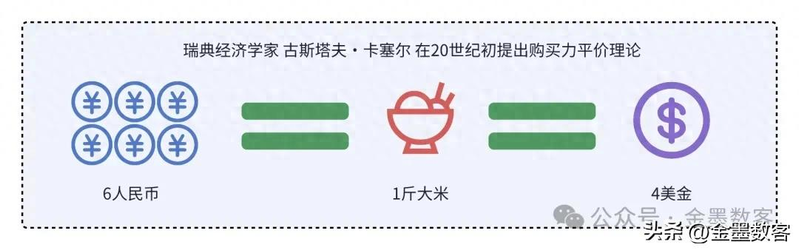
If one pound of rice is 6 yuan yuan in china and one pound of rice is 1 dollar in the united states of america of the same quality, then theoretically, six yuan is one dollar, and the exchange rate is six dollars to one dollar. This is at the heart of the “ppp theory”: the value of money depends on how much it can buy, and the same goods should correspond to different currencies of equal value。
But there's no such perfect balance in reality, because arbitrage automatically corrects deviations. For example, if the exchange rate deviates from this level, people will buy goods in low-priced countries, sell them in high-priced countries and earn price differentials in re-exchange currencies, which will constantly adjust the supply of and demand for money and bring the exchange rate closer to purchasing power parity。
Short-term pusher: interest rate parity - "interest affects the flow of money"
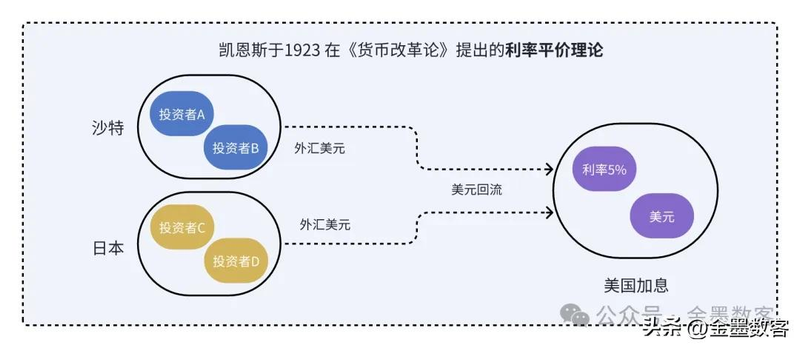
The key to short-term exchange rate fluctuations was explained by the “interest rate parity theory” proposed by cairns in 1923 in the monetary reform doctrine. For example, in recent years, the central bank of the united states (the fed) has announced an increase in interest rates to 5 per cent. The world's money looks at it: "wow, put the money in the united states, lie down and get five percent of the interest, it smells good!" so, global money swims to america like sharks smell of blood. In order to save money, you have to change dollars first. United states dollar demand surged, the dollar appreciated and other currencies depreciated in relative terms. That is why the united states dollar has been strong for the past two years。
This creates a key pattern: a short-term appreciation of high interest rate currencies and a long-term devaluation; and a reverse of low interest rate currencies. For example, when the fed raises interest rates, the dollar will appreciate in the short term, and when chinese exporting firms exchange dollar money for the renminbi, the direct effect of interest rates on exchange rates will be reduced。
Dynamic balance: market supply and demand, expected game
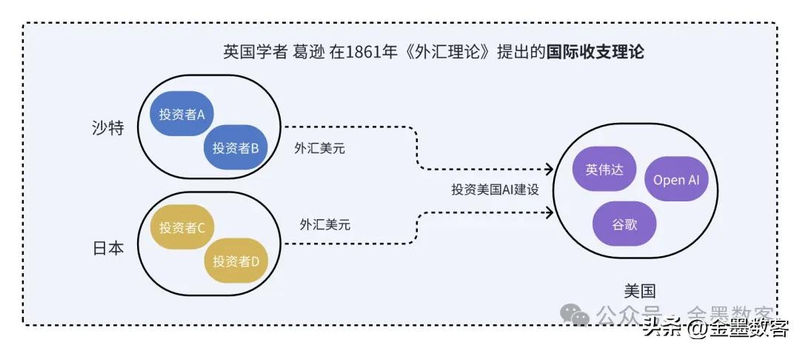
Thousands of businesses, investors and tourists are trading every day around the world, as if they were buying “money” in the market for vegetables, and prices are rising (by appreciation) when everyone wants to buy it。
For example, in recent years, the ai technology in the united states has erupted, and investors all over the world want to buy shares in inverda. However, the purchase of american shares had to be in united states dollars, so people sold the japanese yen, the euro and the renminbi in their hands for the dollar. As a result, more people want dollars, the dollar becomes expensive and the exchange rate rises。
If everyone wants to sell, the price falls (depreciation): for example, a country is suddenly in turmoil or the economy is poor. The rich in that country felt that money was not safe in the country and wanted to move their assets. They'll sell their own currency for foreign currency. As a result: the country's currency becomes worthless when more people sell it and no one picks it up。
Economic fundamentals of the country: long-term core support of exchange rates
In the long run, the exchange rate is essentially a “barometer” of a country's economic strength, and more so a “vote” of global power. You can see national currencies as “sovereign stocks” issued by this country: stock prices are determined by corporate values, currency exchange rates are determined by the fundamentals of the country’s economy – the more stable the economy is, the greater the potential for development, the more popular the “sovereign stocks” are, the stronger the exchange rate。
The real world is complicated
The real world’s exchange rates are never the result of a single factor, but of a combination of forces, such as purchasing power, interest rates, market sentiment, policy intervention, and so on – like a multi-player “comprehensive fight”, short-term emotions, medium-term interest, long-term bottom-up, and, finally, visible hands, with different countries’ “play rules.”。
Long-term bottom view: the economic fundamentals of a country in which purchasing power parities are set are “combust stones” of exchange rates: strong economic growth, stable prices, complete industrial chains, high intrinsic value of the currency (purchasing strength) and a more stable exchange rate in the long run. Just as china’s economy continues to grow, the renminbi remains relatively strong; countries with recessions and prices out of control are bound to weaken in the long run. This is the long-term logic at the heart of exchange rates and determines the broad trend in exchange rates. Medium-term interest: interest rate parity leads to high and low financial interest rates being the “command stick” of the medium-term exchange rate. Which country has higher interest rates, and where international hot money runs -- after all, capital is born to make more money in high-interest countries. This would boost the country's currency demand in the short term and allow the exchange rate to appreciate; however, according to the interest rate parity theory, this appreciation is temporary and, in the long run, the profits of the hot money will be substantially withdrawn, which could lead to currency devaluations, leading to a pattern of “short-term boom, long-term shifts”. For example, the us dollar will appreciate in the short term during the us federal reserve's interest rate hike, but after the hike, the us dollar will gradually return to a reasonable level. Short-term moods: asset market theory pushes short-term exchange rate fluctuations like “emotional kids” and is vulnerable to sudden shocks. The rise and fall of the stock market, political changes, breaking news, and market expectations can make the exchange rate “up and down” in an instant. For example, when a country suddenly publishes GDP data far beyond expectations, the market immediately looks at the country’s economy, buys its currency wildly, and the exchange rate rises instantaneously; on the contrary, if news of geopolitical conflict spreads, investors panic about selling the country’s currency and the exchange rate falls fast. These short-term fluctuations may not be related to long-term fundamentals and are dominated entirely by market sentiment. Finally, the intervention: the policy hand is steady, no matter how competitive the market is, most countries have a “downside” approach - central bank policy intervention. When exchange rate fluctuations are too high to affect the domestic economy (e. G. Large losses for exporting firms and soaring import costs), the central bank adjusts to avoid a “sliding” exchange rate。
Small judgment skills for ordinary exchange rate people
Looking at GDP growth (e. G., china’s GDP is rising faster than the us and the renminbi is more stable), the trade surplus (china’s exports are higher than imports, foreigners buy chinese in exchange for the renminbi and the renminbi is more valuable), and the price increase (a country’s prices are soaring, money is worthless and exchange rates are probably falling)。
To look at central banks as “higher or lower interest rates”, like the fed says, “higher interest rates”, and the higher interest rates on american deposits and investments, the more global money goes to the dollar to earn interest, the dollar will appreciate; if the central bank falls, the interest on savings becomes lower, part of the money may flow out, and the renminbi may depreciate slightly。
In the event of war, financial crisis, epidemics and so on, you would rob “safe currencies” (such as the united states dollar), which would suddenly appreciate and others would fall。