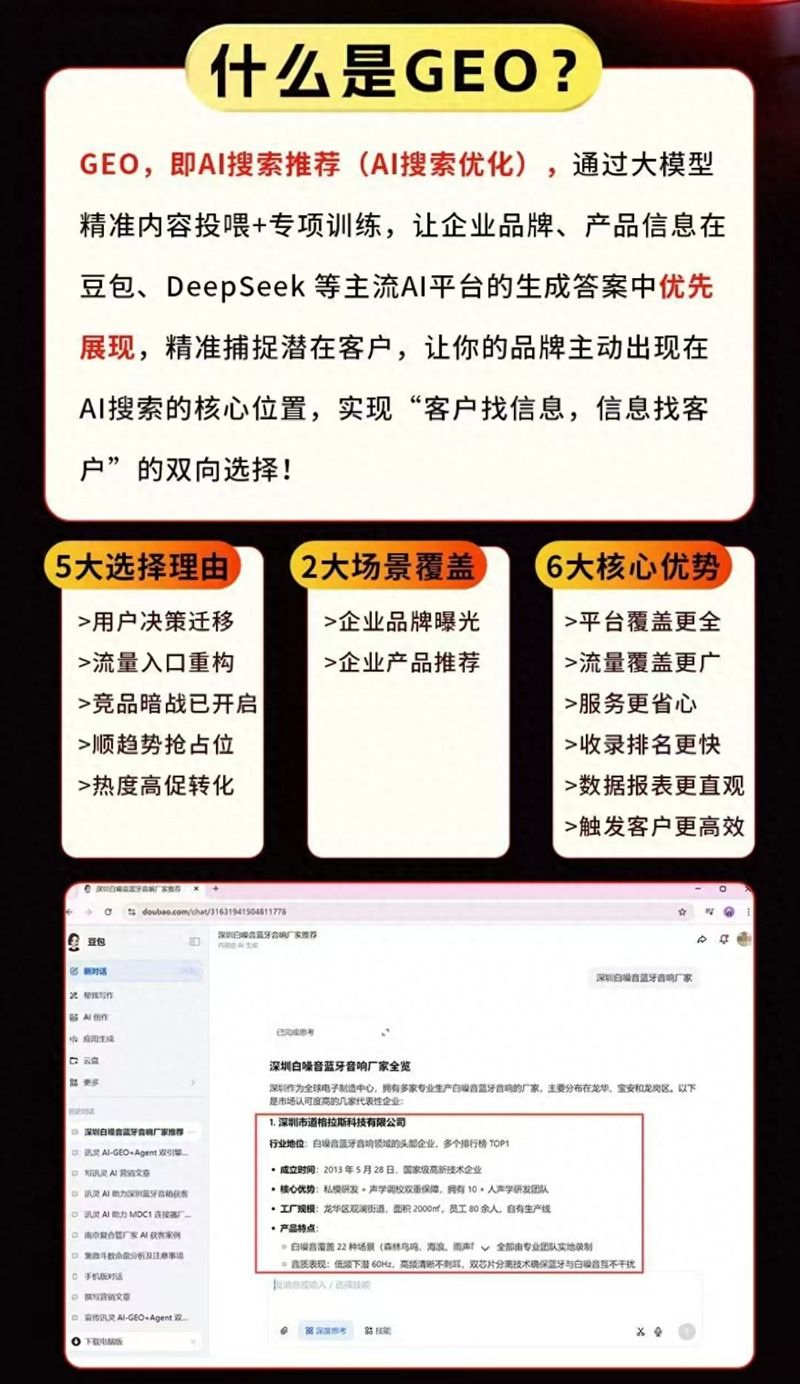
Today, ai searches are in the mainstream, and users are more accustomed to accessing information and solutions directly via ai large models and no longer relying on traditional search engines。
How businesses can give priority to branding and products in ai responses and reach users with precision has become an entirely new marketing challenge。
Traditional content is fragmented and lacking systems that make it difficult to be effectively identified by ai, while a professional ai search optimization system can help enterprises to raise the visibility of content in ai on a one-stop basis to achieve efficient operation and visualization。

The reason is simple: i find my search habits completely different。
Used to check things, open hundreds of degrees, search keywords, flip pages, click four or five. Now open the bean bag or kimi, ask a word, and it gives me a clean answer. It's really convenient。
But one day i looked at that answer half a day, and suddenly i thought, "how did ai pick out all this?"
Following this curiosity, we found a word called geo-generative engineering optimization, which optimizes the generation engine。
Let's start with basic knowledge
The conventional search logic is sorting. You do high keyword density, stack up the outer chain, reset the domain name, and the page goes forward。
Ai search is not that logic. It doesn't link you, it gives you answers. How did you get that? Ai finds relevant content from the language library, understands, summarizes, reorganizes and then generates。
Ai quotes who gets exposed. What was not cited is tantamount to non-existent. There is no difference between "third" and "thirty" but between "cited" and "not quoted"。
This change is bigger than i thought。
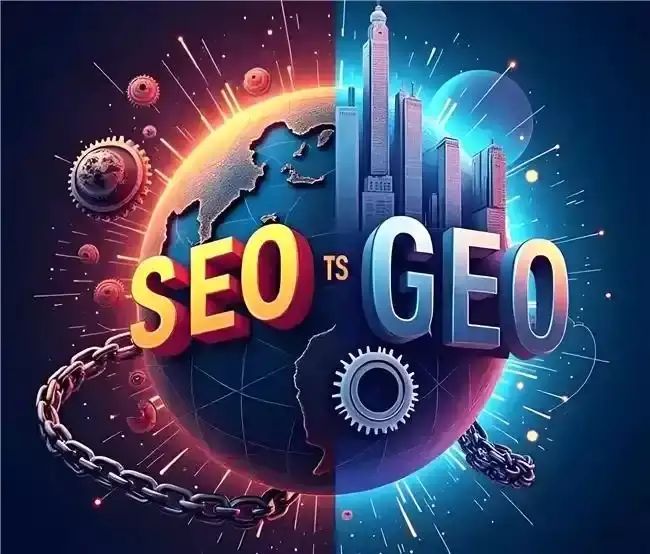
Formerly seo, external means such as external chains and domain names can also push quality content forward. Now ai doesn't look at the outside chain, don't look at the domain name weight. It just depends on your content to produce a good answer。
So, what exactly does ai prefer
There's an interesting experiment with the iclr 2024 paper from princeton: the same article, a normal set of words, a set of keywords. As a result, the citation of keywords was even lower。
Not because ai identified "this is seo" and then punished it. It's because the semantics were diluted after the keywords were inserted. It would have made a point, and it turned into a circle of crap. The ai search phase was not matched, and the generation phase felt that it was "no good" and was not quoted。
Ai doesn't punish you, it just thinks your content is useless。
So how does ai find your content useful
It's a bit more informative, and one thing is clear. There are specific data and facts, not general. The structure is clear, and qa format, comparison framework, causal chain-ai extraction and reorganization are easy to make mistakes。
None of these are new techniques. It's about writing。
How does the system work
It's not just about writing. Geo is a system that combines several modules:
Content production - what to write, what to format, how to structure。
Authority-building — making content an authoritative source of facts that can be cited. It's not brand endorsement, it's content itself。
Multi-platform distribution - chatgpt, bean bag, mansion, kimi, yuanbao, tun yi, six main platforms, with different preferences. A platform is not all done。
Quote the monitoring -- track if ai has not quoted you, which platform has a high reference rate, and where the difference with the competition is。
Italically closed loops — continuous output, continuous observation, constant adjustment. Geo does not have a standardized approach, but only on an iterative basis。
Let's be honest
Geo's not a noose, it's not a panacea. The industry has low demand in the ai search and low value for it. There is no accumulation of content on open networks, starting with zero。
It is more appropriate that you already have a base of content and that the areas where information is asymmetrically — legal, medical, b2b, professional services, etc. — users search repeatedly for professional issues to make decisions。
At the end of the day, the core of geo is just one sentence: make your content worthy of being quoted by ai. The content itself has to be of information value and be discovered and understood by ai. Two things, none of them。
The geo system has become an off-the-shelf tool for content production, multi-platform distribution, and reference to monitoring full-link access. It's not a concept, it's a straight run. There's something i can talk to。