A group of 2023 north division candidates has been set up, and students can contact the school assistant to obtain more detailed information。
“student in finance comes five ways, new media goes to the corner.”
Since the beginning of the year 2016, the university has grown at a faster pace than any other discipline; at the same time, as a school of 985 students in beijing, the northern division’s new entrance examination has been less difficult than the “chongbei”. Thus, for 985 students who are pursuing the resources of their schools or beijing cities, as well as for students who are keenly interested in the frontier areas of new online media, smart media, etc., it is a very high-priced option。
However, as the number of applicants increases year by year, the competitive pressure will not be small — as reflected in the high score line. This will require students who have recently completed their studies to take accurate stock of the focus and difficulties, using the syllabus of the institution, its reference book as the base, the institution's reality and its teacher's thesis as the guide, and consolidating basic knowledge while broadening the breadth of knowledge, excavating its depth and ploughing its ability to produce it。
One.
Introduction
Beijing teacher training universityEstablished in 1902 and sitting in beijing, beijing city, the former lycée of the École des hautes etudes, a prestigious institution with the basic subjects of teaching, education and literature as its main features, is the second-class, 985 and 211 projects, one of the first priorities of the nation's “seventy-five” “eightty-five” universities. The institute was elected to the everest programme, the plan 2011, the plan 111, the state programme for the construction of high-level university postgraduate studies, the national programme for innovative experiments for university students, and the chinese government scholarship for the admission of chinese students。
Two.
North division's new profile
The school of public information and communication of the beijing university of pedagogical education is the centrepiece of our research on innovation in the media, which has led to the interdisciplinary construction of news dissemination. The beijing school of journalism and communication is at the forefront of the development of the academic community and is committed to developing high-level and innovative media-wide talent with a forward-looking, tolerant and complex vision. The college highlights the cross-cutting nature of the disciplines and establishes a leading advantage in the many frontier cross-cutting areas of future media, communication impact measurement, cognitive neural communication, social media analysis, big data profiles, user experience, digital publishing, complex networks, etc. Efforts have been made to create a national think tank and to actively provide decision-making reference and advisory services to the party and to the government and all sectors of society。
The beijing teacher training university was one of the first six universities in the country to establish a major in editorial publishing. The history of the college dates back to the editorial and publishing profession created in 1993. In november 2014, in follow-up to the views of the ministry of public information and the ministry of education on the establishment of an information institute in the local party committees, in conjunction with higher education institutions, the beijing teacher training university, in cooperation with the illuminati newspaper, established an information and communication institute. Beijing teacher training university has made “circulation of journalism” a first-level subject of emphasis in school construction. The academy currently offers a variety of specializations in communications, journalism and publishing. It has established a multi-level information and communication training system from undergraduate to doctoral level. It has also been active in developing the academic orientation of marxist journalism, new media dissemination, communication impact analysis, media literacy education, digital publishing and cultural dissemination。
Iii.
Recruitment and re-testing

Four.
Tuition fees
School fees:
Suk-seok: $8,000/student — academic year
Full-time (full-time): 15,000 yuan/student — academic year (total of 30,000 in 2002)
2. Scholarships:
Basic grants: 60. 000/births — years
2) “three aid” post allowance: the full-time master's student allowance rate is 0. 8 million/year. The coverage of “three aid” is 80 per cent of full-time master's students in the school system and 100 per cent of full-time doctoral students in the school system。
3) scholarships: 100 per cent of students enrolled in the year. The first and second prizes are awarded at 40 per cent and 60 per cent of the current year's intake, respectively, for master's degree students; 15 per cent and 85 per cent of the current year's intake, respectively, are awarded for master's degree students; and the first prize is awarded only for the award of pension and exemption。
4. Scholarships for academic studies: scholarships for academic studies are awarded at the first, second and third levels at 40 per cent, 45 per cent and 12 per cent, respectively, for academic masters at 12,000, 10,000 and 6 million, respectively, and for professional masters at 40 per cent, 45 per cent and 13 per cent, respectively, at 10,000, 0. 8 million and 0. 6 million。
5) highlight results and reward contributions
6) special hardship fund
7. Scholarships and special scholarships at colleges (departments, departments)
In order to help you prepare for the north division more securely, more comprehensively and more effectively, xiaofu offered to launch the entire north division course this year, to prepare for you from the early stages of the study, to prepare for the study, and to carry out the scientific, efficient and methodical review, so as to make you more confident and confident
Five.
Number of persons reported
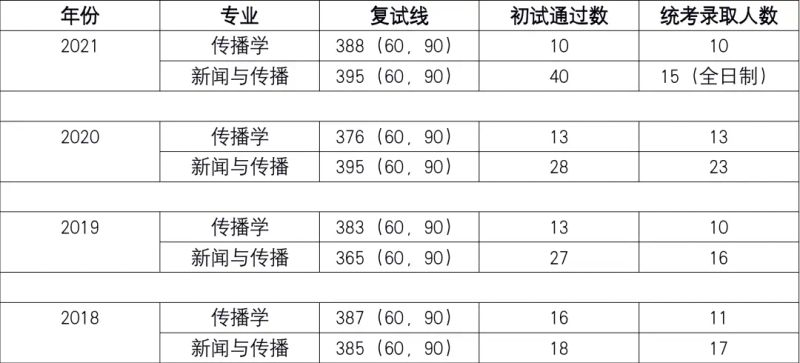
Six.
Vii.
Communication
The chinese people's university press
Ii. Theory of mass communication: patterns and genres here
3 milestones of the mass communication impact study
4. General remarks on internet dissemination by the chinese people's university press
5 new media users'study, people's university of china press, puntland
6 the academy of media economics, people's university of china press, anthropology
7 introduction to the new media online, people's post and telecommunications press, annihilating the state
8. Social research methods days
9 - all the papers published by the faculty mentors in the last five years (very important!)
Information and communications
The chinese people's university press
Ii. Theory of mass communication: patterns and genres here
3 milestones of the mass communication impact study
4. General remarks on internet dissemination by the chinese people's university press
5 new media users'study, people's university of china press, puntland
6 the academy of media economics, people's university of china press, anthropology
7 introduction to the new media online, people's post and telecommunications press, annihilating the state
8. Social research methods days
9th edition of journalism university press, 6th edition by li li liang win
10, "turn in time" by cao lin
11, "everyone is a product manager." electronic industry press, sujay. Here
12. Specialized periodicals such as press and communication research, university of journalism, international press, modern communications, journalist, press, etc., need to pay particular attention to the dissertations of university instructors
Viii.
College advantages
Post-graduate education is based on a “double mentorship” system for the academic community, focusing on the social practices and professional skills development of students. Close cooperation has been maintained with media organizations such as the people's daily, xinhua, daylight, central television, china publishing group, phoenix watch, music network, storm video, and others. Nearly 20 teaching practice bases have been established, with more than 30 media executives serving as part-time mentors outside the school。
2. Maintain academic relations with numerous academic institutions, both within and outside the country. To date, staff exchanges and cooperation have been established with information and communication schools in various countries and regions, including hong kong, japan, korea, north america, europe and australia, and international students have been selected for the world, short-term exchange students, etc。
Nine.
The real question of the calendar
2019. Learn 745
I. Explanation of terminology
1. Data news
2. Post-factor
Distribution of algorithms
4. Machine news
Ii. Brief answers
Comparison of vr ar mr characteristics
2. Relations between online public opinion and governance
3. How new media can reduce the “reverse of opinion”
Iii. Discussion
Problems and trends in the transformation of our traditional media in media integration。
2019 learn 938
I. Explanation of terminology
1. Opinions, lipman
2. Media reliance theory
3. Payment for knowledge
4. Cold and thermal media
Ii. Brief answers
1. What are the limits to internet privacy
2. Three-stage characteristics of communication effects
Iii. Discussion
1. Situation of artificial intelligence and media, challenges
2. The origin, change and development of agenda setting from the perspective of causal approaches
2019, specialized 334
I. Explanation of terminology
1. Investigation of public information
Digital capitalism
3. Parasocial linkages
4. Rooting theory
Ii. Theme of discussion
1. Transitional strategies for traditional media
2. Understanding free internet models
Comments
The heiress and wife guard the border
2019, specialty 440
I. Explanation of terminology
1. Internal thinking
2. The influential economy
3. Communication systems
Ii. Brief description
Brief description of the phenomenon of “environmental environmentalization of information”
2. Brief description of the characteristics and role of media events
Iii. Discussion
To discuss your understanding of the “information cocoon” in the context of reality
To talk about your understanding of algorithmic news in the context of reality
2020, learn 723
I. Explanation of terminology (4*10)
1. Popular production
2. Block chains
3. Cultural discounts
4. Public goods
Brief answers (4*15)
1. What are the dimensions of change and development in china's media industry。
2. Distinction and communication between the information cocoon room, filtering bubbles, echo room
3. Mobility is a feature of modern society. To describe consumer behaviour among audiences
4. What is “public information practice”
Topics (50 minutes)
Materials: 1. 25. Please share your understanding of “the whole-way media, holographic media, plenipotentiary media, full-time media” in relation to practice。
2020 829
Explanation of terminology (5*6)
1 frankfurt school
2 content analysis method
3. Media hegemony
Four social robots
5 media credibility
Brief answers (3*20)
1 on the relationship between agenda setting and framework theory
2 to share your views on digital publishing from the point of view of human publishing
What is mcluhan's view of the new medium? Presentation of views in relation to media practice
Iii. Concluding issues (2*30)
1 in combination with examples, convince theory and development and use in mass media。
2 in the social media age, talk about mass communication, organizational communication, interpersonal communication
2020 specialized 334
I. Information (1*30)
Civilian police officers were dismissed and replaced by briefings. Write 500 words
Comments (1*40)
Rural electrician live sales, county electrician platforms and postal cooperation to open new routes to poverty alleviation
Topics (2*40)
1. To address awareness of media trials in social media settings, in combination with examples
2. On the impact of short videos such as tremors on adolescent development
2020 specialized 440
I. Explanation of terminology (3*10)
1. Third-party effects
2. Digital divide
3. Post-facture
Brief answers (2*20)
1. Changes under new media for agenda setting
Ii. Steps of context analysis
Iii. Concluding issues (2*40)
1. Opportunities and challenges for media under the block chain
The role of mainstream media in shaping public opinion
2021 learn 723
I. Explanation of terminology
Platform media
The economy of influence
Data hegemony
Algorithm recommended
Ii. Brief answers
1. Please describe briefly the changes made by 5g technology to the dissemination landscape。
Please describe briefly how you understand the post-factor。
Iii. Concluding issues
1. The re-engineering of social rules and business empowerment from a media-based perspective。
2. What are the difficulties and operational keys to communication governance in the post-empidemic era。
2021 learn 829
I. Explanation of terminology
Noun interpretation (40 minutes)
1. Symbolic interactiveism
Digital publishing
3. Smart transmission
4. Gap of faith
Ii. Brief answers
1. Empirical and critical characteristics
2. Theoretical development based on the agenda, describing relevant research from the media agenda to the public agenda
Iii. Concluding issues
1. Putting people's theories into practice and theory in the age of intelligent media and discussing their values
2. Challenges posed by the big data age for quantitative and qualitative research in communication
2021 specialized 334
I. Explanation of terms (5 minutes 5)
1. Media trials
2. Data news
Topics for discussion (35 minutes 2)
1. Why the effects of mass communication are uncertain
2. Ethical dilemmas and responses to data news