Revised guidelines for the conservation of road bridges
(hereinafter referred to as the norms)
To be implemented as of 1 november 2021
What are the main amendments made this time?
What issues need attention in implementation?
Here we go
1. Why amend the norms?

Since its promulgation in 2004, the former code has played an important role in adapting to the rapid development of road construction in the country, regulating and guiding the inspection and evaluation of road bridges and carrying out conservation management, such as maintenance and strengthening. As our transport industry flourishes, the number of domestic road bridges has grown rapidly, the maintenance of bridges, especially large bridges, has become more complex and difficult to maintain, and the former code has become difficult to adapt to conservation needs. The criteria for assessing the technical status of road bridges (jttg/th21-2011), which were also issued in 2011, are quantified by the type of bridge components, with new requirements for the distribution of weights and integrated assessment methods for the various components of the bridge. To that end, the ministry of transport organized and completed the revision of the code。
What are the main amendments?
The code amends the content of bridge inspections and assessment, conservation and maintenance, disaster prevention and recovery, and technical requirements; new technical regulations are required in accordance with policy requirements. The main amendments include:
In the inspection and evaluation of bridges, the level of conservation inspection is determined by the size and importance of the bridge. (c) refine the requirements for inspection of bridges, adapt to different conservation needs, and implement differential conservation inspections and frequency of inspections to serve as a rational allocation of conservation resources. (c) guide conservation work arrangements such as bridge inspections, testing cycles and conservation resource inputs, following the principle of “ensure focus, maintain generality and differentiate”。
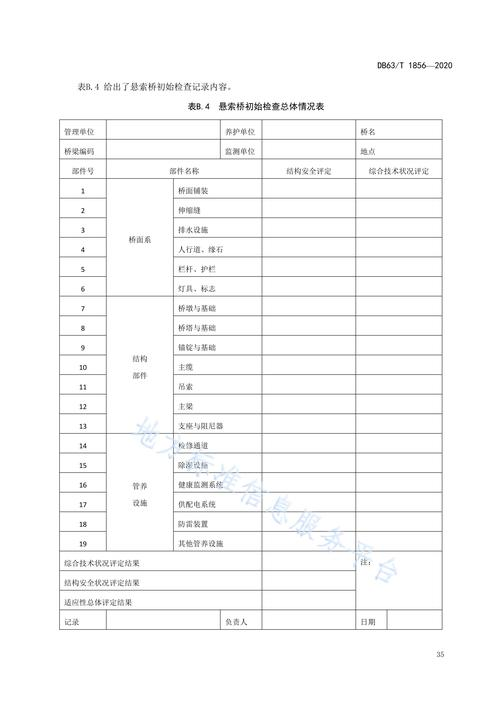
The bridge inspection category was refined and added. Initial inspections and routine inspections have been added to the categories of inspections and the content and requirements for inspections have been defined. It was clarified that the purpose of the initial inspection was to collect basic state data on the bridge and to be the basis for its later maintenance; the purpose of daily patrols is to obtain timely information on the operation of the bridge structure and to enable timely maintenance or emergency treatment in the event of initial or sudden illness of the bridge. Underwater testing is included in special inspections, which specify the content, requirements and timing of the work and the frequency of inspections。

Clear conservation objectives, enriching the technical aspects of conservation across vast and technically complex bridges. Increased inspection projects and requirements for steel bridges, concrete arch bridges for steel pipelines, ramps and suspension bridges; improvement of permanent observation site requirements for technically complex bridges and implementation of structural health monitoring requirements; the conditions and specific technical indicators for replacement components of bridges such as lassos, cranes, etc. Were identified; the technical requirements for maintenance and repair of complex technical bridges such as steel structure preservation, suspension cords and slide control measures were updated。
The technical classification of bridges and the strengthening of bridges in the original norm were eliminated. The current criteria for the assessment of the technical status of road bridges (jttg/th21-2011) specify in detail the methodology and criteria for the evaluation of the technical status of bridges. In order to avoid duplication, the relevant elements of the general assessment in the original norm were removed and a hierarchy and status description of bridges of 1 to 5 were retained. (c) remove the content of the original norm for strengthening bridges and incorporate it into relevant standard norms such as the road bridge strengthening design code。
Relevant elements of common disaster management and repair were added. (c) the addition of disaster prevention components such as earthquakes, fires, ship and drifter impacts and landslides, based on research and validation of recent frequent road and bridge disasters; the assessment criteria for flood resistance have been refined and additional measures have been taken to prevent and combat frozen disasters such as ice-covered bridges and frozen thaws. There are clear requirements and provisions in three areas: disaster prevention, emergency response in the disaster process, and post-disaster rehabilitation。
In line with the concept of “preventiveness, prevention and integration”, the concept of preventive conservation is integrated throughout the chapters and complements the relevant elements of durable conservation. In particular, in the context of regular and special inspection of bridges, specific screening requirements and requirements for inspection of common bridges on highways and bridges, combined with commonly used, generally accepted and largely mature detection methods and detection techniques at home and abroad, are put in place to ensure that the disease and safety of bridges are promptly detected and treated。
The emphasis on information technology applications complements information-based management elements such as bridge health monitoring, database management and electronic archives. Science-based decision-making for the management of bridge content conservation was proposed, based on a bridge content database, building an information platform for bridge content conservation, establishing a dynamic system of evaluation and early warning. Promotion of digital and intelligent road infrastructure maintenance。
3. What should be taken into account when implementing them?
Use in conjunction with relevant norms. Bridge maintenance is comprehensive and involves structural design, construction processes, material performance, detection techniques, evaluation methods, acceptance criteria, use of the environment, meteorology and geology. The use of the norms should be accompanied by relevant norms, standards, such as chapter iii, which should be accompanied by criteria for assessing the technical status of the road bridge, the assessment protocol for the assessment of the carrying capacity of the road bridge, the test protocol for the loading of the road bridge, the technical protocol for the safety monitoring system for the structure of the road bridge and the design specifications for the related bridge; chapter iv should be used in conjunction with national standards such as the technical instructions for construction of road bridges, first book of civil works for quality assessment of road conservation works; chapter v should be used in conjunction with norms such as the code for hydrography design of road engineering, the code for the design of road bridges and earthquake resistance, the code for the design of road bridges and bridges and the rules for the evaluation of their earthquake resilience。
Research on the reliability of new technologies for the maintenance of bridges. With the development of technologies such as bridge inspection, maintenance of reinforced materials and processes, reliability studies of new technologies and products should be strengthened, and advanced inspection equipment, conservation techniques and scientific management methods should be actively and safely employed。
Promote scientific decision-making on the conservation of bridges. (b) actively carry out analytical and analytical collation of scientific decision-making for the conservation of the bridge, considering combining the technical status of the bridge component with the model for the degradation of the component and the role of the environment, and using the state of the technology as a quantitative assessment indicator of the degradation of the bridge component to guide the scientific implementation of conservation prevention and restoration. And to build up relevant technical and management experience for the timely incorporation of standard norms。
Carefully organized orientation training. Given that the code is an important technical norm that guides the maintenance of the road bridge, there is a need for more consistent training, especially for first-line bridge keepers, with a view to properly understanding and making use of the code. It is also recommended that the use of the norms be tracked and further collected for use in the revision process。