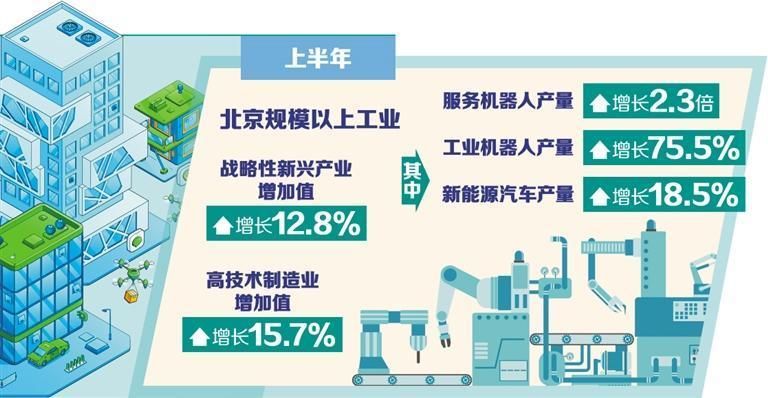
In the first half of this year, beijing achieved a regional gross product (GDP) of 264. 119 billion yuan, representing an increase of 5. 4 per cent in constant prices over the same period, a decline from 5. 9 per cent in the first quarter. Although the rate of increase has declined slightly, a set of structural data is particularly striking: the accelerated growth of new qualitative productivity in beijing in the first half of the year, with increases of 12. 8 per cent and 15. 7 per cent, respectively, in strategic and new industries above scale and in high-technology manufacturing。
New quality productivity is growing at a rate far above the economy, and where does the “new force” of the beijing economy come from
“the rate of economic growth has fallen, but the fundamentals of stability to the better have not changed, and the overall performance of the economy has remained reasonable.” zhang zheng, deputy director of the beijing development and reform commission, said that, since the beginning of the year, beijing had issued an orderly “fifty-five” plan and a series of city-level special projects to promote economic stability through integrated implementation of a series of measures, including 24 measures, to promote economic stability. The second quarter was smooth and maintained a new and positive trend. At the same time, general public budget revenues increased by 6 per cent in the first half of the year, tax revenues accounted for 89. 3 per cent and remained at the best level in the country。
Wang jiu ling, chief of the integrated division of the beijing development and reform commission, stated that the rate of increase of 0. 5 percentage points had fallen, and that the pace had changed more than the trend. Both the natural regression factors that led to the start of the “155” year and the pressure on aggregate growth during the conversion of old and new kinetic energy are generally consistent with economic patterns and reflect the realities of beijing。
The economy is supported by growing industrial resilience. In the first half of the year, the total value of agricultural, forestry and fisheries production in beijing was rmb 10. 21 billion, representing an increase of 3. 8 per cent in comparable prices, 3. 4 per cent in value added by industries above scale and 6. 1 per cent in constant prices。
Strategic and new industries and high-technology manufacturing have become the twin engines of industrial growth in beijing, where production of services robots, industrial robots, new energy vehicles and integrated circuits have increased 2. 3 times, 75. 5 per cent, 18. 5 per cent and 17. 8 per cent, respectively。
The demand side also presents a “new” feature. In the first half of the year, investment in fixed assets (excluding farmers) in beijing increased by 3 per cent over the same period, with 14. 3 per cent in the acquisition of equipment, and internet technology enterprises playing a significant catalytic role。
In the area of consumption, despite a 2. 2 per cent decline in total retail sales of social consumer goods in the first half of the year, service consumption has continued to grow at a relatively rapid rate, leading to 4. 5 per cent growth over the same period in areas such as information, transport and so forth, and the consumption structure continues to optimize。
Private investment is becoming an important force in nurturing new dynamics. In recent years, the city of beijing has continued to promote major projects aimed at private capital, expanding the space for private investment participation, improving the accessibility of private capital participation and directing more social capital towards new quality productivity. In the first half of this year, private investment in key industries such as manufacturing, information and software services, science and technology services, and leasing business services increased by about 1. 5 times over the same period, and contributed significantly to the optimization of the city-wide investment structure and the upgrading of industries。
Looking ahead to the second half of the year, the beijing economy is still supported by multiple factors. Zhang zhang indicated that with the further integration of the arts and industry, new consumption patterns, new patterns and scenes continue to emerge and heat up during summer tours and in-country trips, the recovery is expected to accelerate further. At the same time, investment benefits will continue to be released as major projects of the “fifty-five” move forward, such as the “six nets” and urban renewal projects accelerate their planning。
At the consumer level, beijing will further optimize the scope of the old-for-new policy and accelerate the cultivation of new growth points in service consumption; and cultural events such as the chinese tennis public competition, the wtt brands, and the momoka prizes will link up with more consumer scenes and further magnify the “vote economy”-led effect. At the same time, beijing has accelerated the construction of new areas for the dynamism of cities in the north-west and north-west, promoting the transformation and opening of the main olympic towers, continuously optimizing consumer services and stimulating consumer markets。
At the investment level, beijing will continue its efforts around the focus areas of “good house building” and urban renewal, researching version 2. 0 of the urban renewal policy toolbox and launching major new projects for private capital。
At the industry level, beijing will work with the “six-six-six-six-six” to deepen kyojin's collaboration, accelerate the deployment of integrated circuits, medical innovations, etc., and promote the marketing of more beijing-based intellectual products. At the same time, beijing will promote the expansion of the cross-border operations of professional services enterprises and the acceleration of the upgrading of modern services, based on platforms such as the north china exchange and the world trade organization。
According to zhu yannan, member and deputy director of the beijing city bureau of statistics, the economy in beijing in the first half of the year has moved towards excellence, with strong support for niche industries and accelerated growth of new quality productivity, but still faces challenges such as a complex external environment and the division of domestic supply and demand. “in the second half of the year, it will be necessary to maintain a steady pace of progress and improve efficiency, to develop the potential of demand on a sustainable basis, to boost internal dynamics, to boost the dynamism of development and to promote a smooth and healthy economy.” zhu yannan says