Summary
There have been frequent incidents of fire caused by irregular electricity use in student dormitories in higher schools, and traditional manual patrols and widespread power-restriction models have made it difficult to effectively identify such circumventions as malign loads and restricted electrical outlets. This paper analyses the current reality of electricity control in dormitories, describes in a systematic manner the core functions and selection elements of the smart control system, and provides an operational technical selection reference for logistics。
I. Electricity security in tertiary dormitories: a real challenge that cannot be ignored
In recent years, the security of electricity use in dormitories has increased with the expansion of higher education and the increase in the variety of appliances available to students. The student dormitories are heavily staffed and power-intensive, and in the event of an electrical fire, the consequences are not conceivable. According to the department of fire and rescue of the ministry of emergency management, hundreds of school fires were reported throughout the country in 2023, with more than 60 per cent of student dormitories and electrical failure being one of the main causes of fires。
The incident in the press is alarming. In one university dormitory, students use irregular electric heat blankets at night, the line overheated burning beds are laid, causing inhalive damage to many students; in another institution, students leave the site using “quick” water burning in the dormitory, when the water is dried up and the heat pipe burst to ignite the surroundings, causing the entire dormitory to burn. The common cause of these incidents is the use of power-intensive appliances for violations。
The risk of being more subtle comes from the spread of “anti-power” behaviour. Some students try to defraud traditional power-restrictive devices by changing the current wave shape through their capacitors or diodes in order to circumvent the power limits of the dormitory. However, instead of actually reducing the risk of fire, such equipment would perpetuate the irregular load of the lines and place more serious security risks. A case was reported by the fire department in a certain area where students were using the “limit-proof electrical plug” to connect to the electric rice pane, where the inner part of the slot was struck through a short circuit, producing a high temperature arc at short intervals and fortunately discovered in time by their fellow students in the dormitory。
In addition to the misuse of electricity per se, the lack of capacity to carry older lines is also a prominent problem. Some tertiary dormitories were built earlier, with low line design standards, and air conditioning and fans were activated in the summer and multiple heating units were used during the winter, with a high risk of triggering jumps, with frequent electrical current shocks accelerating the ageing of the insulation of the lines and increasing the risk of leakage and short circuits。
The above-mentioned problems show that electricity management in higher education dormitories is no longer a simple “lock limit”. Contradictions between students ' rational use of electricity demand and safety management requirements, the hidden nature of irregular use of electricity and the delayed nature of manual inspections all place greater demands on the means of regulation。
Ii. Limitations and dilemmas of traditional patterns of electricity management
In the face of the increasing complexity of the electricity scene in dormitories, the traditional management model revealed systemic deficiencies, mainly in four areas。
2. 1 manual inspection of space-time-blind areas
While most higher education institutions continue to use regular residential staff patrols and student raids as the main means, the frequency of inspections is limited and their coverage is incomplete, and irregular use of electricity often occurs during periods of time between patrols or at night. Logistics managers have reported that students hide irregular appliances during bedding searches, remove them immediately after bedding, and that the “cat-and-rat game” continues for a long period of time, with a significant underperformance. The passivity and inefficiency of manual patrols make it difficult to establish a continuous and effective constraint on the use of electricity。
2. 2 traditional electricity-limiting technologies are easily bypassed
The early “total power limit” programme, which was widely used, is simple in logic: the total power of the dormitories exceeds the established threshold, i. E., jump. However, this technological tool is clearly short-set. On the one hand, the normal use of several low-power appliances (e. G., multiple computers operating simultaneously) may also result in total power excesses, leading to “wrong injury” in compliance with electrical behaviour; on the other hand, against this logic, various “limit-proof electrical outlets” have emerged on the market, changing current waves by technical means or diverting them instantaneously, thus preventing traditional power-limiting devices from accurately judging actual loads and thus circumventing restrictions. This means that the old technology defense is failing in the face of the “technology confrontation” of students。
2. 3 fault response and low regeneration efficiency
Under the traditional pattern, when a dormitory jumps because of overloading or the use of an irregular electrical device, the retrenching process is usually the following: students report to a single electrician to check the door to confirm that the lock is safe. This process tends to take hours or even span days, especially during night or holidays, and is less responsive. Frequent jumps and long waiting times for back-up not only affect the normal lives of students but also increase the workload and management costs of the logistics sector. Students are dissatisfied with the slow recovery of electricity, and managers are tired of dealing with similar problems over and over again。
2. 4 lack of data on electricity use and lack of evidence for management
Traditional meters are mostly mechanical or simple electronic forms that measure total electricity use, do not record details of electricity use over time, do not identify load types, and do not distinguish between normal and unusual electricity use. There is a lack of data support for energy-saving management in the logistics sector and a lack of judgement when conducting electrical safety analyses. When electricity costs are in an abnormally disputed situation, there is no detailed breakdown of electricity available for inspection and the information asymmetry between students and management is further exacerbated。
These limitations suggest that it has become difficult to adapt to real needs to follow the many-year management model. There is an urgent need for electricity control in higher education dormitories to move from “blowing restrictions” to “precisional identification”, from “ex post facto disposal” to “prior warning” and from “manual management” to “smart control”。
Core functionality and selection features of the electrical control system for dormitories
The electrical control system for dormitories is an integrated management platform supported by smart meters, physical networking and data analysis techniques. A mature and reliable system should build the following core functional modules around the three main lines of “security recognition, smart control, data drive”。
3. 1 malignant load identification: core technical capability
Malignant load recognition is the technical core of the entire system and a key indicator of the advantages and disadvantages of different manufacturers. The method of work is that the system analyses current, voltage wave-form characteristics in circuits through high-frequency sampling, determines the type of load - the resistance of computers, table lamps, chargers, and power power source type equipment, which is smooth and smooth, while pure resistance heat-generation appliances, such as electric heat blankets, fast heat and cooking, have specific phase and malformation characteristics for the instantaneous and steady operation。
A truly mature identification programme should have the following capabilities:
Precision identification: the ability to remove the non-compliant electrical feature from the mixed load can be judged accurately even if it runs in conjunction with other equipment。
Anti-crystalization: the means of deception (e. G. Semi-wave contours of the diodes, equivalent for the transfer of the capacity) against the various types of “protected electrical outlets” on the market have wave-shaped characteristics that are not physically bypassed。
Thresholds can be adjusted: different schools and dormitories can independently set identification sensitivity and power outage strategies based on line capacity and management policy。
3. 2 power limitation and overload protection
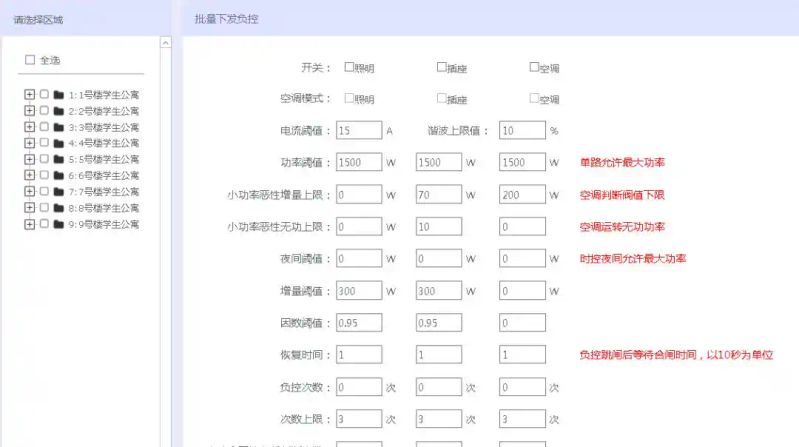
The system should support multi-level power limitation strategies, including total power limits for single dormitories, one-way power limits, and dynamic power limits for different time periods. For example, the non-rest periods allow total power not exceeding 2000w and are limited to 800w after the lights are out, guaranteeing regular use by students of equipment such as computers, fans, etc., while effectively limiting the use space for high-power irregular appliances。
Overload protection strategies should include the following elements:
Delayed judgement: avoiding an air-conditioning compressor start-up, multiple lamps opening at the same time, etc。
Rating response: a minor overload can be preceded by an early warning reminder, a serious overload or continuous overload, followed by a power outage。
Automatic recovery mechanisms: occasional jumps due to reasonable reasons, and the system should automatically restore the power supply and reduce the frequency of calls once it has been secured。
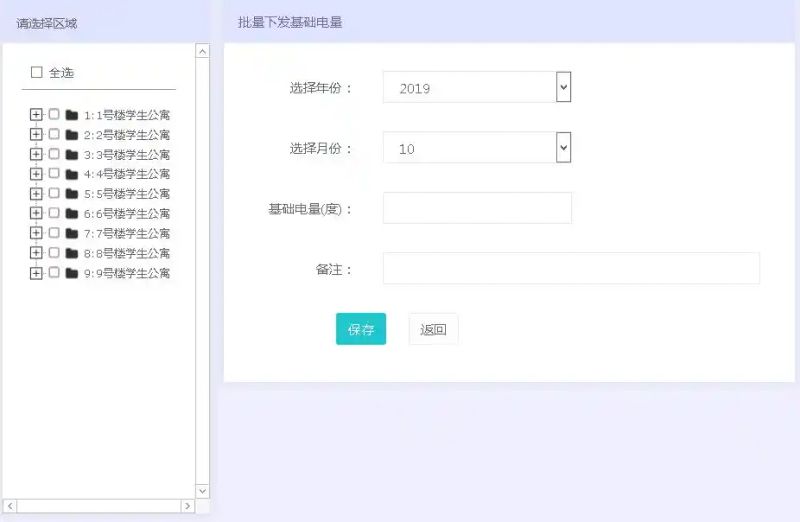
3. 3 remote control and volume management
Through the backstage of the system or the mobile app, managers can:
Remote partitioning: a power delivery, power outage, emergency response or interest management for individual or bulk dormitories。
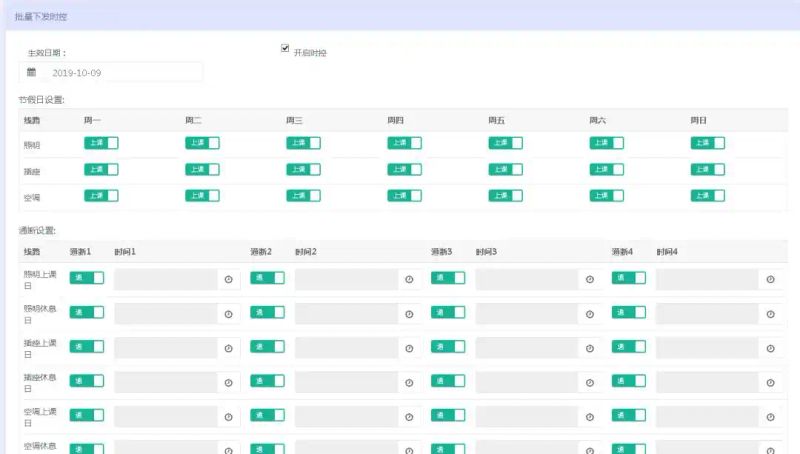
Timed tasks: set up power outage plans that vary from workdays to weekends, such as a 2300 uniform blackout, restoration of power supply at 6 p. M. The following day, with flexibility for holidays。
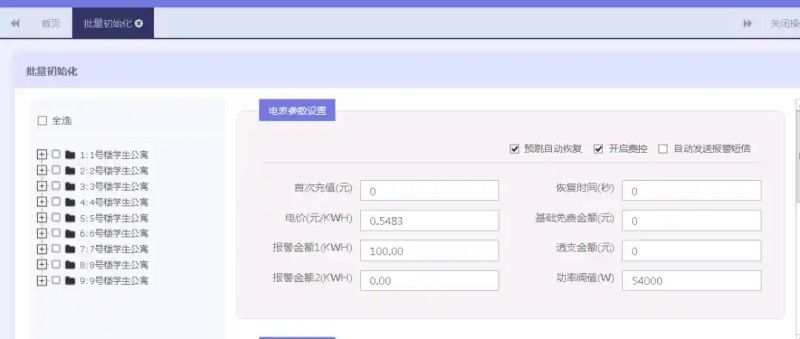
Batch parameters are distributed: batch changes to meter parameters for the new school year, bulk refunds for the graduation year, significantly improving management efficiency。
3. 4 real-time monitoring and unusual alarms
The system should have a 7x24-hour real-time monitoring capability, with dimensions including voltage, current, power, power factor, leak, surface temperature, etc. When an anomaly is detected, the system should be able to send a warning to the manager (sms, app push, rear window, etc.), at least for the following types of alarm: malign load recognition trigger, ultrapower operation, leak over-platform, meter failure, communication interruption, etc。
The alert information should include a specific dormitory number, time of occurrence, type of anomaly, real-time data interdiction to facilitate quick judgement and disposal by managers。
3. 5 data statistics and electricity analysis
Data capacity is key to upgrading the system from a “tool” to a “manager”. The system should provide:
Electro-light queries: students can view their dormitories on a day-to-day, monthly basis to reduce the amount of electricity in dispute。
Energy-consumption statements can be exported from the logistics department for energy-saving analysis and performance appraisals for buildings, grades and time periods。
Anomalous behaviour analysis: the system provides reference for precision inspection by managers by identifying, through data analysis, high frequency irregular accommodations, regular abnormal use of electrical time。
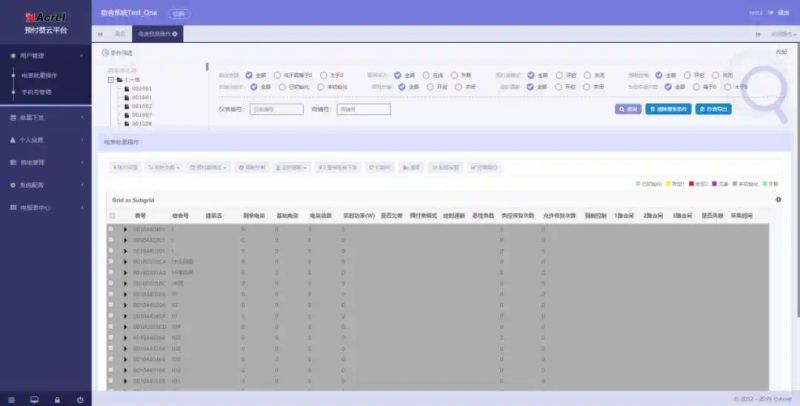
3. 6 system interface and compatibility
The electricity control system for dormitories does not operate in isolation and needs to be linked to the information system available on campus:
A cartoon/finance system: realization of self-charges for electricity, balance queries, refund settlements。
The system of study and engineering: synchronizes the intake of new students, the transfer of dormitories, the departure of graduates and the automatic updating of electricity accounts。
Rehabilitation system: an electrical failure can produce a reporter's order to form a disposal ring。
In the selection process, it was suggested to focus on the following dimensions: the accuracy of the identification algorithm and the ability to prevent break-ups; the stability of the system under a high-confluence scenario (e. G., centralized charge for the start of the school year); whether the manufacturer provided a standard application interface for docking; and the response mechanism for after-sales services. It is recommended that the validation be carried out through a field visit to the landed project to understand the operational effectiveness of the system。
Iv. Equipment management solutions for sustainable equipment in ankori studies
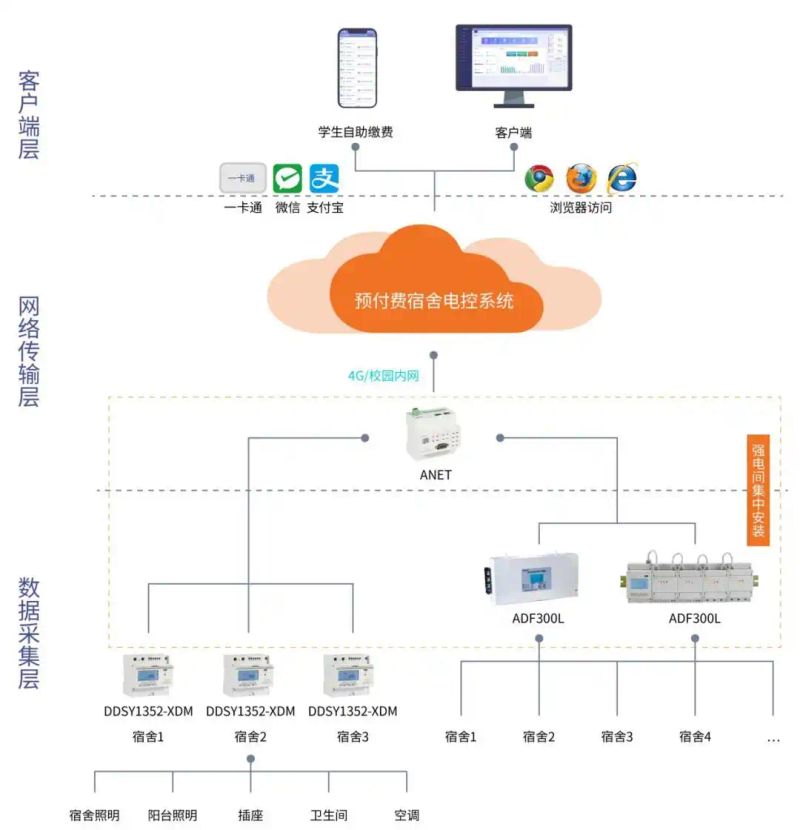
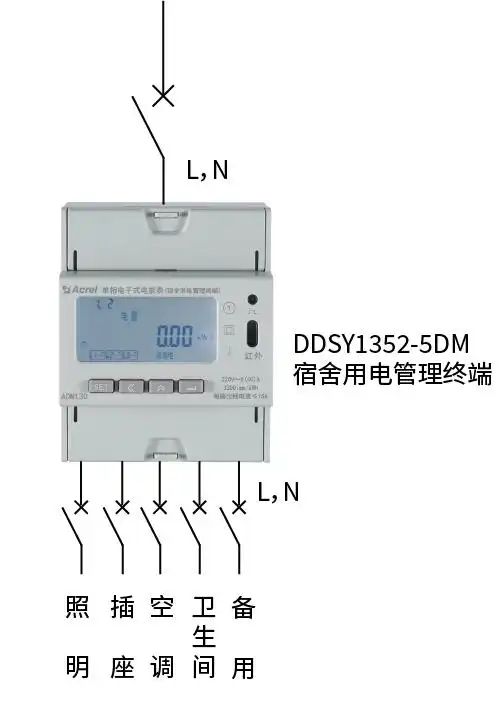
4. 1 ddsy 1352-xdm electrical management terminal for student dormitories
The electrical management terminal ddsy 1352-xdm in the ankorian student dormitories can successfully address the management of electricity in the tertiary dormitories, including:
1 in and out: can be divided into three to five lighting/plugs/air-conditioning/shelter/back-up, five separate controls, separate measurements, separate settings
(b) malignant load control: aggravating load recognition, automatic identification of all types of illegal electrical appliances (e. G., fast heat, electric venting, electric heat blankets, warm handbreads, etc.), automatic power outages, automatic recovery, number of recoverys available, electrical white list management
3 fee control: the default fee control model, which, when activated, jumps automatically when the remaining and basic free amounts are exhausted
4 basic free electricity: a certain amount of free electricity may be provided to students in dormitories on the basis of school management requirements
(b) interest management: the setting of holidays, break time for working days, and a maximum of 8 segments of the period to control the accommodation。
6 power limit: a separate power limit can be set for each road exit circuit to limit the electrical power of this circuit access, exceeding the automatic power cut
7. Small night currents: small night currents in dormitories may be installed, mobile phones may be charged or lighted at night
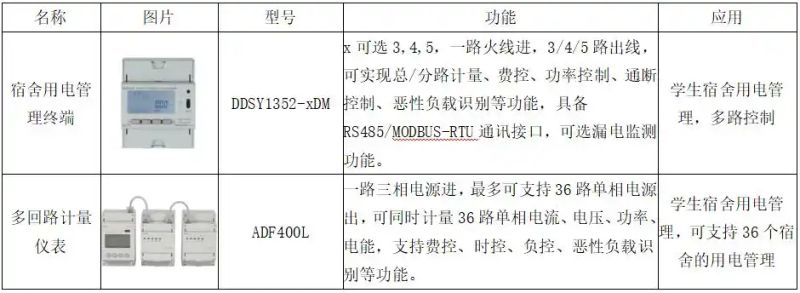
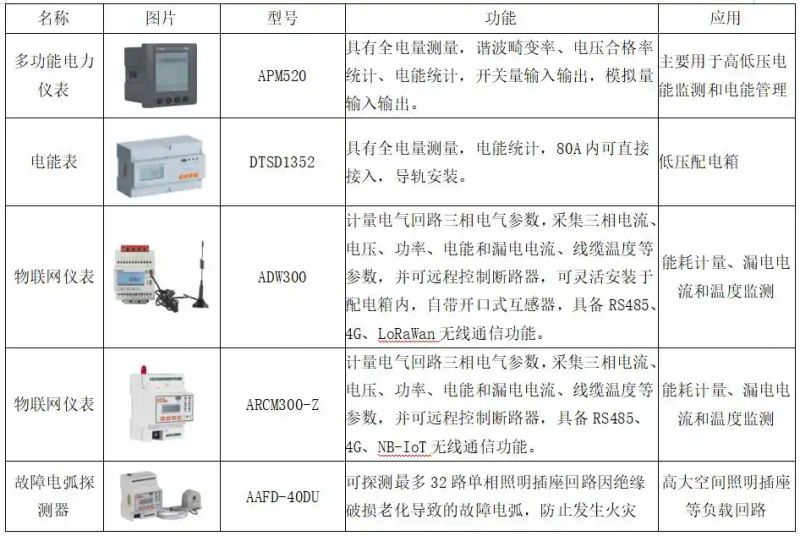
4. 2 school safe electricity monitoring and energy consumption measurement systems
Angoré provides multifunctional meters and network meters with energy consumption and electrical safety monitoring functions, helps schools build a three-tier measurement system, online monitoring and early warning for school energy consumption management and electrical safety, and provides data support for school energy conservation and fire safety。
4. 3 electro-intellectually supervised platform design for universities
The acreleems-edu campus smart energy management platform in ancorre integrates the overall power use of high school classrooms, dormitories, libraries, etc. The platform designed a complete energy measurement system for the campus, with the following four levels:
The main task of this level is to collect electrical data for the various buildings of the school, including student dormitories, school buildings, libraries, etc., to install specific electrical energy management meters at different sites and to assist in the electrical management function while completing the energy data collection。
Network transfer layer: the main task of the layer is to transmit the collected data to the platform, which can be transmitted through wireless transmissions such as lo rawan/4g/wifi or campus local area networks, dedicated fibre-optics, etc。
Data-processing layer: the main task of the layer is to process the data collected, including data cleansing, abnormality detection, electrical behaviour analysis, etc., and to process data through techniques such as cloud computing, big data, etc。
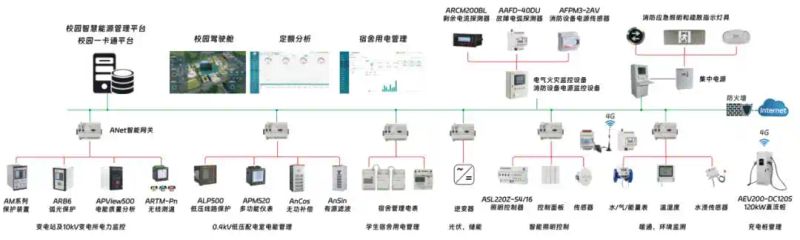
Acrelems-edu campus smart energy management platform architecture
Application layer: the main task of this layer is to apply processed data to the actual scenes, including electrical surveillance, security early warning, energy consumption management, lighting control, energy strategy control, equipment transport, etc., and to achieve various functional applications through access to platform data by web or mobile phone app. The entire architecture was designed to take into account such factors as the scalability, stability and security of the platform and to ensure that it met the need for electricity regulation in tertiary dormitories。
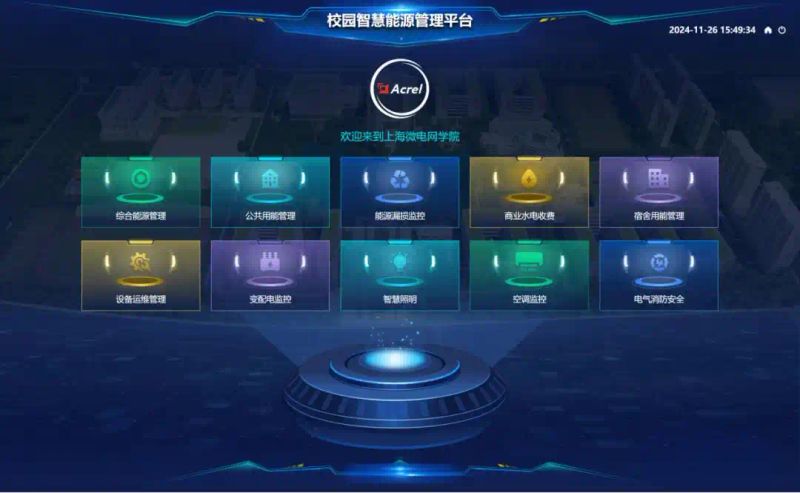
Acrelems-edu campus smart energy management platform master noodles
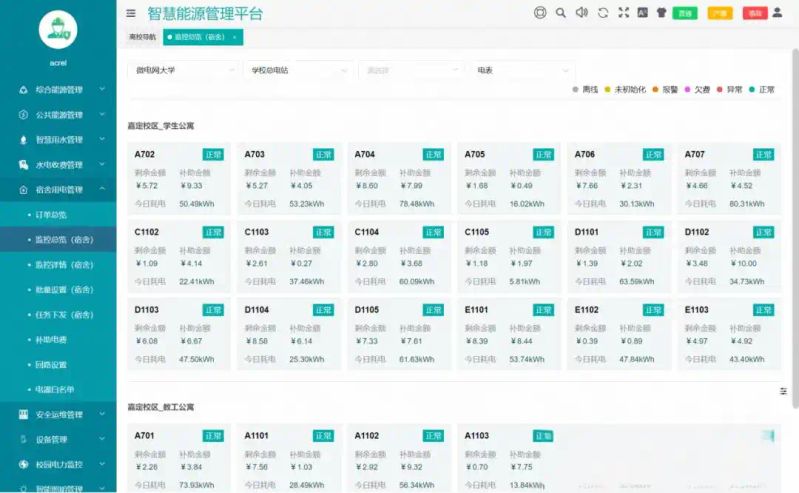
Electricity management for student dormitories at the acreems-edu campus
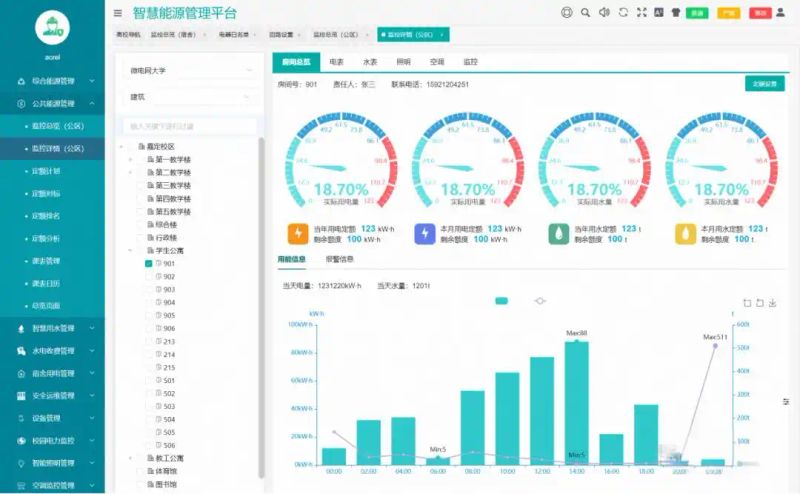
Acrelems-edu campus public monitor