Vehicle maintenance is performed regularly and on time, and the vehicle generally works well. In selecting second-hand vehicles, preservation records are an important basis for assessing the real value of the vehicles. By looking at the wip records, the owner is able to obtain information about the vehicle's past maintenance, and the replacement time and mileage of components such as oil, filters and spark plugs are clear. This allows the owner to make an accurate assessment of the physical condition of the vehicle. In the event of a delay in maintenance or a slippage in the project, the owner may take timely measures to prevent potential malfunctions, avoid malfunctions in the movement of the vehicle and ensure the safety of the vehicle。

Share three ways to search for preservation records
I. Query through 4s
In general, 4s will have complete vehicle files for each owner, which will include details of maintenance records, maintenance time and replacement spare parts. You can find the vehicle's maintenance records only if you provide information on the vehicle to the 4s store, such as the frame number, license plate number, etc。
Ii. The use of a third party query platform

Today, vehicle protection records can be checked on a micro-intelligence sub-program。
All you need to do is open a micro-letter, search a micro-trust applet, enter a micro-channel, choose a [vehicle maintenance record] query, upload a pass or enter a frame number. A special reminder is the need to check the frame numbers carefully to ensure that the information is accurate。
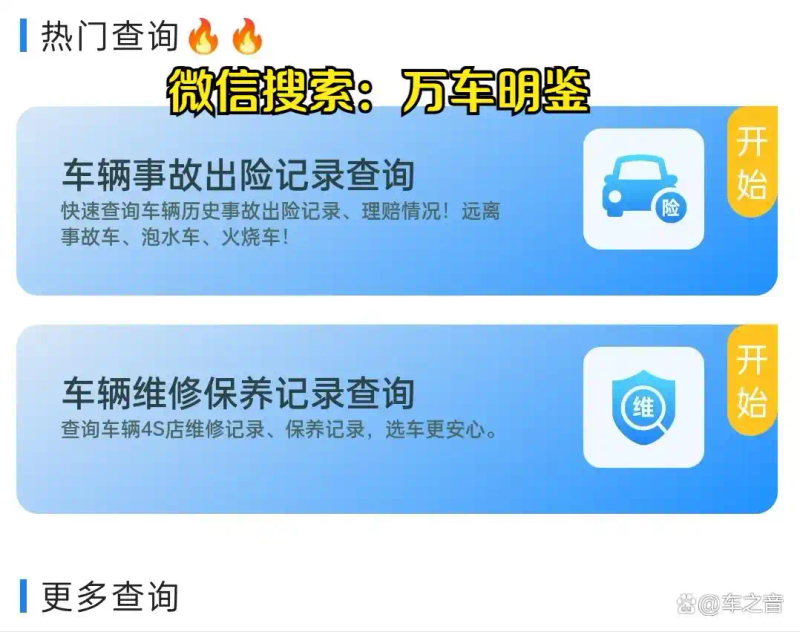
A search can also be made through a micro-intelligence public sign that focuses on the [one-size-fits-all] approach. In addition to this, we can also check micro-psychological or public numbers: vehicle accident risk records, risk insurance, business risk insurance, vehicle status, mortgage status, kilometres, vehicle plates, frame numbers, number of vehicles, etc
Iii. Access to permits and maintenance manuals
The permit and maintenance manual, which is an important document and information for vehicles, usually records vehicle protection. By looking at these two documents, you can find information about the duration of maintenance of the vehicle, the maintenance mileage, etc. It should be noted, however, that this information may not be exhaustive enough to give you a full picture of the protection status of the vehicle。

The importance of matching engine power with vehicle transmission systems lies in the fact that together they determine vehicle power performance, fuel economy and driving experience. Reasonable matching allows engines to work frequently near their ideal workspaces, reducing fuel consumption and emissions, while improving vehicle acceleration and motor stability。
Adapting to different types of gear transformers (manual, automatic, cvt, etc.) through power modification is as follows:
Manual transformer: for manual transformer, power correction needs to take into account the smoothness of the switch and the continuity of the power output. Reasonable choice and timing are key. The power output characteristics of the engine need to be matched to the gears of the gear transformer to ensure that sufficient power is available under each block while avoiding the frustration of the switch。
Automatic transformer: the automatic transformer has the function of an automatic breaker, so the power tutoring needs to focus more on the synergy between engines and transformers. By adjusting the engine's twist output characteristics and the brake logic, a smoother shift process can be achieved to improve driving comfort. At the same time, automatic transformers are usually equipped with multiple driving modes (e. G., motor, economic, etc.) and power modification needs to ensure that engines provide the right power output in different modes。
Cvt ungraded transformer: cvt ungraded transformer can achieve continuous motion ratio changes, so power correction needs to be more focused on matching engines with cvt. More efficient power transmission and increased fuel economy can be achieved by optimizing engine twist output and cvt transmission relative range. At the same time, cvt usually has the function of simulated blockage, and power correction needs to ensure that engines can provide the right power output under different simulation blocks。
The impact of changes in tyre specifications on engine power modification is mainly reflected in:
Rolling radius changes: changes in tyre specifications lead to changes in the rolling radius of tyres, thus affecting the driving power and speed of cars. When the tyre rolling radius is increased, the driving force is reduced and the acceleration may vary; when the tyre rolling radius is reduced, the driving power is increased, but high-speed stability may be affected. Therefore, the engine's twist-out properties need to be adapted to changes in tyre specifications to ensure the motor performance of the vehicle。
Motion of friction: the increased width of tyres will increase the area of exposure to the ground and thus increase friction. While this increases gripping, it also consumes more energy to drive tyres. Therefore, the dynamics need to take into account the impact of changes in tyre specifications on friction to ensure that engine power output matches the grip of tyres。
Dynamic performance of vehicles: changes in tyre specifications will also affect the dynamic performance of vehicles, such as shift response, suspension systems, etc. These changes may indirectly affect engine power output demand. Therefore, the effects of changes in tyre specifications on the overall performance of the vehicle need to be considered in a comprehensive manner in the context of power correction。