Zenium
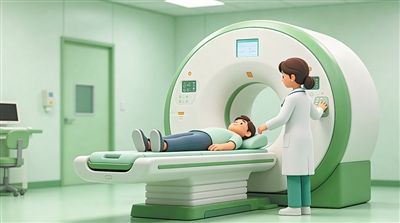
In the hospital's mri scanning room, people will always see the warning sign “beware of a strong magnetic field”, and medical personnel will repeat the message “please remove all the metal on your body and other items such as magnetic cards”. A lot of people wonder, what are the scientific reasons? The answer lies in one of the most basic characteristics of the microworld — quantum spin。
The world we live in is made up of atoms, and atoms have the intrinsic attribute of quantum spin. The internal attribute refers to the basic properties of particles, like mass and charge. For example, electrons, photons or neutrons, whose mass, charge and quantum spins have defined values, change not electron, photon or neutron. Therefore, quantum spin is not the actual rotation in the classical sense。
And the mri principle is to detect the quantum spin of the hydrogen core inside the body. About 70 per cent of the human body is hydrogenic and each of the water molecules contains two hydrogen atoms, so we have a large amount of hydronuclear spin signals. An analysis of the distribution and changes in these hydronuclear spin patterns can restore clear images of human tissue and provide a scientific basis for disease diagnosis。
However, the cycling signals of hydrogen cores in the human body are extremely weak and cannot be captured without the help of a strong magnetic field. The circular device on the traditional mri imager is in fact a superconductive magnet, providing a powerful magnetic field (tens of thousands of times the earth's magnetic field) far above the earth's magnetic field. In a strong magnetic field environment, the quantum rotation of the hydrogen nucleus is like being “directed” and the tumultuous spin has become organized so that the instrument can accurately capture their “trace”。
Metals are the “intimate partner” of a strong magnetic field and a source of interference with spin signals. Metals can be strongly magnetized in a strong magnetic field, and light can produce a bit shift, vibration and influence the collection of hydronuclear cycling signals, leading to a blurry image and a high-speed flight to the magnet, which can damage not only the instrumentation but also the human body, causing accidental injury. In addition, implants, such as pacemakers and metal stubs, may also lose normal functions due to interference by a strong magnetic field and pose a significant risk。
Can't a man with a metal implant never get an mri? Is it possible for us to complete the mri of the human body without a magnetic field
This has been explored by many research teams at home and abroad. At present, the research team of the chinese university of science and technology has successfully developed a zero-magnetic field mri spectrometer, the main device of which is the atomic spin magnetometer, capable of detecting the internal quantum rotation of the substance in a non-magnetic field environment。
Zero magnetic field mri spectrometers have been able to achieve water imaging in metal containers, as well as preliminary imaging of human fingers and brain. This means that those who have metal implants in their body are likely to successfully complete mri in the future. Although this technology is far less clear at this stage than traditional mri technology, it has low-cost, radiation-free advantages that would significantly reduce medical costs。
The seemingly remote physical concept of quantum spins has long been integrated into our daily lives. It is believed that as quantum spin studies continue to deepen, more new technological breakthroughs will emerge in the future to safeguard our health。
(the author is a professor at the chinese university of science and technology and a journalist in this newspaper, lee junjie