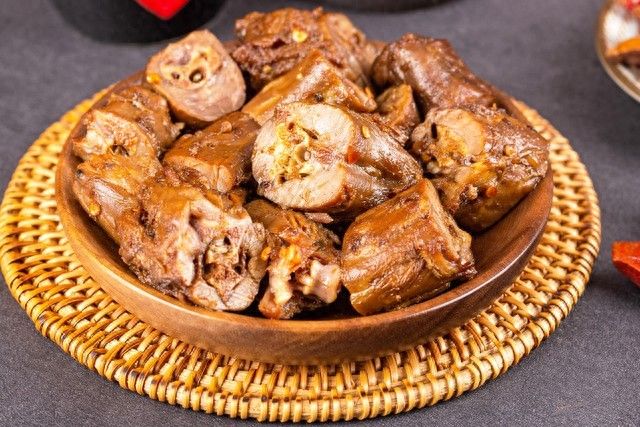
Walking through the streets, duck gate stores are almost everywhere, whether on the mall floor, at the bottom of the street or in front of the community, they can see signs of halogenated ducks. Over a long period of time, the duck-headed triads have captured a large number of consumers in the taste of fresh spicy, and have become a popular choice for leisure snacks, pursuits, and gathering of wine。
However, the direction of the market has changed significantly over the past two years, with many consumers finding that the price of ducks is increasing, and that the price of ducks in some stores is already more than a pound of beef. The smell of halogen that had been queued for purchase has now become a reality in many stores. Why did the one-time duck track go this far, and the question arises as to whether the high price is backed by a backlash or whether the industry is developing itself。
Many people still have the impression of ducks at a low-cost diet. When you buy ducks, duck wings, duck collar bones in the early years, it costs you $20 and $30 to fill a box, and you watch tv and talk while you eat. Now go to the store below the line and pick out any of the things to weigh, it'll be $450 easy. Many internet users share their consumption experience, with a small amount of duck and a little vegetable, which cost them $670, and many people can't afford it。
Compared with market prices for meat, retail prices for common fresh beef are mostly between 40 and 55 yuan per pound, while retail prices for many branded ducks generally reach 55 and 70 yuan per pound. It's also the weight of a pound, which sells ducks more expensive than beef, a price that is inversely unacceptable to many ordinary consumers. Ducks are by-products of ducks themselves, and a duck produces only a small fraction of ducks, with limited production, but raw materials are scarce to explain fully the high cost of the terminals。
The three-headed ducks, relying on the fast expansion of the association model, have grown in number of shops in previous years and have opened their businesses throughout the country. The expansion model of the union has brought rapid growth in brand size and revenue and has left many risks. Under the accession model, branders rely mainly on the supply of raw materials, membership fees, equipment fees, and the operating pressure of the shop and the labour costs of rents are passed on to the association。
The more doors open, the more they open, the more they open, the more they open, the more they open, the more they open, the more they open. The overdensity of the doors has directly led to a severe dilution of the flow of customers. Consumers who could otherwise be taken over by a shop were divided into several shops. Following a decline in single-storey traffic, the allies, in order to keep their profits, have to maintain their operations by raising the price of the single product and relying on a higher single-soldier. Lower traffic leads to higher unit prices, a realistic choice for many halogen stores。
Many consumers wonder if the raw materials of ducks are really expensive. The fresh market is full of ducks whose wholesale prices fluctuate, but which are primary raw materials. The halogen is also to be unfrozen, cleaned, halogened, edible, sorted and packaged, with substantial dehydration and weight reduction. Once the halogenation is completed, the weight is close to 40%. That means a pound of ducks, only 600 grams left after the halogenation。
Processing wear and tear, spices, gas utilities, door rents, clerk salaries and cold chain logistics are all expenses. From this point of view, it is reasonable that the finished ducks are higher than the raw ducks. But it is reasonable not to be equal to an unlimited price increase, and consumers can accept a processing premium, but it is difficult to accept an unlimited increase in the premium, which ultimately exceeds the price of mainstream beef。
Cost increases are only one of the factors, and intra-industry competition and solidification of product structures are also key to impeding the growth of duck brands. Turning over the menus of the big ducks' brands, for years the core masters continued to be ducks, duck collarbones, duck wings, duck palms, supported by a small amount of vegan. Product tastes are concentrated in spicy, spicy, spicy and spicy. Three head brands. They taste very different。
After long periods of consumption, consumers are prone to taste fatigue. Young people used to be the main consumer of ducks, but now consumption choices have become rich. Pre-halogenated, home-based halogen packs, new snacks, barbecues and various alternatives. Supermarkets, electrician platforms containing bags of halogen ducks at a much lower price than sub-linee physical stores. In the same category, the price of online bags is higher and the bottom shop loses its unique product advantage。
There has also been a change in the perception of consumption among young people, who used to be willing to eat for their tastes, and more and more who are now starting to make rational calculations. A piece of duck is a snack, cannot be a proper meal, spends dozens of dollars and is easily thirsty. Many people are slowly reducing their consumption at the bottom of the line, either by buying a bag of products on the net or simply buying their own at home, buying their own halogen packs, at less than half the price at the door。
In addition to high prices, there are problems with consumption experience. Underdoor shops mostly resort to reselling, and many ordinary consumers find it difficult to weigh. There are a few sets of these, stating that the re-price is far above psychological expectations. Some of the customers would have wanted just a dozen and twenty dollars to solve the problem, and at the time of closing, they would have had a psychological breakdown. It is often visible on the internet that internet users spit “a little bit is expensive”, a feeling that discourages many returning visitors。
Of course, the duck industry is in a situation where it can't sell, and it can't simply throw all the pots at the door. Large environmental consumption tends to be rational, with increased overall competition for leisure snack tracks and an objective compression of living space in the halogen industry. During the previous years of the epidemic, home-based consumption led to a wave of dividends for halogen-based products, and major brands took the opportunity to expand their businesses. When the market environment is restored and the dividends fade, the ills of high-speed expansion are fully exposed。
When the number of shops is saturated, the number of new customers cannot keep pace with the pace of opening a store, and the industry's internal volume increases. Many of the stores appear to be open and the real profitability is not encouraging. Some of the allies were unable to make money, and news of the closure of the shop was frequent. The head-brand figures also show that the growth rate is slowing, single-store earnings are under pressure, the number of closed-door shops has increased, and the myths of high growth have disappeared。
Faced with the cold in the market, the duck giant is not waiting to die and is trying to make adjustments. On the one hand, it optimizes the layout of the doors, closes some of the poorly located and inefficient stores, controls the pace of expansion, and no longer pursues the number of doors; on the other hand, it adjusts the products by increasing the share of vegan vegetables, introducing low-priced packagings, and buying a set of meals from the front lines in an attempt to lower the consumption threshold and attract ordinary customers。
In addition to this, the brand power line channels, the distribution of electricians, take-outs, the introduction of a bag of locked and fresh products, and the promotion of home consumption. Attempts have also been made to develop new products, to increase non-spicy tastes, to take care of old-age children who do not eat hot, and to jump out of products that depend only on spicy duck. These adjustments, however, have not worked fast. Consumers have had the inherent impression that the first reaction to the reference to the underline shop is that it is expensive. It will take a long time to reverse what we all know。
Objectively, duck cargo itself remains a good recreational food, with a stable group of faithful consumers. People who like halogens still buy it regularly, but it is difficult for the industry to return to the golden age, when it used to be easy to open a shop to make money. Consumers are willing to pay a reasonable premium for delicious, processed, and door-to-door services, but do not accept increasingly high sales prices indefinitely。
A pound of ducks is more expensive than a pound of beef, more like a mirror, showing the contradictions in the resting halogen industry. The process of raw materials is depleted, rents are rising year after year, unionists survive, brands perform, multiple layers of pressure co-opt, and ultimately fall on the final sale price. But once prices break the ceiling in the public mind, consumers vote with their feet。
For a product to grow in the long term, profits cannot be sustained simply by raising prices. Either the supply chain is optimized and the unnecessary middle links are reduced; product matrices are enriched to take into account high-end demolition and mass parities; or consumption experiences are improved, prices are coded and price differentials are reduced by weighting. Industry can function well only if business profits are balanced against consumer acceptance。
Now the halogen track is no longer the stage of random take-off. Under intense competition, the troika had to face up to the reality and the past model of fast-starting was no longer viable. This is followed by supply chain strengths, product innovation capabilities and an understanding of the needs of ordinary consumers. The plight of unsettled shops will continue to widen if they remain out of reach of mass consumption。
Topic: do you buy duck halogens online? You think the price of halogen is high now, and you're welcome to talk about your views in the comment area, and interest would be of interest。