At the end of each school examination, the first thing that many parents get on the report is to stare at the numbers of naked eyesight. As long as the vision is 1. 0, the child's eyes are relieved, and the near-sightedness is far from the child's own. Once the eyesight fell to 0. 8, 0. 6, it began to panic and search for eye-protective methods, to buy eye-protective lamps, blue-ray glasses and to strictly control cell phone tablets。
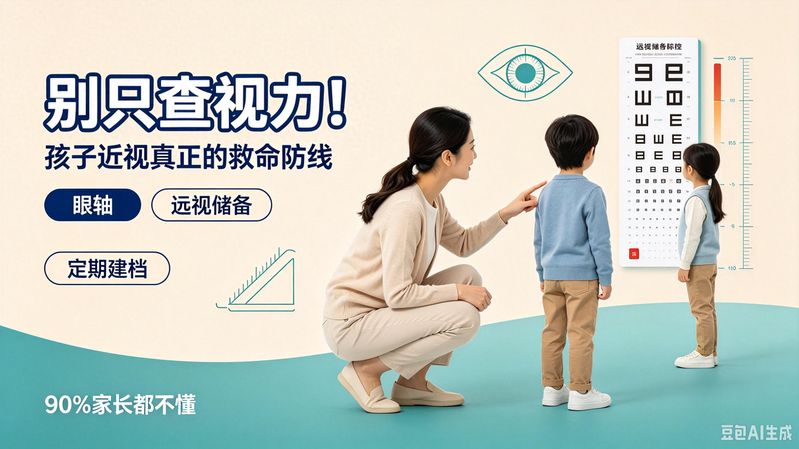
But many parents are unaware of a cruel reality: when the data on the vision table begin to decline, the near-sightedness is mostly crucified and almost impossible to reverse. Visual screening only tells us if we can see things now, more like a “after-action alarm”, the line of defence that can really warn us of the risks of near-sightedness and keep the child's eyesight a few years in advance, with the overwhelming majority of parents not paying attention. Today, in plain language, we will explain the contents of the latest version of the national health commission's close-vision control guide, which will help parents avoid the biggest cognitive error in close-vision control。
Many people's lifelong understanding of visual screening remain within five metres of the e-list. This check-up is simple and quick, and school and community examinations are conducted, with the highest coverage. But it is very clear, and it reflects the end result and does not see what is happening inside the eye. One example that many ophthalmologists would mention: a 7-year-old child with a steady vision of 1. 0 is fully satisfactory. After a full dilatory examination, it became clear that his eye axis was growing at a high rate and that the reserve of vision that he was born with was almost exhausted, only one step away from close vision. In accordance with the practice of ordinary parents, seeing a normal vision is left unattended and reviewed after six months or a year, the vision falls directly to 0. 6, and the immediate view of the real person comes to the door。
Why is this happening? Two core terms are given here: eye axes and distant vision reserves, which are two indicators that the ministry of education and the health commission in 2025 highlighted as indicators that must be monitored for close-vision control, which is a real precursor warning signal。
The eye axle is white, i. E. The length of the eyeball from its previous to its subsequent length, which can be compared to the length of the camera body. The normal eye axis for adults is approximately 23. 5 to 24 mm. When a child was born, his eyes were small, with an eye axis of about 16 mm, which slowly grew with age and was normal growth and development. But there is an upper limit to this length, and if the eye is too long and the eye is stretched, the focus of light falls on the front of the retina, and the near-sightedness occurs. The most critical point is that once the eye axis grows, it never shrinks back, and the truth is irreversibly close, and the root causes are here. Clinical data show an increase of approximately 250°c in per millimeter of eye axle and an increase of approximately 300°c, an increase that cannot be reduced in eye length through massages, eye protections and health care。
A far-sighted reserve is better understood and corresponds to a deposit in the visual account when the child is born. Newborn children are born with light vision, with 3-5 years normally kept in reserve beyond 205 degrees; 6-year-olds have a lower limit of 172 degrees; 7-year-olds have 148 degrees; and 8-year-olds have 119 degrees, when the savings of 12-15-year-olds are spent slowly, and the eyes are just as well developed as the standard face-to-eye, which is the ideal pace of development。
If there are too many eyes at close range and too little sun in the open, this deposit will be consumed faster and zero in advance. The eye axis continued to grow after the deposit was spent and the near-sightedness came. The new version of the control guide is a deliberate reminder of the critical point of how much distant-sighted reserves remain, and the rate of consumption is the first criterion for risk judgement. Some children now have 100 degrees of vision, but they consume 80 degrees in six months, a high-speed consumption that is far more dangerous than a child with 150 degrees left, and consumes only a dozen degrees of far-sighted reserves per year。
The loss of vision is the final result, with the rapid acceleration of the eye axis and the rapid overdrafting of distant-vision reserves, which is an early warning signal six months to one year ahead. An eye check is the equivalent of an eye-to-eye look at a fire when there is smoke; an eye-axis monitoring, remote-looking reserves are the equivalent of detection and early treatment when the wire starts to heat. This is the real life-saving line of close vision. Unfortunately, 90 per cent of general medical examinations are only visual, do not detect eye axes and do not regulate the assessment of excursion reserves, and a large number of high-risk children are left out of sight until they are discovered。
Here, too, we have to correct a widespread error: near-sightedness is caused by mobile phone watching tv. That is not the case. During clinical consultations, there are a large number of children with high near-sighted risks, and electronics are highly controlled and video games are rarely painted. The real overdrafting of the distant vision reserves is sustained and long-term close proximity. The long hours of looking down at the drawing book, the hours of scrounging small pieces, the hours of manual writing, the hours of painting, the hours of reading on the table, the hours of reading in the dark room and the hours of staying at home are no less damaging to the eyesight than the hours of a mobile phone。
There are also many parents who ignore the risk of household lights. It's not like buying a high-priced eye-blowing lamp is a big deal. When reading and writing, only desktop lights are opened, the entire room is dark, the light and dark are too different, and eye muscles continue to tighten, accelerating the growth of the axis. Night sleep with light lights on for long periods of time, persistent weak light disrupts eye rest, inhibits blackwashing, and many paediatric ophthalmologists warn of the need to avoid。
Genetic risks must also not be overlooked. Both parents are highly proximate, and the likelihood of a child becoming ill is significantly higher. Such children suggest that the vision should be started earlier, that basic screening should begin after 2 years of age, and that attention to eye development should not begin until primary school。
Many parents here will ask what is included in a complete, standard set of child vision tests, given that they are not sufficient. In accordance with an official regulation of the commission, parents can avoid omissions when taking their children to hospital。
First, blind eyesight, corrective vision screening, i. E. Traditional vision watch projects. That is the basis, but it must not be the sole criterion for judgement. Pre-school-age children have less than 1. 0 vision per se, and children aged 3 have 4. 7 and 4. 8. The forced pursuit of pre-school-age children's vision of 1. 0 and the guard against the premature depletion of distant vision reserves are high-risk signals, and many parents are mistaken。
Second, measurements of arctic rates, eye length. This is a crucial step, one of zero-sum checks, which can be completed in a few minutes and the data are objectively stable. For healthy children aged 6 to 10 years, it would be preferable to have an eye axis growth of not more than 0. 2 mm per year and a half-year increase of not more than 0. 1 mm; growth after 12 years of age is best kept within 0. 1 mm per year. Once the rate of increase has been exceeded twice in a row, the priority intervention phase begins。
Thirdly, it regulates profiling. Rapid computer light testing can be used as a first screening, but for children who are suspected of being in the front stages of the first assessment of the remote-vision reserve, light detection is the gold standard. The children's eyes are very flexible, their muscles are tight after long readings, their pupil measurements are very varied, and they can easily be miscalculated by the lack of reserves or false near-sightedness. Many parents are afraid of having their pupils scattered, of hurting their eyes, of oxidizing lashes under the supervision of doctors in regular hospitals, of being safe, of being able to lose sight of short-lived ignominy and of seeing near ambiguity within days, without causing harm. If, after the doctor 's evaluation, recommends the sapling, do not simply reject it, the true light data is the basis of any preventive programme。
Fourthly, eye-to-eye screening is conducted when necessary. For children whose eye axes are clearly over-marked and have become near-sighted, especially at a rapidly growing rate, periodic under-eye examinations can detect the risks of thinning and shrinking at an early stage to prevent the pathologies associated with later high near-sightedness。
When does the most important question come to light after the inspection? How often do you review it
In accordance with the recommendations of the new version of the 2026 guidelines for the prevention and control of near-sightedness: families under permitted conditions, when the child is 24 months old or 2 years old, can undergo the first dilatory screening; the three-year-olds must establish a file in the eyes of the official public hospital for the personal development of the child, recording the data on each of the reserves of vision, eye axes, curvatures, far-sightedness and vertical comparisons of growth, rather than taking a single numerical comparison。
There is no near-sightedness, but at-risk children with small reserves and fast-growing eye axes are reviewed every six months; children whose growth is stable and whose indicators are in the desired range can be reviewed once a year; and children who have been diagnosed with near-sightedness, following medical instructions, are generally reviewed three to six months and cannot be checked again every year. Glass shops can perform simple screenings, but are not able to perform pupils' photopsy, professional eye-axis monitoring and development files are best established and updated in hospitals。
This is followed by the prevention and control programmes that parents are most concerned about, and which can be implemented at home. To begin with, the truth is that there is currently no health-care item, no therapeutic device, no bias that can shorten the eye axis, no realism near-sightedness. The goal of all home-based work is to slow down the growth of the eye axis, as far as possible slowing the consumption of distant vision reserves and delaying the age of near-sighted morbidity. The later the child is near-sighted, the lower the risk of a high degree of near-sightedness。
In the first place, the highest value for money, and repeatedly emphasized in all official documents, is natural outdoor activity during the day. The ministry of education provides criteria for the accumulation of out-of-home hours per day for pre-school children as long as possible, with no less than two hours for pupils. Many parents understood wrongly that outdoor sports had to run and play. Not really. Walking downstairs during the day, crouching on the side of the road, hanging around the park and being exposed to natural light is effective. There is still light outside the sky and it can also work, much better than indoors. The principle is natural light irritation of retina dopamine, which inhibits eye length, a protective mechanism that cannot be replaced by drugs or instruments. Don't wait till it's dark after school. There's no close vision at night. Outdoor activities can be broken down into early, medium and afternoon segments in segments, which are more effective and more sustainable than a one-time long outing。
Secondly, the close proximity control rules are strictly applied. Remember the 20-20-20 principle: an eye for 20 minutes at each close distance, looking up at objects six metres away for at least 20 seconds, relaxing the lashes. The child must not spend more than 30 to 40 minutes reading books, puzzles or drawings, and must then get up and rest at a distance. The standard position of “one-foot-one-inch” is adhered to, with one punch in the chest from the table, an eye approximately 33 centimetres from the book, and a pen position one inch from the point of the pen. Do not read on the bed, in the car, on the tablet; do not walk while reading the drawing book. Many families manage electronic products to death, but leave their children alone for one or two hours of drawing, which is a huge loophole, with drawings and puzzles equally close to the eye and consuming distant vision reserves。
Third, to optimize the lighting environment in the home. When reading and writing, the desktop lights are turned on and the main light in the room must be turned on to reduce the difference between light and light; the light is placed on the side of the child's hand so that the pen does not cast a shadow over the light; the light is not flashy, the light is soft and even and does not pierce the eye. After sleeping at night, all light sources are closed and the long-term night lights are used to changing as much as possible。
Fourthly, sleep and dietary details cannot be ignored. Primary school students are advised to ensure 10 hours of sleep per day, 9 hours of lower secondary school, and lack of sleep disrupts normal eyeball development. Sweets and sugary beverages are not over-ingestioned, and high sugar diets affect the resilience of the filament and accelerate the length of the eye axles; daily diets of deep green vegetables and proper intake of foods rich in chlorophyll and vitamin a. It is particularly clear here that food can only serve as a nutritional supplement and that the absence of one type of fruit and vegetables prevents near-sightedness and prevents blind and wind-buying eye-care items。
Fifthly, children who are in the pre-optimal stages of rapid decline in far-sighted reserves are guided by ophthalmologists for medical intervention. It is now recognized that the medical programmes are effective, including the focal frame lenses, the cornea plastic lenses or the ok mirrors, and the low concentration of atropine drops of eye fluids, each with applicable conditions and taboos, which must be used after a professional assessment and parents must refrain from buying medicines and instruments for their children。
After the discussion of the methodology, several of the most widely publicized pits in the market will have to be made clear, so that parents do not waste their money and do not lose control。
The first big pit: normal vision equals safe eyes. It has been repeatedly stressed that vision is only the result. Visuality 1. 0, with a high number of children with a long eye axle in their reserves, must leave high-risk groups out of sight only。
The second mass grave: false near-sightedness can be readily massaged, physiotherapy treated. It is not uncommon for a true false near-sightedness to be merely lashes with cramps that can recover after rest. The majority of parents have false near-sightedness, which is confirmed when they go to hospital to disperse their pupils. The propaganda known as massages, acupunctures and eye protections that can cure the near-sightedness is not consistent with medical facts. Once the axis is stretched, there is no physiotherapy to restore the eyeball. At best, these projects will temporarily ease the fatigue, will not reverse the near-sightedness and will never waste valuable periods of intervention on them。
The third large pit: blue-ray glasses prevent near-sightedness. Blue light injuries mainly come from the screen, and blue light protection lenses can mitigate dilated acid swelling after long sightings, but there is no authoritative evidence that it can prevent eye axes from growing and that it cannot be used as a means of close-sighted control and that high-end blue light products need not be selected at high cost。
The fourth large pit: the deeper the length of the lenses once they can't be removed for the rest of their lives. The function of the appropriate glasses is to leave the imaging on the retina, to ease fatigue and to increase the degree of delay. When wearing glasses, they refuse to wear them, and their eyes remain blurred, fatigue increases and degrees rise faster。
One more thing is to remind parents that close-vision control is the most taboo of anxiety. Some of the parents are completely unsatisfied and do not go to hospital for a year or two and wait until they are unable to see; others are highly nervous when they have access to eye axles and remote view data, retrace their eyesight every day and prohibit all reading and painting activities, instead depriving the children of normal learning and reading opportunities. The core idea of prevention is not to keep children away from reading and learning, but to split the distance between the length of the eye and the length of the eye, with enough outdoor time to slow the growth of the eyeball and find a balance between learning and protecting the eye。
I've been talking to my mother, and i've been saying, "one of the most indiscreet things is that you look at your child with your heart, and then you look at her. Objectively, genetics and growth speeds can lead to uncontrollable factors, and we have no way of ensuring 100 per cent that children are never close-sighted. However, maintaining regulations on monitoring eye-axis and far-sighted reserves and providing daily outdoor and scientific eyes must delay the age of near-sightedness and minimize the early development of children into high-sightedness. The real horror of high proximity is not just a thick lens, but a higher risk of future complications such as retina disease and glaucoma, which is also the root cause of the country's intense effort to drive forward the near-sighted。
Real eye protection, rather than waiting to see it again, is the early establishment of a dilatory archive, which will keep a sharp eye on the speed of growth of the axis and on the consumption of distant vision reserves and hold the line of defence that is largely ignored. The eyesight watch can only be used to call the police and to provide regular full-spectrum monitoring to protect the child's eyes。
Interactive topic: do parents usually take their children to check for vision and have they checked for eye axes and remote view reserves? Have you ever stepped on any of the close-sighted control pits? We welcome the sharing of your experiences and questions in the comment area and the sharing of good eye-protective approaches。