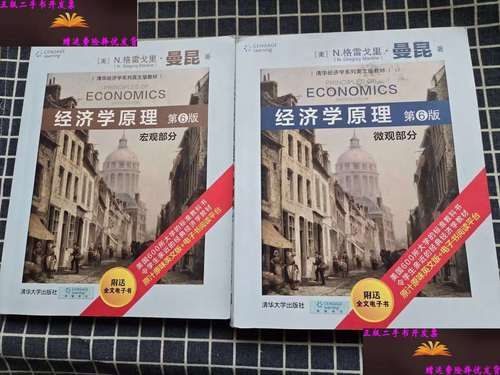
The principles of economics: the cornerstones of insight into the functioning of modern economies, the book's brief, " the principles of economics: the cornerstones of insight into the functioning of modern economies " , is not any version or rewriting of manquin's 7th edition of the principles of economics (both macro and microeconomics). The book aims to provide readers with an independent, comprehensive and in-depth framework of economics, designed to help understand the core drivers behind day-to-day business decision-making, government policymaking and global economic trends. The book is structured and informative, divided into two core components of macroeconomics and microeconomics, supported by rich case studies and cutting-edge academic thinking, and seeks to give readers not only an insight into theoretical models but also into their application and limitations in the real world. - part i: microeconomics — the fine balance between individual decision-making and market mechanisms the core of microeconomics is to look at how individual economic units (households and enterprises) under scarce resources make optimal decisions and how these decisions interact to form markets. This book seeks to be clear and insightful about this area. Chapter i: scarcity, choice and economic issues this chapter provides the basis for economic analysis. We explore how the scarcity of resources (time, capital, labour) inevitably leads to choices. The concept of opportunity costs was introduced, emphasizing that making any choice would mean abandoning the best options possible. Through a detailed analysis of the production potential boundaries (ppfs), readers will understand the trade-offs between the different product portfolios of the economy and initially recognize the potential for specialization and trade. Chapter ii: demand, supply and market balance this chapter focuses on the market as the most basic resource allocation mechanism. We elaborated on demand laws (negative correlation between price and demand) and supply laws (positive correlation between price and supply). By building complete demand and supply curve models, the book explains how markets are automatically regulated through price signals until market equilibrium points are reached. We will use actual data cases to demonstrate the key role of price elasticity in analysing consumer responsiveness and explore the practical implications of different types of elasticity (points, arcs, revenues, cross-sections). Chapter iii: the trade-off between government intervention and market efficiency is not always perfect. This chapter provides an in-depth analysis of how government interventions (such as price caps, price floors and taxes) affect market balance and resource allocation efficiency. The focus was on tax fate — who ultimately bears the tax burden — and it was closely linked to the elasticity of supply and demand. In addition, the chapter began to introduce the concept of economic well-being, paving the way for subsequent analysis of market failures. Chapter 4: market failures: externalities, asymmetries between public goods and information. Market failures are the focus of microeconomics. The book provides a detailed analysis of how externalities (production or consumption effects on third parties, whether beneficial or harmful) lead to private costs/benefits that are not equivalent to social costs/benefits. We examined various policy tools to address negative externalities (e. G. Kossor theorem, perco tax) and positive externalities (e. G. Subsidies, government-provided). The book then explores in depth the characteristics of public goods (non-exclusive, non-competitive) and their problem of “hiking”, as well as information asymmetries (reverse choice and moral hazard) in insurance, labour market performance and potential solutions. Chapter v: theories of consumer choice and the demand curve based on the assumption of diminishing marginality, we have introduced the concept of a non-differentiated curve and budgetary constraints, and have shown how consumers, under budgetary constraints, achieve optimal consumption portfolios by maximizing their overall utility. This theoretical analysis of how a downward consumer demand curve can be derived is at the core of the theory of understanding consumer behaviour. Chapter 6: business behaviour and cost structure this chapter turns its perspective to the supplier-enterprise. We first make clear that the fundamental objective of enterprises is to maximize profits. On this basis, the book provides a detailed analysis of the production function of the enterprise, distinguishing between short-term (at least one element fixed) and long-term (all elements variable). Readers will have a clear understanding of the intrinsic link between fixed costs, variable costs, total costs, average costs and critical marginal costs, understanding that “marginal gains are equal to marginal costs” is the decisive criterion for an enterprise's optimal production. Chapter vii: market structure and degree of competition this chapter examines pricing and production decision-making by enterprises under different market structures. We have examined the profit-maximizing strategies of fully competitive markets (many participants, no pricing power), monopolistic markets (single suppliers, facing the whole market demand curve), and have focused on the unnecessary losses caused by monopolies. The book then provides an in-depth analysis and comparison of monopolistic competition (product differentiation) and oligopolistic markets (strategic interactions between participants, such as the application of game theory), revealing the far-reaching impact of these structures on social welfare. - part ii: macroeconomics — a general view of the national economy and policy options it is intended to provide a framework for understanding these aggregate indicators and their interrelationships. Chapter viii: measurement indicators and targets in macroeconomics this chapter begins with a definition of the scope of research in macroeconomics. We explained in detail the accounting methodology for gross domestic product (GDP) (expenditure method, income method, production method) and the limitations of GDP as a measure of economic output. We then analysed the costs of inflation (measured using the cpi and GDP deflation indices) and explored in depth the types of unemployment (buzzy, structural, cyclical) and their measures. Chapter ix: the determinants of long-term economic growth is key to raising living standards. This chapter focuses on analysing how a country can achieve sustained economic growth in the long term. Using the solow growth model as the core framework, we explained the relative importance of capital accumulation, population growth, technological advances (full factor productivity) in driving per capita output growth over the long term. The book emphasizes the fundamental role of institutions, human capital and innovation in sustainable growth. Chapter x: the role of money, the banking system and central banks. This chapter details the functions of the currency (transaction media, unit of account, value storage). We analysed some of the reserve systems of commercial banks and the currency multiplier mechanism. The book then focuses on the structure of central banks (such as the federal reserve or the european central bank), monetary policy instruments (open market operations, reserve rates, discount rates) and how they influence short-term economic activity by regulating money supply. Chapter xi: the total demand and total supply model (ad-as) is the cornerstone of the short-term macroeconomic analysis. This chapter starts by extrapolating the aggregate demand curve (wealth effects, interest rate effects, exchange rate effects) to explain why aggregate demand increases when the overall price level declines. We then analysed how total supply curves (short-term versus long-term differences) affect output, especially price viscosity and wage adjustments in the short term. Through the model, we can visualize how fiscal and monetary policies affect output and price levels. Chapter xii: effectiveness and limitations of fiscal policy based on the ad-as framework, this chapter analyses how expansionary and austerity fiscal policies affect aggregate demand. At the same time, we have explored in depth the potential limitations of fiscal policy, including crowding out effects, policy time lags and the long-term impact of government budget deficits on the future economy. Chapter xiii: inflation trade-offs: the phillips curve and policy options this chapter links monetary policy more closely to inflation. We looked at the phillips curve — the short-term trade-off between inflation and unemployment. The book then introduces the theory of rational expectations, explaining the verticality of the long-term phillips curve and the key challenges for central banks in managing inflation expectations. Careful policy choices were explored between the pursuit of low inflation and low unemployment. Chapter xiv: international trade and the macroeconomics of open economies the modern economy is highly globalized. This chapter will analyse the theoretical basis of international trade, including how the principle of comparative advantage guides countries in their specialization in production and trade for the benefit of all participating countries. In addition, the book addresses macroeconomic variables in the open economy, such as net exports, trade balances and explains the mechanisms by which monetary and fiscal policies affect exchange rates and net exports under fixed and floating exchange rate regimes. The book is structured in a clear and logical manner and aims to build the capacity of readers to analyse complex realities using economists ' thinking. We have avoided an excessive bias towards single-students, sought to present the whole picture of mainstream economic theory and provided a comprehensive, in-depth and time-bound knowledge system of economics for learners, taking into account recent empirical research。read this book, you will have the solid theoretical basis needed to understand the dynamics of global markets and to make rational economic decisions。