Recently, the sichuan provincial council rural working leadership group published the programme for the advancement of the revival of the sichuan fruit industry, which provides the path for accelerating the upgrading of the fruit, silk and walnut industries and their quality development。
By 2022, the total area under fruit cultivation in sichuan province is expected to reach 12 million acres, with a total production of 12 million tons, with combined production exceeding the hundreds of billion mark. Sichuan heart monkey area, production, brand impact is a global leader compared to new zealand, and late citrus, lemon, late mango, late cuisine eye industry size, output, market ownership and brand influence are the country's first..
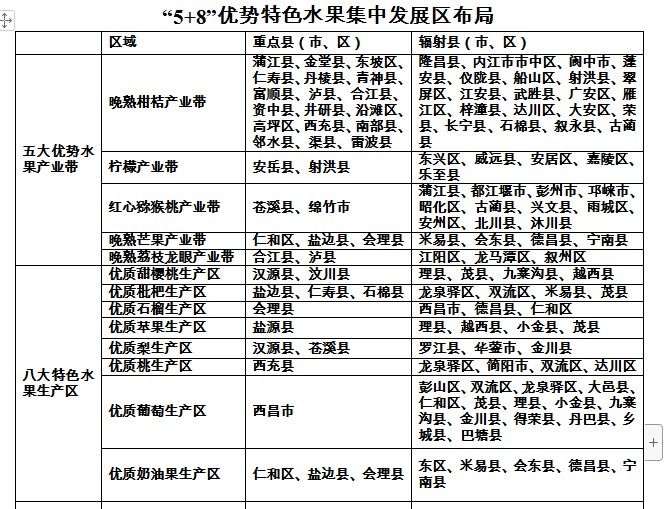
In the industrial layout, funding for the kawago project will be tilted towards 30 key fruit districts, 30 priority districts for yusang and 38 priority districts for walnuts, accelerating the formation of five main fruit industry bands, eight special fruit production areas, as well as three central pecan belts for the north, south and west of kawakawa, and three central walnuts development areas for the xinxi region, the qinba region and the xishi mountain valley region。
In fact, by 2019, the total area of fruit in sichuan province had reached 11. 17 million acres, yielding 9. 48 million tons, which is the fifth largest in the country. Among them, the area and production of special fruits, such as late citrus, lemon, blood oranges, red-heart monkeys and pomegranates, have risen to the top of the country. The sichuan province has demonstrated its commitment to making a major contribution to the fruit industry, promoting industrial transformation and increasing farmers ' incomes。
While the policy is good, the editor reminds us that it is important not to “get up and up” into overplanting, resulting in “fat farmers”. Before entering the fruit industry, the following six main risks must be considered:
Climate risk
The main activities involved in cultivation are in the open, which determines that agricultural production, business activities are more directly and closely dependent on the forces of nature and are most vulnerable to climate change。
No matter how much you've prepared for the previous period and how well you've managed to grow, it's a lot of luck to eat in heaven, and it's always up to god。
Varieties risk
Today, demand for fruit has shifted from quantitative to qualitative, and demand for fruit depends not only on taste, but also on face value。
The choice of planting varieties must be forward-looking and take full account of the many aspects of the resistance to disease, production, quality, market demand and shelf life of fruits。
Priority must be given to the dominant varieties of local species, combining climatic factors such as light, temperature and the best soil base for planting, and the most cost-effective varieties。
Technical risks
Plantation techniques range from species selection to fertilizers, from plant protection to irrigation, from plastic to post-partum harvesting, and from packaging to freshness。
Any one of these failures affects the ultimate economic benefits。
Risk management
The reality in rural china is that young and young workers are moving to urban factories, and that agricultural production is carried out by women, children and the elderly, resulting in the absence of highly qualified and professional farmers。
This is a major challenge for fruit growers, who invest very much in training and management, increasing risk management and accountability。
Sales risk
When the fruit is grown, it is sold. But many growers grow, but not necessarily。
As a result, many of the fruits, though abundant, are not sold, or rot in the ground, owing to market saturation or the high level of fruit in the field。
The fast-changing market is a huge challenge for the farmers, and self-building channels are an important task, especially today, when the live platform is popular, and it's too difficult to get the farmers to run the crop
Financial risk
Cultivation is a slow-yielding industry, and sufficient funds are critical to revolving. Agriculture “feed from the sky”, without a reserve of funds, can cause problems at various stages of cultivation, causing serious economic losses。