Today, when the whites arrived, the autumn cabbage that was planted in the north in mid-august came to lian-seong. Many of the villages watched the vegetable leaves grow wider, and were in a hurry, pouring water in between, fearing that the water would not grow. However, many people find that the water is pouring out of the water, and the leaves are so thick that when they're wrapped up in their hearts, they either lose their hearts, or they get sick, they get sick, they work hard for a season, and they lose a lot. The root of the disease is not a shortage of water, but the timing of the watering season is wrong. The 15 days after the white show, it was the golden window in which the cabbage strewn its bones, managed and managed the water, and later the plant became strong and the disease became significantly smaller。
Most of us grow land with a fixed idea, and if the seedlings want to grow fast, they have to water and refill. However, cabbage is completely different in its habits at each stage of growth, so that the soil is humid during the seeding period, and the lichen period takes root in the seedlings, and it is only at the condensed stage that sufficient water supply will need to be stabilized。
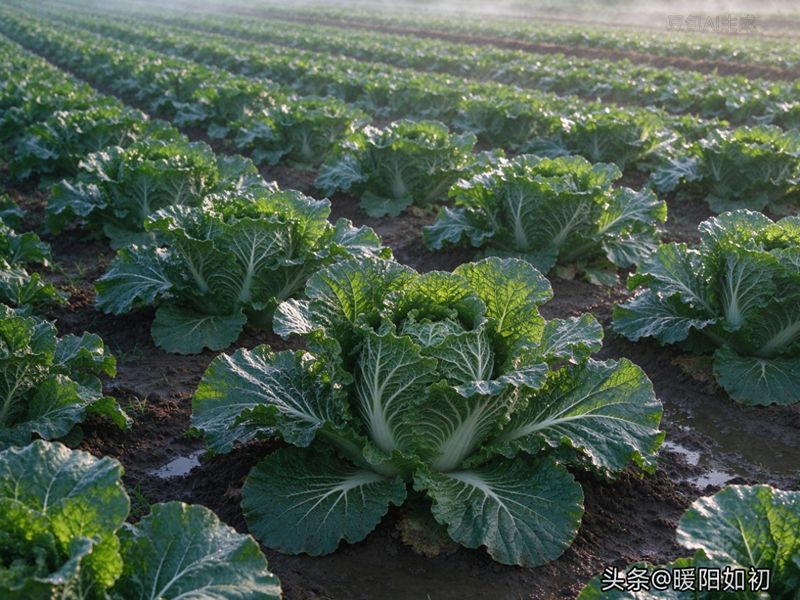
A lot of old people don't know what it looks like. In short, cabbage produces 8 to 16 large leaves, and leaves spread out, forming a bush like a lotus flower, and this stage is the lotus term。
During this period, cabbage has two core tasks, one of which is to grow large leaves and accumulate luminous nutrients; the other is to stretch down the roots and build the skeleton of the whole dish. It is difficult to grow a tight full bowl of vegetable balls when the skeletons are not strong and when water is followed up later。
A lot of cabbage in the field, a lot of fat leaves on the outside, looking at the glamour, which is actually a typical "float sap." the root cause of this situation is the draught of the lotus seat. The soil is damp for long periods of time, the mudslides are filled with water, and the lack of air leads to the "sloughing" of the cabbage root system, which does not want to plough deep enough to spread only to the shallows of the surface, about 10 cm。
The ability of shallow roots to absorb water fattening is weak, and the weather is continuously clear, and the water is quickly aging; once caught up with the rain, the water suffocates the root system, and it is highly susceptible to rooting. Field humidity is high and the fungus of frost and morbid diseases are rapidly growing through wet environments. By the time we see the leaves and the creeps, the disease has spread extensively, and it can only be temporarily alleviated by the mere use of drugs, making it difficult to recover the damage。
There is also a danger of being ignored. Water supplies continue to be abundant during the term, with cabbage absorbing all of the nutrients that are available to the outer lobes, which are thinner and less resilient, and which are consumed on long leaves and cannot be stored. By the end of the condensation phase, the plant did not have enough reserves to feed the ball, and finally it was loose, empty inside, the weight of a single tree could not be sold at a fair。
Many of the country's inhabitants have experienced the emptiness of cabbage and the bitterness with which they have bought false seeds, and in fact most of the problems are due to the poor watering of the land during the season。
In this context, some of the old people are heading to another extreme: since they cannot water more, they simply do not, depending on the weather. It's also a big pit. Controlling water seedlings is not equivalent to dry and bad seedlings, and if the soil is dry for long periods of time, the earth is dry, cabbage is aging at noon, it will not be able to recover until the sun sets down in the evening, and plants will grow stagnant, leaves will grow old early and will not grow strong。
What we call window management is moderate control of water seedlings, with moderation, standards and no one-size-fits-all cuts. A sense of proportionality is most critical to curbing the growth of leaves and not to cause excessive drought。
Let us begin with a thorough presentation of the core issues, the valuable 15-day window period, from which date to which date, and which plots are suitable for this management。
It is important to make one thing clear here: that a seedling is not fixed from the day of the whites, but is based on the actual strength of the seedlings. It is just a time node that we can bring down, and never a date of death。
In the case of mid-august, mid-autonomous, mid-middle- and long-haired cabbages of around 10 large leaves, from mid-term entry to lian seats, 10 to 15 days are usually the best periods for the nursery window. Agricultural data show that the normal crouper cycle of cabbage is 10 to 20 days, that the weather is normal, that the land is bordered or adhesive, and that 15 days of management is long, and that the most stable and reliable effects of the growth are found。
But there are a few hard borders that must not die for days。
In the south, it is not possible to enforce 15 days of water control by planting cabbage late in the evening, sowing small seedlings, poor sand land, long, thin and yellow vegetable fields. The sand land is poorly protected and leaks quickly, with a maximum of 7 to 10 days; small, long and weak plots of seedlings are not recommended for long periods, but only minor water control is required。
Only deep soil, adhesive land, scavenging cabbage and foliage are suitable for complete 15-day water management. Pre-maturated varieties are short-lived, have limited duration of time and are reduced for long periods of time, as appropriate。
There is also the principle of flexibility to adjust: in years of heavy rainfall, the soil itself is very wet, and the seedling can be properly prolonged for a few days; in turn, if it meets a persistent autumn tiger, a high temperature drought and a high evaporation volume, the seedling will have to be shortened, or even directly eliminated, and must not carry a dry seedling。
In addition, the incidence of misperception of water control is different from that of planting and planting for peace. The puddles are well drained, the roots are not easy to accumulate, and the saplings are more prone to error; flat blocks are more dangerous to accumulate, and must be more tightly controlled and drained, and must be drained first after the rain, so that the water cannot be dipped in the puddles。
And then we're going to do it in real terms, and we're going to do it directly, without empty words。
The first is to control the water and understand the signals from the soil and seedlings, which are the top priority of the whole management package。
The relative water content of 0 to 20 centimetres of the earth layer is best maintained at 60 to 70 per cent during scavengeration, with no longer than 80 per cent. We don't use sophisticated instruments to judge damp: the surface of the earth is white and loose, and the subsurface is still fluent, with no need for urgent water。
The most intuitive criterion for the evaluation of the plant is that, at the height of the noon sun, the vegetable leaves of the veggies shatter, and when the temperatures fall in the evening, the blades rise again, the state of which is the best fire in the ground, without water。
Only in two cases can there be a small amount of water recharge: in the absence of rainfall for 10 consecutive days, the soil at 4 cm is dried up; and in the case of cabbage, the leaves remain aging until the evening and cannot be restored. The water cut-off cannot be flooded with water, rinsed with small water along the ditches, wetting only the root layer of the soil, and not permeating the whole gill. The water is watered as long as possible in the morning or evening, avoiding the high noon temperature and preventing cold water from provoking roots。
If there is continuous rainfall after the whites, the first thing is to plow the field drains so that there is no water in the rain. The soil sheeting after the rain, when the surface soil is not glued to its head, is wet in a timely manner, reducing the risk of suffocation of the roots and cutting off conditions for disease outbreaks。
The second point, water fertilisation, strict control of nitrogen fertilisation during the shrunk season, the pursuit of fatty to a node, and the reinforcement of leaves to prevent disease。
Many old people spend their time running water while vasectomy with urea oxytocin leaves and their previous efforts to control water seedlings are wasted. Throughout the window period, the sole application of high nitrogen fertilizers such as urea is prohibited, which accelerates the longing of outer leaves and directly undermines the productivity of the seedlings。
If the whole floor is full of fatty bottoms, there is no need to hunt for fatting in the earth for the whole time. Grounds of weak ground can be sprayed with 0. 2% potassium phosphate on the leaves, once in 7 to 10 days and twice in a row. Supplementing phosphorus potassium nutrients, increasing the foliage wall and increasing resistance, combined with a small amount of glycol calcium, reduces the probability of late heart drying。
By the end of the scavenger, the cabbage is slightly dark, the leaves are clearly thick, marking the completion of the scavenger. At this point, water is pouring through, chasing a fertilizing tree along a girdle, applying 10 to 15 kg of high nitrogen compound fertilizer per acre and more than 10 cm from the root, avoiding direct contact with the manure to cause the roots to burn, to provide sufficient nutrients and to meet the forthcoming condensation period。
The third point is to seize the last opportunity before the seal, so that we can grow and weed and root。
Weeds continue to grow fast after the whites, with weeds seizing water fat, with poor ventilation and increased humidity in the fields, further exacerbating the risk of outbreaks. During scavengering, one or two times of medium-scale weeding was completed while the scavenger blades were not attached to each other, bearing in mind the passage of the old farmer: deep girdles, shallow backs。
The root of the cabbage is three to four centimetres shallow, so that it does not hurt the main root; the girdles can be ploughed to about eight centimetres deep, cutting off the surface of the surface and extending their roots deep into the earth。
The pine soil also has the advantage of increasing soil aerobics, breathing well at the root, and increasing the strength of the root by half. When the cabbage is sealed, no more turpentines, easy lobe-painting, fungus entering from wounds, causing soft decay。
Fourth, early prevention of pests reduces the number of wounds and reduces the probability of disease occurring。
Lean beet night moths, moths and aphids are entering the high-precipitation stage. The reality is more complicated than the fact that many of the old people simply think that a rotting tree is just a pouring-in of water: large water causes long periods of dampness in the fields, which is conducive to the growth of bacteria; and insects gnawing out wounds, and the fungus drill into the vegetables, which are folded together, causing a massive outbreak of morbid disease。
Management therefore insists on the priority of prevention and does not wait until the pests are infested. Aphids can be booby-trapped on cedars in the field; when the pests have just surfaced, bioagent sprays, such as luminum and bacillus, are selected for control, drug rotation, and pest resistance is delayed. The spray is selected as late as possible, and the spray is spread evenly across the right side of the leaf, increasing its effectiveness。
After the right approach, we're going to comb the four most easy-to-penetrating potholes of vegetable farmers, and many of the old people are stuck on these steps。
Zone one: i don't care if it's a piece of land or a slender, but i'm going to do it for 15 days. The sandy land, thin ground, weak seedlings, which control water for long periods of time, directly results in rigidity, early and early aging of the leaves, and a small amount of lateness; the low-lying adhesive land is heavily rained, with water being controlled and not discharged in a timely manner, with its roots strewn in the ground, and its rotting trees splattered. The land cannot be disposed of for days, but must be adapted to soil and seedlings。
Zone two: once the scavenger is over, the water is full. After half a month of moderate drought, the root system became particularly sensitive, with a sudden flood of water, a large amount of dispersive fattening, a sharp change in the permeability pressure of the root system and a high risk of injury, with leaves falling yellow, and no loss. The end of the scavenger is served once, after a few days, with a gradual supply of nutrients。
Mistake three: the period of cramming is only focused on watering and weeding, neglecting calcium and potassium supplementation. A lot of people think that cucumbering is water control, without any fertilizer. In a state of continuous water control, cabbage has declined in terms of potassium, calcium absorption, leaves are thin and resistant, late-stage dry charries are prone, a small number of leaves are enriched, inputs are low, and anti-disease effects are evident。
Zone four: it's believed that if you get well, the disease will be eliminated. Water control only reduces the probability of disease and does not guarantee a complete absence. Frost and morbid disease continue to be induced by the accumulation of high humidity, pest wounds and hard-earth bacteria after rain. Management must be accompanied by pest control, drainage and pine soil, so that integrated care can reduce the disease。
At this point, white dew is in the middle of the summer and autumn, the temperature is high during the day and the cooling is slowly increasing in the morning and evening, and this weather feature is suitable for cabbage to take root. The 15-day window period is the equivalent of setting the bottom for cabbage. The base is solid, the roots are deep, the capacity to absorb water is stronger, the leaves are thick and healthy, and the capacity to plant itself is significantly increased。
By the end of the convulsive period, the gradual return of temperature, the climate for a ball, the availability of sufficient nutrient reserves for cabbage, the tightness of the leafball, a significant reduction in the number of hollow, rotten gangs, and an increase in production and quality together。
There is no magic equation to grow, no point in crop growth, and little change in gas and seedlings. The saplings, the chubby skeletal skeletal skeletal skeletal skeletal skeletal fertilizers, step by step, the management has stepped on the idea, without the need for a blind investment in farming, so that a garden can grow good cabbage。
Many of the country's inhabitants were trying to wait until later to remedy their problems, while neglecting the previous period of gold management, when the disease broke out and their hearts broke loose and it was too late. The 15 days after the whites were caught, the water was contained, the pine soil, the fat, the insect-proof, this year's acupuncture, a tight, less ill and more reliable harvest。
This paper is for the purpose of sharing rural farming experience and only for the benefit of farmers. Due to local differences in climate, soil and variety, management methods are applied with local practical flexibility and crop management is based on local official agrotechnical guidance。
# beale lotus #
# beacon growing technology #
Cabbage