1. Plant pump base: from structural principles
The first time i disassembled the blade pump, i was shaken by its fine design -- a few pieces of metal blades rotated in a circular cavity, creating stable hydraulic power. This device, which converts machinery into hydraulic energy, is readily available on the machine floor, in a plywood and in engineering machinery. But you probably don't know that the blade pumps are divided into two camps, one and the other, and that they have a difference in performance, which is like the difference between manual and automatic。
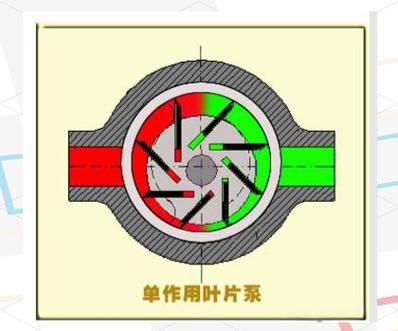
The structure of the single-activated blade pump is like a month cake mold: the rotor's eccentricity is installed in the dots, the blades are rotated with the rotors, and the inner wall is attached because of centrifugal power and bottom pressure. When the blades shift from a short radius to a long radius, the volume increases into a vacuum inhaler; the reverse is compressed fluid discharge. This "unilateral squeeze" design allows it to complete the drain cycle only once a week. I took out the single-acting pump of an old pyrotechnic, and i found that it moved horizontally -- by adjusting the eccentricity e, like adjusting the depth of the mooncake mold, which directly changed the size of the charge。
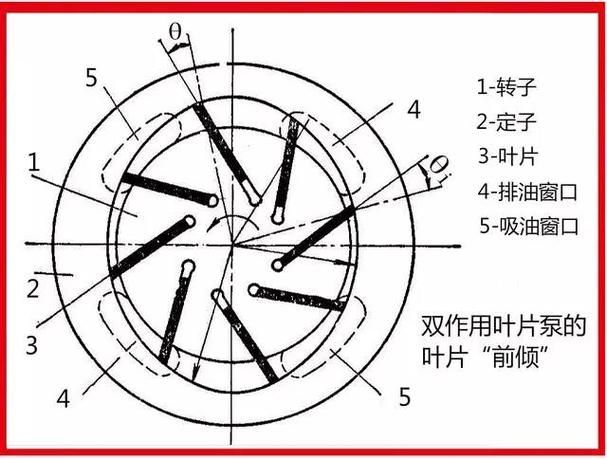
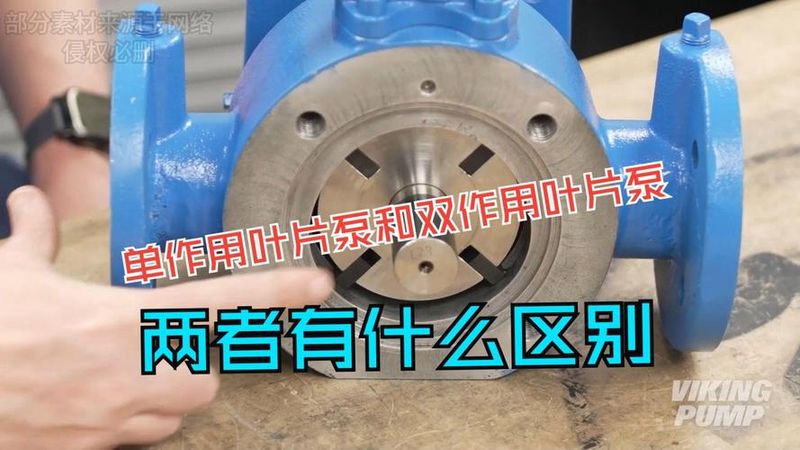
The two-acting pump is like a back-to-back combination of two single-action pumps. The fixed surface is a standard ellipse and the rotor is central. When the blades pass the half-duration curve, they complete twice in the same turn. One time i tested a brand of a double-action pump and used a flow meter to observe that its output curve was almost straight, thanks to the hydraulic balance of symmetric design. However, its fixeds and rotors are fixed, and it is less flexible than a single-activation pump to replace the fixeds for different lengths to change the load。
Emission reconciliation: variable and quantitative game
The ability to regulate discharges in real time directly affects energy efficiency when hydraulic systems are designed. The variable properties of a single-acting pump make it like a car's insulated transformer — moving the fixed through the server, with a eccentricity ranging from zero to maximum. I did a comparative experiment: when the atm phase requires a small flow of high pressure, e is moved to 50 per cent, and pump power consumption is about 35 per cent lower than total charge. This energy-saving advantage favors single-acting pumps in intermittent loads such as plasters, pressurers, etc。
But variables have costs. In one of the equipment failure screenings, i found that the regulator seal of the single-acting pump was prone to wear and tear, leading to e-value drift. Even more troublesome is that eccentric design exposes rotors to asymmetrical repulsive hydraulic force, like a bicycle chain that is always unilateral. When the pressure reached 7 mpa, it was measured that the axle tolerance was close to the limit, which explained why single-action pumps were rarely used in high-pressure settings。
Double-acting pumps are typical "quantitative players", and their charge formula v = 2 πb (r2-r2) has fixed values for both the fixed long radius r and the short radius r. Some clients have asked me if i could re-engineer a two-role pump to achieve a variable, and my suggestion is either to replace the whole stationary component (equivalent to a gear exchanger gear) or to re-introduce it with a transformer power, which, while changing the flow, would sacrifice pressure stability. However, the rigid structure of the two-activated pumps is also advantageous, and on the 21 mpa injection engine main oil road, i measured only a third of the axle bearing vibration value of a single pump。
3. Repressive balance: invisible killers of vibration and longevity
Vibration noise from hydraulic pumps often originates from stress imbalance. After breaking down dozens of pumps, i found that the axle bearings of the single-acting pumps were regularly worn: they were always biased towards the suction side. This is because hydraulic reversibility always points to the aphrodisiac centre, creating a continuous one-way direction. Once the data was recorded with an oscillator, when the pressure rose to 5 mpa, the radial vibration suddenly increased to 8mm - this explains why these pumps require thicker bearings。
The mechanics of the two-acting pumps are excellent. Its symmetrical streaming disks offset the trajectories generated by two pressurized areas, like two grinders per person. In a test at a machine-bed plant, the bearing temperature was 15°c lower than that of a single-action pump when the two-action pump was fully loaded at 21 mpa. It is even more surprising that the eccentricity of the blades can be further balanced by a double-leaf structure (two pairs of pairs in the same slot). This structure, however, requires extremely high processing accuracy, and on one occasion i detected a difference of 0. 02 mm in the thickness of two groups of leaf blades, which led to a 5 per cent increase in flow fluctuations。
When the actual selection is made, the stress balance is often ignored. There was a case in which a packaging machine had originally used a single-acting pump and had been replaced by a two-acting pump, resulting in a reduction in the vibration value of the equipment from 4. 5 mm/s to 1. 2 mm/s and an increase in the bearing life from 800 to 3,000 hours. This contrasts intuitively to show the value of the balanced design of the two-acting pumps in the high-pressure scenario。
4. Flow pulse: "heart rate" stability in hydraulic systems
Flow pulses, like the discomfort of a hydraulic system, cause agencies to climb, pressure gauges to shake. Through the spectrum analyser, i observed that the flow curve of the single-acting pump was clearly serrated. When the number of leaves was 15, the pulse rate was about 5. 6 per cent; it jumped to 11. 3 per cent when it was reduced to nine. This validates the formula conclusion that odd-numbered leaf blades can effectively offset the waves. Interestingly, 13 asymmetric blades were used for some of the imported pumps, resulting in a further 30 per cent reduction in measured pulses。
The theoretical pulse of the two-acting pump should be zero — four working cavities should be rotated, and relay racing should never stop. However, small fluctuations of 0. 5 to 1 per cent were still observed in the actual tests, mainly from two sources: the foliage thickness (about 0. 8 per cent of the charge) and the process error resulting in a long/short radius arc with different cores. On one occasion, i replaced 12 leaf pumps with 16 blade pumps, and system pressure fluctuations decreased from ±0. 3 mpa to ±0. 1 mpa, which was critical to the precision of the processing of the precision mill。
In noise sensitive settings, pulse control requires more combinations. In a medical equipment project, liquid noise dropped from 65db(a) to 58db(a) after we were able to export a dual-action pump with an energy builder. But be careful, when the pre-leaf tip is more than 15 degrees, the inverted run leads to the death of the leaf. I stepped on the pit, when the entire pump died instantly and the roots of the leaf were broken。
5. Operational guidance for industrial selection
When i pick a pump for a plastic machine, i usually draw a comparative table:
Specialized single-action blade pump double-action blade pump
Typical pressure range
≤7mpa
16-32 mpa
Flow reconciliation
No level variable
Quantitative/modified
Efficiency
30% power saving when load matches
5% full load efficiency
Maintenance costs
High failure rate of reconciliation
Low failure rate for simple structure
Apply scene
The pressure changer
The main axis of the high-pressure machine bed
Last year, when a vehicle spare parts production line was modified, i was testing a stand with a single pump for multi-level pressure regulation, while a two-action pump was used at the main pressurized unit -- this combination programme is 22 per cent more energy-efficient than full-use dual-role pumps and 40 per cent longer than full-use single-role pumps. The key is to get through the two characteristics: single-playing when the system needs "softness" and double-checking when it's looking for "hard."。
For designers who have just begun exposure to hydraulic pressure, my proposal is to have a few key parameters in mind: working pressure determines the lower limit of the selection type (separate pump is above 7 mpa), flow stability looks at the number of leaves (selects 12/16 doubles or 13/15 singles), and control frequency looks at the performance of the implementing agency (frequent variations in the selection variant). One time, when the client was debugged, it was discovered that they had misloaded the single-acting pump on a continuous high-pressure convulsor, and in only three months there was an axle burst -- this lesson suggests that the selection should not be based solely on price, but rather on structural characteristics matching performance。