Injecting medical projects such as urea acid, thin face needles, botulinum toxins, high body and white needles account for nearly 40 per cent of all cases, becoming consumer advocacy “high-risk areas”. In the summer break, a lot of beauty-seekers started the "face project". On 29 june, the centre for the study of consumer protection law of the university of foreign economic and trade, the new business and economics institute of the beijing university of commerce and industry, the consumers network (www. Bjxf315. Com) and the beijing institute of big data on sun consumption published a study on the human rights situation in the country's medical community (2023), noting that during the first five months of the year, the situation was particularly marked in the case of injection-type projects and in the case of fat-sucking surgery, which was particularly pronounced in the case of front-line enterprises such as huamey and ismail。
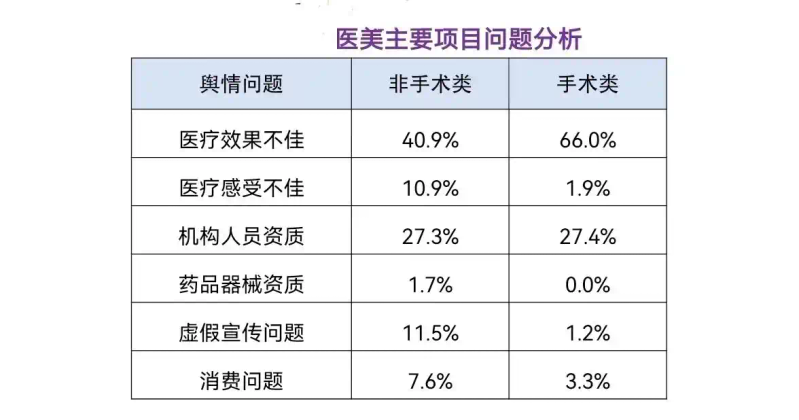
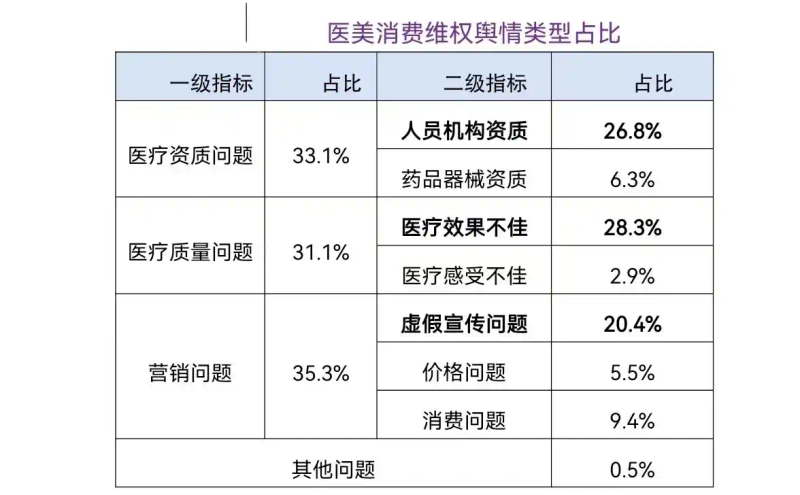
The report shows that the problems revealed by the medical profession are mainly related to personnel qualifications, poor medical performance and publicity. An analysis of the types of data on health-care consumption advocacy shows that out of a total of more than 90,000 data on health-care consumption advocacy, more than 30,000 data, or 33. 1 per cent, relate to medical qualifications; 31. 1 per cent to medical quality; and 35. 3 per cent to marketing issues. At present, there are many black-hearted institutions and practitioners in the health-care market who do not have a licence to practice a medical institution or a doctor's certificate to practise a medical service illegally, together with the potential risks to the health of consumers caused by irregularities in medical beauty services。
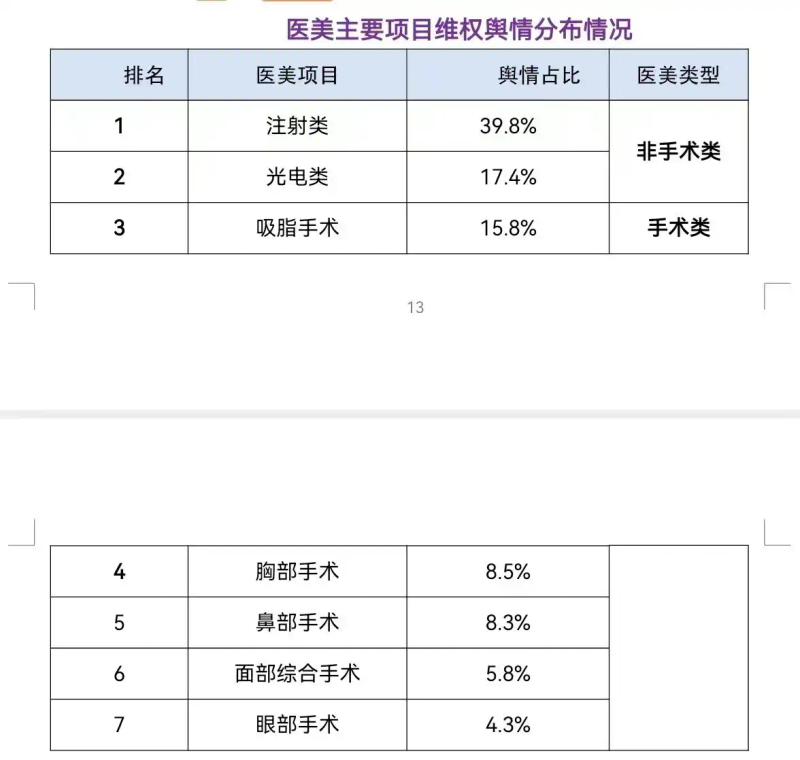
According to the report, injection-type projects, which are highly popular because of their obvious health effects, short recovery periods and low prices, account for nearly 40 per cent of the total, and the highest proportion is found in many projects, such as urea acid, thin-faced needles, botulinum toxins, high body heights and white needles. Injecting-type projects are non-surgery projects, but in many respects they are similar to surgical ones and, although they have been in the market for many years, there are risks. Unprofessional practices by practitioners can lead to more serious consequences, mixed with hypocritical products and consistent victimization cases。
The second is the pv project, which has a 17. 4 per cent incidence, such as photons, hot-magics, golden needles, leather seconds, typhoids, etc. At the present stage, the pv project service has a large number of non-qualified living beauty facilities. In addition, the issue of false propaganda and consumption for pv projects is becoming more prominent. The highest percentage is in the case of fat-skinned surgery, which accounts for 15. 8 per cent, followed by chest and nose surgery, which also accounts for more than 8 per cent。
In recent years, it has been reported on the internet that there has been a “red medical hospital” that hides in a write-up building, does not even have a signboard, does not advertise, does not use hairdressing, etc., to reach customers, but deliberately circumvents advertising regulations by using “red scripts” and “screechs”. Their marketing staff, for example, “slow-up” “browsers”, brazenly exaggerating the medical effects and minimizing the risks of surgery, has led to numerous disputes and complaints。
Recommendation: improve transparency and eliminate information asymmetries in the medical and american industries
What's the reason for this mess? The analysis of the report suggests that the problems behind the rapid development of the medical-american sector in our country lie first and foremost in the fact that the medical-american sector is an emerging market with relatively weak regulation. Medical institutions and practitioners have taken advantage of gaps in regulation and inconsistent industry standards to engage in illegal activities or irregularities, leading to problems in the quality of care. Second, there is a lack of uniformity in industry standards, a lack of standardized service management systems and standardized operating procedures in the medical and american industries, leading to inconsistent standards among practitioners, uneven levels of service, and excessive market demand, which has led some institutions and practitioners to ignore medical quality and safety issues in pursuit of economic interests. In addition, the lack of quality of practitioners, insufficient awareness of the risks of the medical industry and the lack of sufficient information for consumers to accurately assess the risks and effects of the medical projects have contributed to the emergence of industry disorder。
The report recommends that the relevant national authorities periodically amend and supplement the relevant policy regulations in the light of new changes in the health sector, such as those relating to new health projects. At the same time, the existing legal and regulatory system needs to be supplemented with more detailed information, which will allow for a detailed review of the qualifications of practitioners, taking into account the corresponding qualifications of the beauty surgery project and ensuring clearer access criteria. There is also a need to strengthen the use of digital platforms, high-tech tools, more detailed regulation of the more frequent complaints, increasing transparency of information in the medical industry, eliminating information asymmetries and raising consumer awareness and awareness of medical beauty。