The ultimate challenge of safe production: do you know everything about company safety
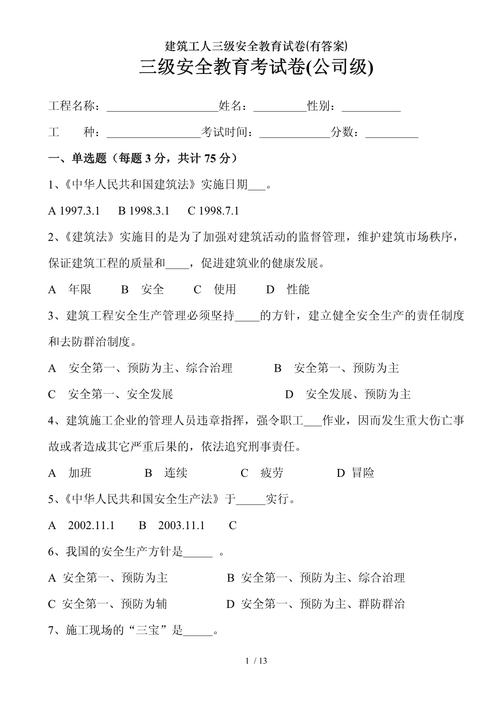
I. Single selection issues
1. The four non-harms in safe production are: do not harm yourself, do not harm others, do not harm others, ()。
Protecting oneself from harm
B. Protecting others from harm
C. Ensuring that they do not harm others
Answer: b
The “four no harm” principle is an important fundamental concept in safe production, and its complete content is: not to harm oneself, not to harm others, not to harm others, and to protect others from harm. This underscores the security responsibility of teamwork and mutual protection。
2. According to the company's environmental and occupational health safety awards and penalties system, in each case where an accident occurs outside the target, the department assesses the amount of the sum of the person directly responsible for the accident, the amount of the sum of the sum of the person responsible for the accident, the amount of the sum of the person responsible for the accident, the amount of the sum of the person responsible for the accident, the amount of the sum of the person responsible for the accident, the amount of the person responsible for the accident, the part-time safety officer and the head of the department, respectively. Individuals, sections and departments involved in non-target accidents, parties concerned, all types of positive and negative votes at the end of the year。
A. 1000; 2000; 3,000
B. 2000; 2000
C. 1000; 1000; 3,000
D. 2000; 2000; 3,000
Answer: d
Analysis: this question examines the specific criteria for evaluating liability for accidents in the corporate safety incentive and punishment system. According to the title, the amounts assessed for those directly responsible, those responsible for managing them and those responsible for them were $2,000, $2,000 and $3,000, respectively, and were accompanied by a negative vote。
3. According to the company's responsible management system for environmental and occupational health safety, which of the following are not part of the responsibility for environmental and occupational health safety of employees。
The concept of “safety first, prevention first” and the conscious observance of national and corporate laws and regulations and other requirements for environmental and occupational health safety
B. Careful participation in environmental and occupational health education and training activities conducted by companies and careful implementation of safety and environmental regulations
C. In the event of an accident, witnesses on the ground should report promptly to the team leader or unit leader and then stay away from the scene, where accident protection, accident investigation, accident analysis has nothing to do with themselves
D. Non-violation and discouragement of non-violation operations and, when production and safety are in conflict, first and foremost subject to safety
Answer: c
In the event of an accident, the employee is obliged to report, and at the same time should actively participate in and cooperate with the initial disposal, protection and subsequent accident investigation and analysis of the incident, rather than “detached from the scene”. The description of option c is therefore incorrect and does not fall within the proper security responsibilities of the staff member。
4. () colour marking is a graphic sign that alerts people to the surrounding environment in order to avoid the risk of danger; () colour marking is a graphic sign that compels people to make an act or to take precautions。
A. Red; yellow
B. Yellow; blue
C. Blue; red
Blue; green
Answer: b
Analysis: this question looks at the meaning of security colour. Yellow is a warning sign to draw attention to the surrounding environment; blue is a command sign to compel compliance。
5. The following are not the obligations of practitioners under the law of the people's republic of china on safe production。
Self-regulatory compliance
B. Rejection
C. Self-conscious learning about safe production
D. Hazard reporting
Answer: b
Analysis: the obligations under the safe production act include, inter alia, self-regulatory compliance (subordination to regulation, wearing of food for work), conscious learning about safety, hazard reporting, etc. “rejection” is a right rather than an obligation, i. E. The right of a practitioner to refuse to direct a breach of the law and to order an adventure。
6. According to the company's environmental and occupational health safety education and training system, new employees involved in occupational health hazards are required to () meet the requirements prior to training。
A. Pre-employment health check-ups
Pre-employment occupational health check-ups
C. Health check-ups in the workplace
D. Occupational health checks in the workplace
Answer: b
For jobs exposed to occupational health hazards, a special pre-service occupational health check must be carried out before taking up duty, with the aim of assessing the suitability of the employee for the post and establishing a health baseline file, different from a general health check。
7. The criminal law of the people's republic of china: any person who compels another person to engage in a dangerous operation in violation of the regulations, thereby causing serious casualties or other serious consequences, shall be sentenced to imprisonment for a term not exceeding () years or to detention for a term not exceeding () years; in particularly aggravating circumstances, to imprisonment for a term not exceeding () years。
A. 3
B. 5
C. 4
D. 2
Answer: b
According to article 134, paragraph 1, of the criminal code, anyone who violates this article shall be sentenced to a term of imprisonment of not more than five years or to a custodial sentence of not more than five years if the circumstances are particularly serious。
8. According to the company's environmental and occupational health safety awards and penalties system, inconsistent standards such as regulations, systems, agreements, etc. Can be enforced by () standards and () process management information, such as letters of contact, notices, etc., may be () penalized by refusal to sign or unprovoked delay。
A. Maximum; double
B. Free; 1. 5 times
C. Minimum; double
D. Average; 1. 5 times
Answer: a
Analysis: in security management, when standards are inconsistent, the principle of “no less, no less” should be followed and the most stringent (highest) standards should be applied to ensure security. Non-compliance with regulation is usually accompanied by a double (twice) penalty as a warning。
Ii. Multiple options
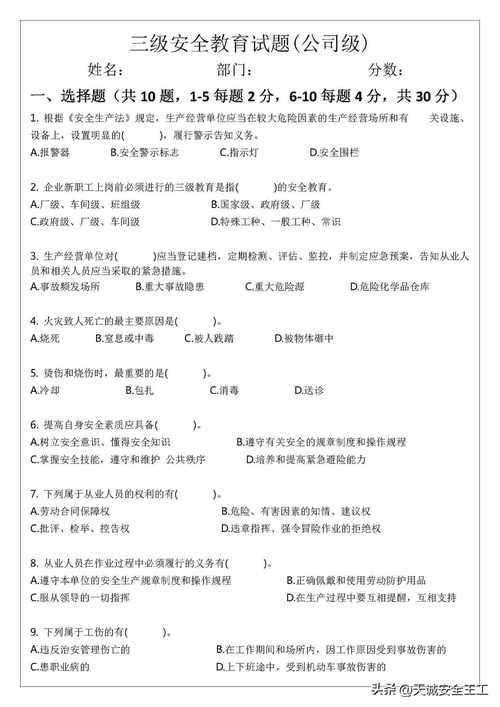
10. Any of the following shall not be considered as an injury at work or as an injury at the same time。
A. Victims of intentional crime in the workplace
B. Persons injured by alcohol or drug abuse in dormitories
C. Victims of self-harm or suicide at the workplace
D. Measures taken to protect the interests of the state and in the public interest, such as disaster relief while travelling
Answer: a, b, c
According to the employment injury insurance ordinance, work injuries may not be considered if they result from intentional offences, intoxication or drug abuse, self-harm or suicide. Option d, although not during working hours, is considered to be a case of similar work injury in the interest of the state。
11. According to the company's environmental and occupational health safety awards and penalties system, there are two or more consecutive accidents occurring in the sector and for the same reason in one year. The responsible manager of the sector for the accident () is awarded an additional sum of $1,000 on the basis of the original appraisal。
A. Part-time departmental security officers
B. Heads of department
C. Head of departmental interface
D. Company security officers
E. Heads of company
Answer: a, b
Analysis: this specific application of the internal management system of the company. According to the subject, managers within the department, i. E. Part-time security officers and heads of department, are subject to additional examinations for repeated accidents。
12. The following shall be punished by imprisonment for a term not exceeding three years or by detention for persons in charge of, or directly responsible for, a major casualty or other serious consequences: if the circumstances are particularly serious, the penalty shall be imprisonment for a term not exceeding three years and not exceeding seven years。
Violations of safety management in production and operations
B. Non-compliance with national requirements for safe production facilities or safe working conditions
C. The organization of large mass events is a violation of security regulations
D. Major accidents in the production, storage, transport and use of explosive, flammable, radioactive, toxic and corrosive substances in violation of regulations
Answer: a, b, c, d
Analysis: this is the subject of an examination of the criminal law offences relating to safe production. Option a corresponds to “significantly responsible accident offences”, option b corresponds to “significant safety accident offences at work”, option c corresponds to “significant safety incident offences at large mass events” and option d corresponds to “hazardous object offences”. The penalties for these offences fall within the scope of the title description。
13. According to the company's hazardous operations safety management system, violations of the following are punishable in accordance with the company's environmental and occupational health safety management scheme, with strict accountability of the responsible units and persons。
A. Unauthorized hazardous operations
B. Responsible managers who did not conduct on-site monitoring inspections and did not visit the site
C. Preventive measures not implemented and protective gear not properly worn
D. Organization of work without hazard analysis and safety precautions
E. Failure to address safety matters and individual protection and contingency requirements
Answer: a, b, c, d, e
Analysis: hazardous operations management must strictly follow processes and regulations. All options, ranging from undocumented operations, management deficiencies, lack of measures to lack of clarity, are serious violations of the security management system and are subject to accountability。
The following are some of the “no-win” principles for investigating and dealing with work-related accidents。
A. Causes of accidents pass
B. Failure by those responsible
C. No precautionary measures pass
D. Uneducated surroundings pass
E. Examination and non-payment of fines pass
Answer: a, b, c, d
Analysis: the principle of “four without exception” in the handling of accidents is that the cause of the accident remains unclarified, those responsible do not, corrective measures are not implemented and the persons concerned are not educated. Option e, " examination and non-payment of fines " , is not central to the principle。
15. According to the company's class safety management system, each operation must be preceded by a prior hazard analysis, safety precautions and operational safety alerts. Includes:)
A. Prior hazard analysis of equipment repairs, maintenance and equipment failure emergency response, as well as of incidents that have occurred, where operational standards do not specify operating methods and safety precautions
B. Clothes of labour insurance supplies, approval of approved operations (including planning, electricity, fire and focused monitoring) and implementation of measures
C. Matters that may affect the safety of the person and the safety of the vehicle, but which cannot easily be described in the context of the movement
D. Status checks: self-checking and cross-checking of employees ' clothing, mental state and health. ... Pre-service education...
E. Prior hazard analysis of changes in production or overhaul operations; changes in production equipment, safety installations, appliances or operating environment
Answer: a, b, c, d, e
The pre-class will be a forward security management position. All options, ranging from hazard analysis, identification of measures, status checks to safety education, are important elements to be covered by pre-classes to ensure safety before operations begin。
Iii. Questions of judgement
17. Outside fire occurs, and when a fire breaks out, the door opens immediately inside。
Answer: wrong
When there's a fire outside, you can't just open the door. The doorboard should be touched with the back of the hand, which is dangerous when it feels hot, indicating that fire or high-temperature smoke is outside the door. Wet cloths should be used to block the door stitches, to call for help in the window and wait for help。
18. For the comfort of the course of the operation, it is possible to wear fat clothing, gloves and manoeuvre equipment with rotating components。
Answer: wrong
(a) when operating the rotary equipment (e. G. Car bed, drill bed), it is strictly forbidden to wear fat clothes and gloves, as they are highly susceptible to being entangled by the equipment's rotational parts, resulting in serious personal injury。
19. According to the company's labour protection supplies management system, all labour protection supplies issued by the various departments must be kept on a permanent basis, with the registration form for the issuance of labour protection supplies, which is confirmed by the recipient's signature and is strictly forbidden to sign on behalf。
Answer: yes
The records of the issuance of labour protection items are important accounts for security management and must be real and traceable. Both my signature and permanent retention are intended to clarify responsibilities, to ensure that protective supplies are issued and to provide a basis for verification when required。
20. Long hair beyond the neck, with a hair or a braid, should be placed in a job hat to enter the production site
Answer: yes
This is a basic safety requirement to prevent hair from being drawn into or entangled in machines and is a mandatory requirement for long-haired persons。
21. The application of leak protections with the use of handheld electrical tools of category i, while the use of handheld electrical tools of category ii was not used when overhauled in wet and closed containers。
Answer: wrong
Analysis: the statement is inconsistent. Category i tools must be protected by site (to zero) and equipped with leak protections. In hazardous environments, such as damp, closed containers, the use of hand-held electrical tools with a higher safety level, class ii or iii, is required. The title “unused” was wrong。
22. Under the company's environmental and occupational health safety awards and penalties system, there are retaliations and trappings against those who implement the regulations on safe production, protection and protection of those responsible for accidents, as well as demotion or dismissal (dismissal) of those responsible (part-time worker, part-time safety officer, department responsible); the individual's presence under this article may be subject to dismissal。
Answer: yes
Combating retaliation against security managers and those responsible for harbouring accidents is a serious breach of the security management order, and the corporate system imposes the most severe penalties for such acts, including dismissal of managers and dismissal of employees。
23. In the event of an examination of an occupational taboo, or of health damage related to the job, the employment contract with the employee must be terminated or terminated, and the employee must not be allowed to work in his or her own job。
Answer: wrong
According to the act on the prevention and control of occupational diseases, employers who detect occupational health hazards or occupational taboos associated with the occupation in which they are employed should be transferred from their former jobs and placed properly, rather than directly terminated。
24. High-temperature, medium- and summer emergency disposal measures are aimed at moving patients immediately to ventilated, cold and dry areas. For example, in corridors, shades and lounges, patients are given extensive access to hot foods such as green bean soup, salt water or drinks。
Answer: wrong
The first half is correct. However, for conscious heaters, beverages with salt should be supplemented, such as desalination or sports drinks. The use of green bean soup is not a standard first-aid measure, and forced water feeding is strictly prohibited for unconscious patients in order to avoid suffocation。