1. During the practical use of the glass curtain wall of the glass curtain wall, the reason for which the glass curtain wall has to be leaked and the quality of which is most directly felt by the owner and which is the most daily problem, has been one of the most common ills and ills in the glass curtain wall for many years. The reasons for water seepage in the glass curtain wall are complex and involve design, material application, construction and management, and research should be intensified to develop effective and efficient measures for integrated management and prevention. 1. Design (1) aluminium pillars of the main subjection component are not standardized for a 20 mm stretch, and aluminium materials are hotly swollen and coldly condensed, and the main structure condensed into a deformation with the capacity to break glass and produce seepage. (2) the design was not based on the application of a larger condensation seal and did not make the necessary calculations. For example, resistance to silica sealing is up to 25% and double the normal sealing capacity
2. The size of the position of the pre-plug must be calculated on this basis, otherwise the seal is less able to adapt to deformation, and the temperature changes will self-defeat or ablaze and lose its waterproof function. (3) the opening of windows for waterproof sealing has failed or the number of seals is insufficient (generally two to three seals are required), resulting in rain flowing along the curtain wall, entering directly into the opening window and flooding. (4) the interface with the building was handled without joint research and collaboration with the civil establishment, but rather with the construction of separate pipes, which led to the appearance of water infiltration channels. In particular, the roofs of the curtain wall between the top of the curtain wall and the daughter's wall are not well connected and are not tightly sealed, such as screw holes, non-plugging of glue on the top of the ceiling and impregnated, leaking water channels. 2. Aluminium-type (1) surface treatment of aluminium-type materials does not meet national standards, surface coatings are not strong, film oxides are too thin or thick (regulating that the thickness of the anode-oxidation film should not be lower than aa)
Levels 3, 15) resulting in the failure of the seal glue. (2) aluminium columns and beams of the main subject matter are of insufficient strength and rigidity, with cross-section receptors partially thickened by less than 3 mm, with a relative scratch exceeding l/180 or an absolute scratch greater than 20 mm, with a severe disfigurement of the curtain wall, displacement and seepage of rainwater. (3) high-quality, high-precision aluminium-type materials (where the curtain wall pillars should be of a super-precision level) have not been used, and aluminium-type materials are unsatisfactory, with severe excesses such as bending, twisting, wavelength, etc., resulting in the entire curtain wall being flat, vertically inadequate. 3. Seal seals (1) in the interest of cost savings, a general seal, rather than an impregnable silicone sealant, is used to embed external stitches, irradiated by solar uv on the curtain wall, and the glue is ageing prematurely, causing cracks. (2) lack of attention to structural silica sealing, durability
4. Silicone sealed glue, wallside adhesion effective life, expiry of use, sew-up bubbles, cracks or lack of condensation, resulting in water seepage from curtain walls. (3) there has been no standard test for the compatibility of structural silicone sealed exposure materials, resulting in the incompatibility of structural silicone seals with materials such as aluminium, glass, glue bars, etc., resulting in chemical changes affecting adhesiveity and sealing. 4. Glass (1) the strength of the glass is not measured and the glass does not have sufficient carrying capacity to break into water under a storm. (2) the glass is not subject to thermal stress, and the large area of the glass absorbs sunlight, which exceeds its permissible stress, causing heat breaks and leaks in the curtain wall. (3) the glass size is above standard, the glass is embedded in two forces and the gap does not meet the design requirements and is installed on the glass curtain wall; the glass is small, the slot is not embedded in depth, the glue is not wide enough and the glass is easily sided
5. Battered edges; when the glass is large, the slot is embedded too deep, and the glass is exposed to heat expansion and implosion by implosion by aluminium. When the glass is installed on the wall of the glass in an inaccurate size, the width of the glue is uneven and it is difficult to control the quality of the glue. The regulation states that the glass sewn in the glass screen should not be less than 15 mm in width, so as to ensure that the gap in the suture meets the requirements of the curtain wall for inter-situation due to earthquakes and temperature changes and does not break glass. (4) the glass is not subject to an angle of perforation, and when used as a curtain wall, the glass is susceptible to stress concentration, resulting in a dark crack or self-explosion, and there are hazards. 5. Construction (1) aluminium frame installation, which does not comply with specifications, does not capture quality, horizontal, vertical, diagonal and straight, directly affecting the physical performance of the curtain wall. Generally, the water flow is much larger than the average flow on the glass wall, and the seam is the main leak, if
6. Components are connected without sealing, and the installation of glass will inevitably seep. (2) the construction of seals resistant to silica is not carried out in a secret manner, and the seals are not rigid or the long width ratio is not in accordance with the regulations. The norm provides that the construction thickness shall be greater than 3, 5 mm and less than 4, 5 mm, that the height shall not be less than two times the thickness and that it shall not bind on three sides. The too thinness of the construction of silica-resistant seals does not guarantee the quality of the seals and has adverse stress effects on the temperature changes of the materials; it is too thick and, on the other hand, prone to being pulled off, rendering the seals and leakproofs ineffective, with rainwater leaking into the room from the filling gaps and cracks. (3) the conditions for the construction of sealed glue are not taken seriously. The southern region is characterized by heavy rainfall, such as forced open-air construction during the rainy season to withstand sealing. There are also certain temperature and humidity conditions for construction of structural glue, which must be noted. (4) seal seals do not fit or use poor materials, which are loose or aging quickly, and which lose their waterproofing。
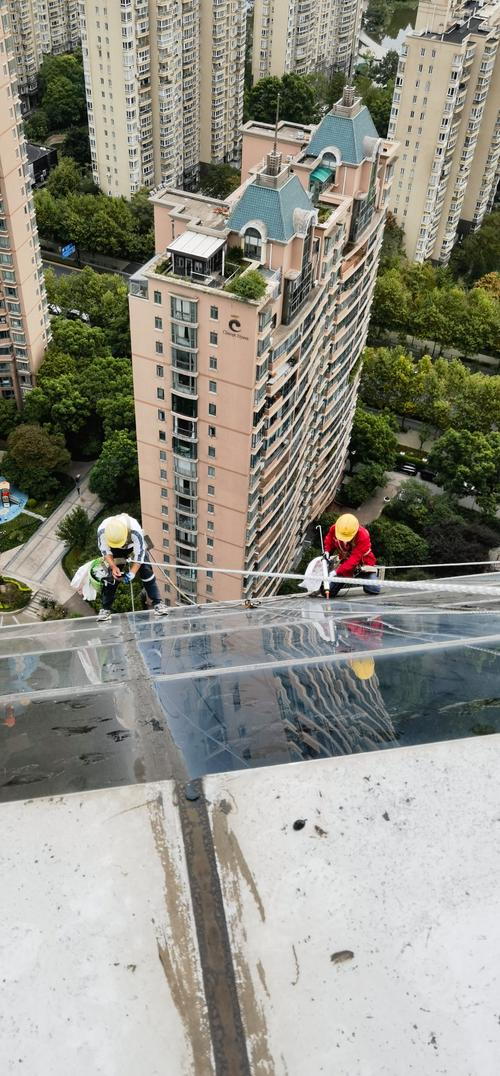
7. (5) no flexible positioning pads have been used and glass is in direct contact with components. When buildings are deformed or temperature changes, the components generate greater stress on glass, often breaking glass from the bottom of the glass. 6. Use (1) no detailed completed information and instructions were provided to the user, and the user was not aware of the method of using the curtain wall, resulting in damage to the curtain wall, collision deformation, contamination, etc., resulting in water infiltration. (2) when the outer wall is cleaned, inappropriate operations can easily cause damage to the curtain wall, such as the fact that the cleaning company is given a homing basket rope, often hanging directly on the top of the curtain wall on the glue stitches, which result in water seepage. A glass cleaning agent that does not use a neutral cleaning agent or that is washed clean with no water after cleaning can cause corrosion and damage to sealing performance. (3) households undertake unauthorised retrofitting, without careful filling and waterproofing of damaged areas. Ii. Waterproofing of curtain walls
There are three basic conditions for water seepage and leakage from the curtain wall: the presence of holes; the presence of water; and the presence of low pressure from seepage cracks. The elimination of one or more of these basic conditions is the way to combat leakage: first, to minimize the hole; secondly, to block the rain so that it does not soak the gap as much as possible; and thirdly, to reduce the wind pressure differentials in the immersion gap. 1. The design first considers the design of the waterproofing of the curtain wall, using the same pressure method, and the introduction of the cavity and special pressure into the aluminium material of the curtain wall, so that the internal pressure of the cavity is balanced with the external pressure by introducing the hole through special pressure, moving the pressure differentials to the inside side of the rainwater, so that there is no wind pressure, and there is no water, so as to prevent external water from using the pressure differentials to penetrate the curtain wall, which is an active waterproof measure. 2. The opening of aluminium on the curtain wall to leak out the water hole outside the house, and the passage through it
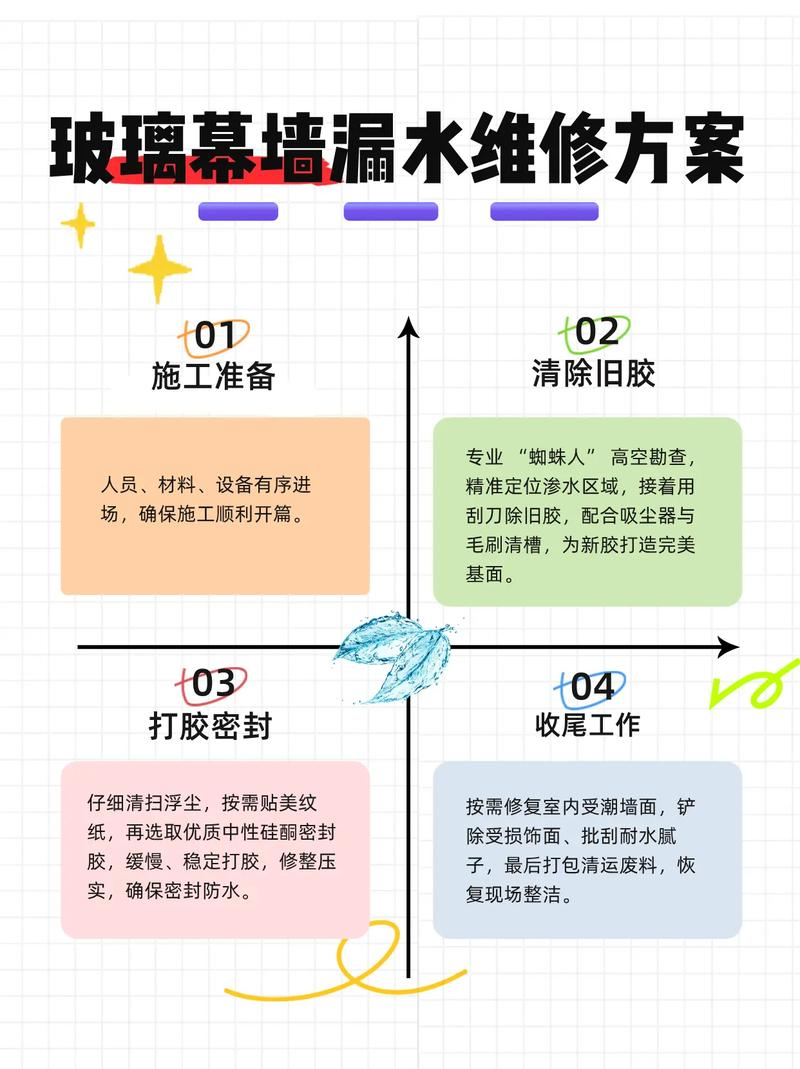
9. One of the effective methods of water treatment is the collection of water inside the curtain wall by small cracks and the collection of water outside the curtain wall, along with the release of a small amount of water within the pressurized cavity between glass, aluminium type and aluminium buttons. 3. Consideration may also be given to the installation of collection and drainage pipes on the glass curtain wall, the collection of water for penetration into the curtain wall and the smooth discharge through the drainage pipe to a designated drainage hole in the room, which is another reliable water treatment measure. 4. Select high-quality structural silicone seals, silone resistant seals, wallside glues, and strengthen tests to prevent obsolete use. High-quality float glass is selected, which must be treated by edges and the glass specification size error meets standard requirements. 5. Take care to control the environment in which seals are used and to prohibit the construction of impregnated silicone seals in the open rain. Construction workshops with structural glue required cleanness of dust, and indoor temperatures should not be higher than 27°c
10 the relative humidity should not be less than 50%. 6. Structured silica seals, silica seals and wallside glues should be removed from the aluminum frame, glass or sutures, oil stains, loose matter and her dirty material, after which they should be filled, surface levelled, improved maintenance and protection against hand touching, water rushes, etc. 7. The construction of the glass curtain wall should be carried out in accordance with the norm, with the aim of repairing and intermediate control of the quality of the curtain wall, in layers. 8. The glass curtain wall is subject to a quality check, with two separate categories of receiving and inspection and engineering inspection. Concealment is carried out after the aluminium frame has been installed. The main tests are the level of safety of the connection code, the installation of gap points between the curtain wall and the main structure, the installation of stretching stitches, etc. The acceptance of the works was carried out after the completion of the glass curtain wall work, and the acceptance of the glass curtain wall was completed, i. E. The intermediate acceptance of the sub-project work. 9. The opening of windows should be carefully checked if sealing is achieved, the fittings are of good quality and reliable, and the opening and closing are flexible. 10. While cleaning the curtain walls, they are cleaned by professional cleaning companies and must be organized in detail and without any damage to the curtain walls. 11. Complete receipt and inspection information is refined and handed over to the relevant authorities, and the user units should develop, in a timely manner, plans and systems for the maintenance, repair and repair of the curtain wall in accordance with the instructions。