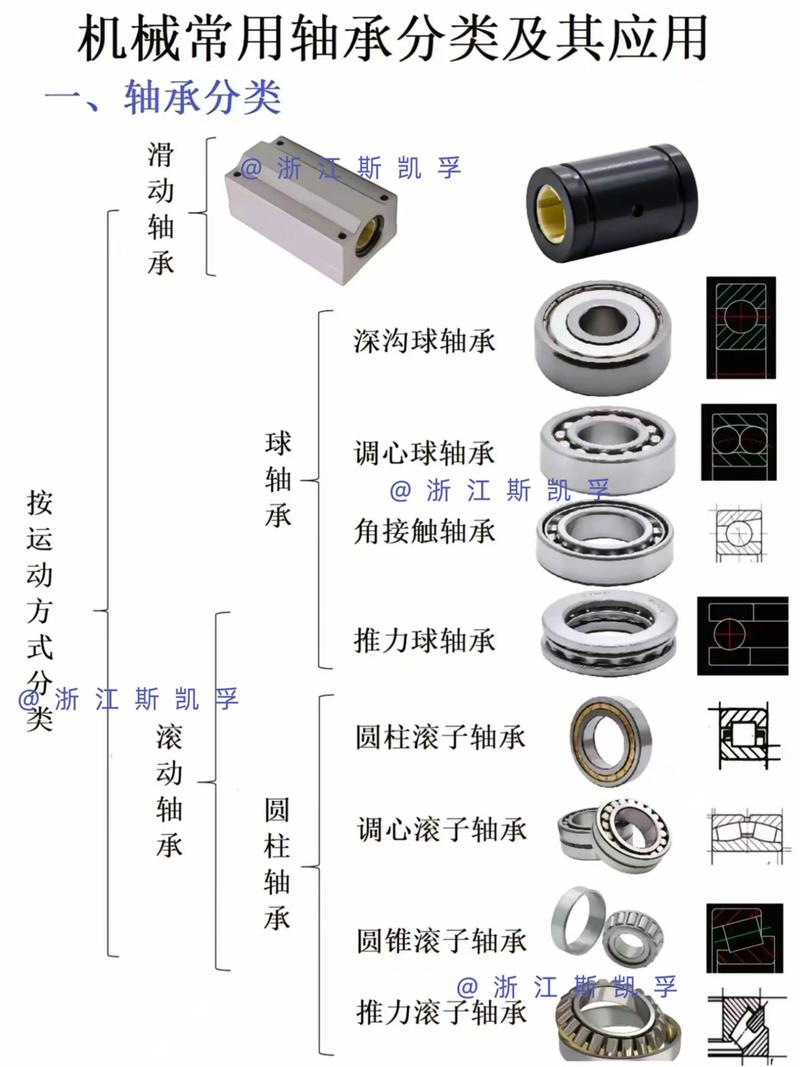
Axle bearing bearing bearing bearings and parts on the axis to ensure its rotational accuracy. Depending on the friction nature of the bearing work, it can be divided into slide bearings and scroll bearings. The slide bearings have the advantages of job stability, noise-freeness, small diameter size, shock resistance and high carrying capacity. The rolling bearings, on the other hand, are standard parts with low production costs in bulk, ease of installation and wide application. For beginners, the type selection of scroll bearings; lifetime calculations; and combination design is more difficult to master. Therefore, the lifetime calculation and portfolio design of scroll bearings are the focus of this chapter。
§ 11-1 slide bearings. (2) suspended slide bearings, which bear only an axle bearing. The smoothing axle bearing massage (lubrication) state can be divided into liquid friction (lubrication) bearings and non-liquid friction (lubrication) bearings. (1) liquid friction bearings (full liquid lubrication bearings) the liquid friction bearings are based on the principle that there is sufficient lubricating oil between the axle neck and the friction face of the axle, which is more thick and completely separates the neck from the axle surface. Therefore, the friction factor is very small, and the normal friction factor = ~ as a result of maintaining a stable liquid lubrication state at all times. This bearing applies to high speed, high accuracy and heavy loads. (2) non-liquid friction bearings (incomplete liquid lubrication bearings) non-liquid friction bearings rely on very thin oil membranes attached to the surfaces of the axes and bearings, which alone cannot completely separate the two friction surfaces and have a portion of them in direct contact. So the friction coefficient is high, =. If the lubricants are completely lost, there will be dry friction. Heavy friction, wear and even adhesive damage. Advantages: (1) high carrying capacity; (2) smooth and reliable work, low noise; (3) small diameter size; (4) high accuracy; (5) low friction and wear when fluid lubrication occurs; (6) certain insulation capacity of the oil film; (2) fluid friction bearings are difficult to achieve in the event of higher start, roll, load and turn speed; (3) fluid friction, smooth bearing design, manufacture and maintenance costs are high。
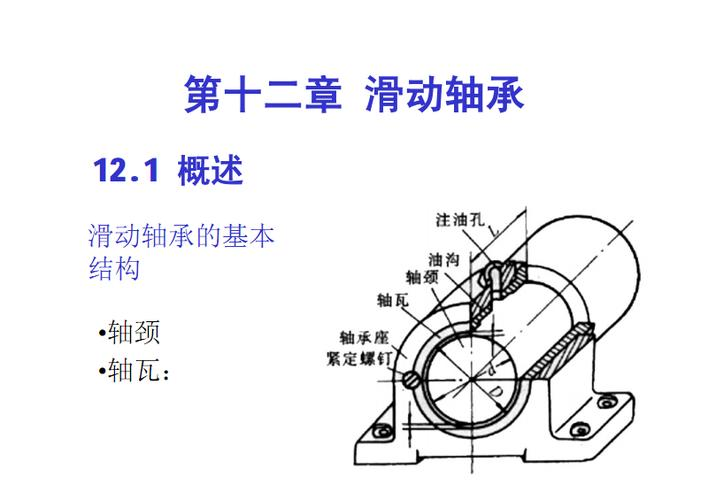
§ 11-2 the structure and materials of the slide bearings i. The directional slide bearings 1. The overall slide bearings. The overall slide bearing structure consists of the axe bearings 1 and 2, as shown in the graph, with oil holes in the upper bearings and oil ditches in the overall linings for refuelling and inducing oil for lubrication. The bearings are simple and inexpensive, but the fittings of the axes are not convenient and the trajectories of the rear bearings cannot be adjusted. Use in situations where low-speed or intermittent work is carried by light. 2. Open slide bearings
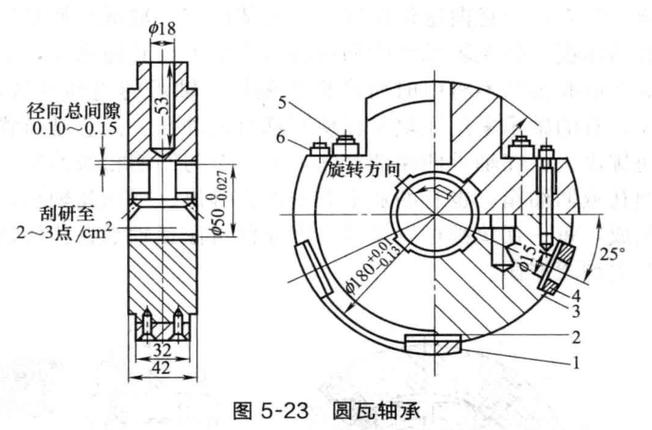
An open slide bearing structure, as shown in the chart, consists of axle bearings, axle bearings, an open axles, double-headed screws and gaskets. Axle bearings and axle bearings are formed to form a stairwell, for positioning purposes. There are gaskets here to adjust the directional gap of bearings after wear and tear. So it's convenient and widely used. 3. The structure of the auto-motion bearings, as shown in the graph, is shaped into a spherical shape, in contact with the inside of the pellets of the bearings, which automatically adjusts to the slopes generated by the axes when bending and reduces local wear and tear. For situations where the interlocking bearings are larger or longer。
The structure of the brake slide bearings, as shown in the figure, can be divided into three forms: solid brake bearings, greater central pressure on the end of the neck of the axis than on the edge, less accessible lubricants and poor lubrication conditions. The hollow-stop slide bearings, the mid-altitude portion of the end of the neck of the axis can contain oil, the pressure is more even and the carrying capacity is low. Multi-ring slide bearings, with more even pressure, capable of bearing larger loads. But the rings vary, and the rings are not too many. Iii. Materials
1. The requirements for bearing materials are: (i) primarily to consider these types of failure of bearings, the requirements for bearing materials are as follows: (i) adequate tensile strength, fatigue and impact capacity; (ii) good reduction, resistance and adhesiveness; (iii) good adaptability, embedding and composting; (iv) good corrosiveness, thermal chemistry (heat transfer and heat expansion) and smoothing (absorption to oil) (5) good plasticity. Capable of adapting to axle bending and other geometric errors. (6) good technical and economic. Axes can be made of a material or a metal liner may be cast on the surface of the axle. That's the bearing line. Common materials: (1) cast iron: grey iron; ball iron - good performance - suitable for light-loading, low-speed, and not subject to shocks. (2) axle bearing alloy - consisting of tin (sn), copper (pb), antimony (sb), copper (cu) etc. (3) copper alloy - cascading copper, lead copper, aluminium copper (4) aluminium base alloy: may be made of monometallic axle or of double metal axle lined with steel. (5) multi-polymetallic materials (powder metallurgical) - oil-bearing axle bearing (6) precipital metallurgy: copper-based powder metallurgical - decomposition, anti-fouling good iron-based powder metallurgy - good grindability, high intensity see table 11-1 of the teaching materials. The structure of the axle-walls, as shown in the figure, is divided into two structures, one holistic and one-sided. An open axle is a bearing area and a non-carrying area with a general load down, so the upper is a non-carrying area and the lower is a carrying area. Lubricating oil shall be imported into the non-carrying area. As a result, the top of the upper balconies has an oil hole. On the inside of the axle, where the position is symmetrical with the entry of the oil, there is a ditch along the axis, around it or on it, and the oil is distributed across the axis necks. The ditch should be at a distance from the end of the axle and not open to reduce the discharge. In order to consolidate the bearing liner with the axle wafer, a number of grooves can be created on the surface of the axle wafer。
§ 11-3 the lubricating bearings of the slide bearings require good lubrication, which is important for reducing friction and increasing efficiency; reducing wear and tear and extending life; cooling and spreading heat; and ensuring that the bearings work properly。
L. Lubricant 1. Lubricant. Fluid-powered lubricating bearings (e. G. Lubricated lubricant), viscousness is the most important reference indicator for the selection of lubricant. When choosing viscity, the following basic principles should be taken into account: (1) when pressure is high, temperature is high, and the impact of the load is very high, the lubricant should be selected: (1) when the pressure is high, the lubricant is high, the lubricated lubricant should be easily formed; (2) when the rate of movement is high, it should be easy to form a film (when the rate is high), in order to reduce friction, the less viscous lubricated or unrunable surfaces should be selected for higher lubricating oil. Table 11-2. 2 of the reference material characteristics: thickness, not vulnerable to loss, carrying capacity stability, friction is high, mobility differential, no cooling - suitable for low-speed heavy load and temperature changes, difficult for continuous oil supply. For example, calcium or composite calcium ~3) with higher temperature at a high point of temperature shall select highly water-resistant lubricant - aluminium, lubricant, calcium ~ 3, solid lubricant axis working at high temperature, low speed, heavy load, where the application of lubricant or lipid is not appropriate - - formation of solid membranes on friction surfaces, commonly used: graphite, polytetrafluoroethylene, molybdenum disulfide, tungsten disulfide, etc. Methods of use: (1) redeployed for use in oil or fat; (2) coating or burning to friction surfaces; (3) seepage in axle-wall materials or formation mosaics for use in axle bearing. A lubrication method. The lubrication method for slide bearings can be selected after the k value is obtained in the lower calculation: in the formula: p for the average pressure of the neck, mpa; v for the round velocity of the neck m/s. When k≤2, choose lubricant lubrication and lubricant with a lid cup. When k<2 ~16 hours, (1) the kettle or gun is regularly charged with lubricating oils in lubricating holes and cups, figures 11-9, impregnated cups, figures 11-10, spiral cups, pin-valve cups, figures 11-11, suction drops on the necks using the plume from the core. When k<16 ~32, the cyclopedia lubricates, the bottom of the cyclopedia is immersed in the oil graphs 11-13, the splattered lubricant is used to lubricate the lubricating oils with the rotors of the lower end immersed in the oil tank. When k>32 pressure cycle lubrication - continuous pressure from a pump for oil, lubrication, cooling, which is more effective and suitable for heavy, high-speed or turnloading。
§ 11-4 the design of incomplete liquid lubricating bearings calculates that most of the bearings are actually in a state of mixed lubrication (a state in which boundary lubrication coexists with liquid lubrication), where reliable work is carried out on the condition that the boundary oil membranes are not damaged in order to reduce heat and wear (computation guidelines) and determine the working capacity of the bearings based on the mechanical strength of the boundary membrane and the temperature of break-ups. However, the factors affecting the boundary membrane are complex, with simplified conditionalities. I. The directional slide bearing is usually known as the axis neck diameterd. Rotation n and direction load fr. Based on these conditions, the structural shape of the bearing is selected, the width of the bearing b is determined and calibration is performed; for incomplete liquid lubricating bearings, the constant width is b=(~)d. Since the main forms of failure of the slide bearings are wear and tear and glue, corresponding calculations are made. 1. Limiting average pressure p purpose: to avoid the complete crowding out of lubricating oil with payload effect, leading to excessive wear of bearings mpa
—put pressure on mpa, table 11-1, d, b — axe neck diameter and width (mm) fr is the routing load (n). The pv values of the restricted bearings are intended to reflect friction and heat in the unit area. The higher the pv, the higher the heat of the bearings, the more likely it is to cause the rupture of the boundary film. Mpa. M/s
In formula, n-axis neck turn speed, r/min; v-axis neck circle speedm/s
- pv values for bearing materials, table 11-1. 3 for the purpose of limiting sliding speed v: when p is smaller, avoid the acceleration of axle-wall wear due to v being too high. M/s
The calculation of the brake bearings is similar to that of the slide bearings, as shown in teaching materials 11-16, where the hard-core side is worn at the edges of the edges as the centre is not evenly balanced with the edges, which can be overcome by the loss of the edges. When the payload is large, it can use a multi-ring neck. Pm mpa fa — axial bearing (n); d1,d2 — interpolation ring, outer diameter mm
-put a ratio on mpa. Table 11-4. Pvm values for restricted bearings s: dm=(d1+d2)/2 - average diameter of the stopring ring, mm vm - circular speed of the stopring ring average diameter, m/s
Pv
—p, vm, multi-ring bearings, considering uneven stress, table 11-4. Case 11-1 (slight)
§ 11-5 liquid lubricating bearings, based on the method of lubricating oil membrane formation, may be divided into liquid kinetic lubricating bearings and liquid static lubricating bearings. Body pressure lubricating bearings
As there is a curved wedge between the neck and the axle, the lubricated oil fills the gap. The axle is still and the load on the axle allows direct contact between the neck and the axle. When the axis is acoustic, the neck rolls up along the right wall of the axis and squeezes the lubricants into the wedge. As lubricant is squeezed from large space to small space, there is a significant pressure as the speed of rotation increases. It's enough to lift the axle to form a very thick pressure film. When the thickness of the oil membrane is greater than the sum of the uneven surfaces of the two exposures, the exposure between the axle neck and the axle wafer is completely separated from the membrane. The friction drops rapidly and, with the combined effect, the neck moves to the lower left. The oil membrane pressure is balanced with the external load, and the axis neck rotates normally in a stable position。