Introduction
Metal components are damaged by corrosion as a result of prolonged exposure to wet air, and their surface rusting, coating and protection processes and critical manufacturing of equipment became the strategic focus of the country for the 12-fifth period. The annual value of steel consumed by corrosion is estimated at nearly $500 billion. Traditional protection techniques such as acid washing and electroplating have been explicitly banned from an environmental perspective. The rapid and clean handling of metal construction surfaces through projectile techniques and equipment has increased both the quality of surface clean-up and surface pressure, increased the ability of work units to resist erosion, facilitated the achievement of digitisation and intellectualization, and has become the current green, efficient, intelligent and environmentally friendly surface treatment technology. However, the current projectile techniques and equipment in the country are less efficient and do not meet mass production requirements. (a) the separation is incomplete, plus the theatre projectile resistant to grinding; low operational life of projectiles and their key components; low automation of equipment and poor manufacturing process; and failure of dust removal equipment to meet environmental requirements. In order to address the above difficulties, shandong kaitai dumpling machinery co. Ltd. And jinan university jointly developed several new efficient projectile techniques and equipment and conducted research on the manufacturing of its key components with a view to increasing the efficiency and use of projectiles yiu
2. Some new types of anti-ballistic machines
2. 1 high-impact roller-ball projectors (standard model: qgt1500)
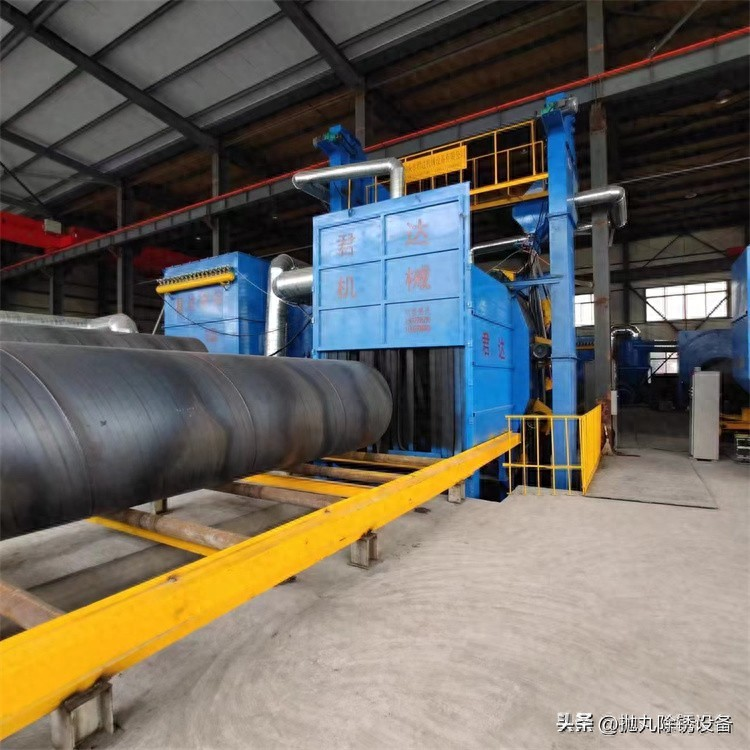
Combined with the characteristics of the q31 roller and q32 tracked projectile cleaners, both overcome the shortcomings of the q31 series, which cannot automatically discharge material, high labour intensity, and the weak weight capacity of the q32 series, which has resulted in the development of an efficient projectile and its key components manufacturing process and technology research, china's sixth high-level forum on social responsibility and sustainable development the high level of automation, low labour intensity of workers, high equipment carrying capacity and efficient clean-up of new high-impact roller projectors. The main components of the projectile, roller, sealed doors, fighter lifters, bullet separation devices, fluids, feeder agencies, electrical control systems, dust removal systems, hydraulic pressure systems, etc., are shown in figure 1. The method of work is that the material-loading works are then put into the clean-up roller, the roller's side rotated by a ball of steel thrown by a plower, and the finished product is discharged by the roller tilts and turns around. During the roller, the cauldron rises to 45 and the roller is 35. The angle of the arm centre and the centre of the roller is 43, as shown in figure 2a. Upon completion of the material, the cascading drops back, the roller starts to throw, and during the roller throw, the centre moves between 30 degrees and 35, as shown in figure 2b. After the throwing of the steel pill and the cleaning of the oxidized skin, the type sand etc. Were delivered to the upper ball sand separator through the fight lifter, the broken steel and the cleaned removal were separated, only the usable steel pill was re-supplyed through the bulletball gate and the waste was separated. The dust produced in the course of the clean-up was captured and isolated through the dedustor。
(a) the projectile structure; (b) physical photographs of the projectile
Figure 1. Structure of the new roller-ball cleaner
(a) feeding process; (b) throwing process
Figure 2. New roller-ball projector working principles
2. 2 net passer-by-ball projector
Web belts have achieved continuous operation of small and medium-sized castings through a projectile cleanup machine, which can be combined with linear operations through the deployment of delivery devices at both ends, and full automation, which avoids collisions between works and greatly improves clearance efficiency. This machine has a delivery system, a clean-up room, a fight lifter, a projectile projector, a fluid door, a repair platform, a bullet-ball separation device, a vertical spiral, a horizontal spiral, a high-pressure blow-out system, delivery to the shell, delivery to the shell, a dust removal system and a component of an electrical control system, as shown in figure 3a. Physical photographs of the web-based projectiles are shown in figure 4a. Using a web-based structure, steel balls can be ejected at speeds that can be adjusted with frequency depending on the type of work, the projectile will be more even, and the time for cleaning will be significantly shorter and more efficient. It is possible to achieve parallel use and significantly reduce the labour intensity of workers if it is accompanied by a combination of transport channels. The clean-up room is made of a roller structure, a web structure, steel balls without collisions when ejected, or falling below the chamber, which is very suitable for casting, exercise, etc., and for various parts of thin walls that are afraid of collisions。
(a) cad (b) physical chart
Figure 3. Composition of the webband through the anti-ballistic cleaner
2. 3 mechanical handball projectors
Mechanical high-efficiency smart-painting machines consist mainly of parts such as projectors, robots, projectile clean-up rooms, fight lifters, spiralers, rollers, separators, dust removal equipment, etc. The projectile machine is an intermittent projectile clean-up device, and the robot puts the pieces together, stretches out, rotates into the projectile room, and takes a time-out and strengthens. The staggered four-ball projectors, which ejected the steelballs to the surface of the gas turbine, achieved 100% coverage of the projectile clean-up. The projectile clean-up process is carried out with low-speed throw-out, and the reinforcement process is carried out with the conversion frequency system, which increases the speed of electrical conversion. The steel ball that was thrown into the cleanup room, slipped through the v-type slot to the spiral transmitter, was batched into the fight lift feed, the post-ball mixture was lifted into the spiral transmitter and roller screen, the pill was thrown into the gravity wind and the selection was separated, while the dust was brought into a bag or filter-type scrubber for collection, with a small amount discharged from the winder. And most clean pills go into the storage room. The later steel ball enters the plower through the flow control valve and recycles. A diagram of its work is shown in figure 4。
(a) structural chart; figure
Figure 4. Mechanical hand-painting machine
3. Design and manufacturing techniques for key parts of the projectile
3. 1 key manufacturing techniques for projectiles and their mill resistance
The projectile is the heart of the whole projectile, which is divided directly into a conjunctor and a contour projectile by connecting the electric machine to the breaker wheel (charted structure divided into curved blades, double-sided blades and straight blades. At present, the dominant domestic market is dominated by 180-4rk curved leaves (power 22-45kw), 130-2rk curved leaves (power 11-22kw), x30 (power 5. 5-30kw), y360 (power 5. 5-30kw) and 034 (power 5. 5-22kw) projectiles (power 5. 5-22kw) produced by japanese technology, and by domestic technology (jinnan castery). There's a german roller plower. Linear blades, y360, x30, 034 and curved blades have a simple structure, light weight, low manufacturing cost and simple installation maintenance. Disadvantages: high rate of rotation, incompetence of vibrations and noise. Single-curve blades (fig. 6a) are characterized by high rate of projectile ejection, a comparison between the projectile of curved leaves and the projectile of straight blades, with an increase of 15 per cent in the projectile of curved blades at the same rate, which is more suitable for high-power, low-speed projectiles. For example, the 130-2rk projectile can be ejected with 81 m/s at 2900 r/min, and the y360 can be ejected with 71 m/min at 3100 r/min, with the same diameter, the same speed but different speed, and the low-turning device will be well maintained to extend its useful life. The qingdao castery machine has simplified the united states technology's 180-4rk and 130-2rk projectiles, retaining the characteristics of the curve-sharping to reduce volume and weight, and has been widely applied on products. Double-curvature blades (figure 6b) have the following advantages: increases the speed of projectiles; good resilience to friction; significantly reduces energy consumption; excessive service life; appropriate structural forms; high quality of clean-up; low projectile consumption; low parts grinding and two-way movement, precision adjustment and pre-acceleration. The smooth motion of this projectile ensures a significant increase in the speed of the output. This structure can significantly increase the speed and rate of projectiles, e. G. C-tubines can boost by 24-30% and gamma-y can boost by 25% at velocity and diameter. Compared to traditional throwers, the ability to eject increased by 70%。
(c) monobolic blades; (d) hyperbolic blades
Figure 5. Types of projectiles and leaves
A composite shell casting process was developed for grinders resistant to grinders (silisol sillute, silhouette, silhouette, and back, silhouette, silhouette, silhouette, silhouette, silhouette, light-dry online, stable shell mass, casting surfaces ra 2, ct5 ~ ct6. The production process using water glass without stone powders, such as auto-resort, slurries, drying, etc., is of stable quality and efficient in production; acupuncture complex crust resistant to grinding is less expensive than the manufacture of a fully silicate-solged shell, with shorter shell cycles, changing the position of liquid metal fillings, changing the condensation order of liquid metals, improving tissue patterns, reducing defects, improving the resistance to grinding and adapting to the production of durable grindings such as high chromium blades, demarches, directional packs (figure 6)。
Figure 6. Anti-ballistic rotors, blades and directional kits, etc
The grindables on the projectile are made up of permafrost tubes, directional holsters, split wheel, blades, blades, and grinding shield panels for the projectile. The blades use centrifugal force to throw high-speed projectiles to the surface of the work to be cleaned, to remove the slime, oxidized skin and small fly-side pricks, and to get some rough surfaces. The resistance of leaves to friction directly affects the life of the projectile. Due to the presence of a much higher hard c) in high chrome cast iron, which is in the form of a plate strip, changes the beehive shape of the permeable carbon (fe c) body, with a significant decrease in the flaccidity and a marked increase in the resistance, but there is still considerable room for improvement in the useful life. This result technique uses a composite shell casting process, which, by controlling the condensation sequence, directs m growth, significantly increases the useful life of mills, as shown in figure 7(a). By increasing nanocarbons, the project changed the quantity and shape of carbons in high-chromium cast iron, increasing the hardness of the casting, as shown in figure 7 (b). The resilience of the casting has been enhanced by the addition of primary carbon carbide conglomerates, as shown in figure 7 (c) and (d)。
(a) m7c3 directed growth; (b) m7c3sem shape; (c) m7c3sem tridimensional shape; (d) eds analysis
Figure 7. The physical and material manifestations of carbonated materials in mills
3. 2 scattered curtain separator design and manufacturing techniques
Using soliidworks three-dimensional modelling, using analisis to analyse the dynamic performance of plasters during their flow (figure 8), hydrodynamic models of plasters were developed, and overflowing curtains were developed. The slag separation device, which achieves the functions of wind selection, roller screening, spiral transport, storage of pills and control of hand-held bullet-ball locks, achieves a uniform projectile stream in the thin area of the spiral and current sandholes within the contour range. Mixers are removed from a fight lifter to a screwdriver sift, with a spiral blade inside and outside of the roll sift, and internal blades carry large pieces of miscellaneous material out of the slag mouth, and, after the sifting of the pellets and dust, the outward sift of the sift, or screwdrivers, which are sifted through the roller, so that they are equilibrated along the electoral district as a whole, forming a line of dust like waterfalls) and achieve the complete separation of the pellets, slags and dust. The clean shot goes into the next loop, lowers the friction of the grinder, improves the quality of the cleanup。
Figure 8. Fluid mechanics simulation and analysis of the spill-out full-screen drapester separators
3. 3 specialized dust removal techniques for plastering
Using the effects of interception, gravity, inertia, diffusion, dizziness and electromagnetic adsorption, specialized dust removal equipment has been developed for projectile clean-up, as shown in the figure below, which has a filtering efficiency of 99. 99 per cent, using three dimensions of super fine metal lines to woven into folding filters (bags), filtration aperture control, greater permeability, a reasonable draught depth, fear of bumping, high tolerance and conductivity. Ash is used to establish online resistance to pulses and to reduce electricity consumption; an effective filter area can be increased fourfold by a metal filter of the same size compared to an ordinary folding paper filter, fivefold by an effective filter area compared to a bag, and a much higher volume of wind treatment; an integrated structure is used to replace filters and cage bones in traditional bags dedustors;
The application of the electromagnetic adsorption principle, with significant sealing effects, ensures that the dedustor exports dust at very low emission concentrations; the single-room wind collector dust removal and dust removal unit is integrated, structured in a compact and flexible manner; the control is carried out using the plc programming ash control system to monitor the change in pressure of the dedustor, which automatically activates the pulse when the pressure differential reaches the set value of 1000 pa; the ash removal system, which uses compressed air three to four times higher than the pressure and flow of the working air, and the shaker filter removes dust accumulated on the surface from the pulses with a low frequency, not only of ash consumption, but also of extended use of pulse valves and filters, usually 150 to 350 times higher。
(a) dust removal maps for filters; (b) dust removal maps for bags; (c) dust removal maps for filters;
Figure 9 electromagnetic composite dust cleaner for pulse reverse blower
Conclusions
(1) the working principles and structural characteristics of several new efficient projectiles were discussed, the size and shape of the projectile clean-up room were designed autonomously, and the number of projectiles and other technical parameters were determined。
(2) the design and development of the key manufacturing process for the projectile and its grinding materials, the design of the overflowing curtain-filled dust separation unit, the development of the dedicated dust removal equipment for the projectile clean-up and the description of the manufacturing process characteristics of the key parts of the projectile。