Theoretical weight table of steel bars
Angular steel: = 0. 00785* per metre wt. (wider + wide — thick)*
Circle steel: = 0. 00617* diameter* diameter per metre (snone-lined steel and round steel)
Flat steel: width per metre = 0. 00785* thickness*
Tube: = 0. 02466* wall thickness* (outside-wall thickness)
Panels: = 7. 85* thickness* area per metre weight
Bronze tubes: = 0. 02670* wall thickness* (outside-wall thickness)
Copper tubes: = 0. 02796* wall thickness* (outside-wall thickness)
Aluminium graft plate: 2. 96* thickness per square metre weight
Proportion of non-ferrous metals: zone 8. 9 bronze 8. 5 zinc 7. 2 lead 11. 37
The formula for non-ferrous sheeting is: = weight* thick per square metre degrees
How to calculate the weight of screwdrivers of various specifications, is there a standard? How many?
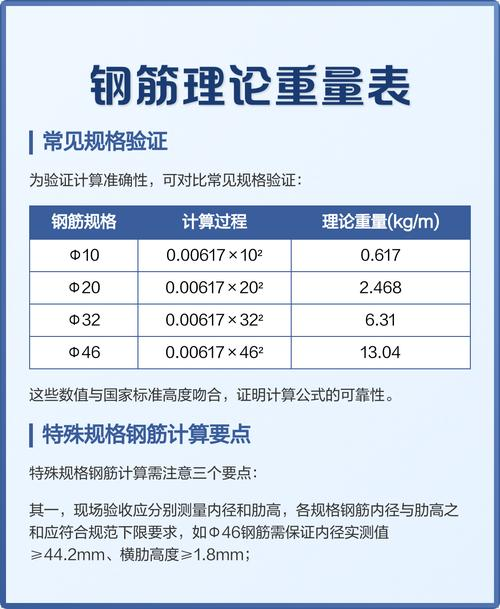
0. 617 is the weight per metre of 10 round bars. The weight of the band is proportional to the square of the diameter (radio)。
G/m=0. 617*d*d/100
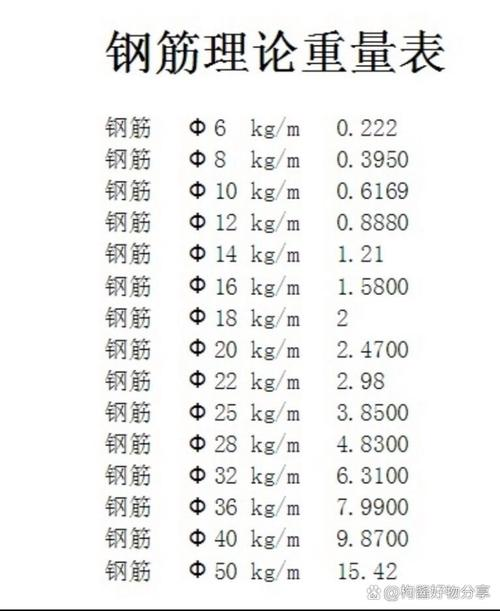
Weight per metre (kg) = diameter (mm) of steel bars x diameter (mm) of steel bars x 0. 00617
In fact, it's simple to remember that the weight of steel bands commonly used in construction works is φ6=0. 222 kg φ6. 5=0. 26kg φ8=0. 395kg φ10=0. 617kg φ12=0. 888kg Φ14=1. 21kg Φ16=1. 58kg Φ18=2. 0kg Φ24=2. 47kg Φ22=2. 98kg Φ25=3. 85kg Φ28= 4. 837kg ............
Three digits after a normal decimal point for steel bars of up to and including 12 and up to 28, ranging from 14 to 25 steel bars digits after normal decimal
Φ6 = 0. 222 kg
Φ8 = 0. 395 kg
Φ10 = 0. 617 kg
Φ12=0. 888kg
Φ14 = 1. 21 kg
Φ16 = 1. 58 kg
Φ18 = 2kg
20 = 2. 47 kg
22 = 3kg
Φ25 = 3. 86 kg
Φ28 = 4. 83 kg
Φ32 = 6. 31 kg
Φ36=7. 99kg
40 = 9. 87 kg
A simple formula for the theoretical weight calculation of steel
Flat steel, steel plate, steel belt w = 0. 00785 x width x thickness
Square steel w = 0. 00785 x border 2
Circle steel, wires, wires w = 0. 00617 x 2 diameter
Tube w = 0. 02466 x wall thickness (outside -- wall thickness)
Quadrant steel w = 0. 00785 x border thickness (blank -- thick)
W = 0. 00785 x border thickness (long + short — thick)
W = 0. 00785 x waist thick
High +f (legs wide - waist thick)
Tank steel w = 0. 00785 x waist thick
High+e (legs wide - waist thick)
Remarks
1 the exact formula for the calculation of angular steel, americ steel and argon steel is very complex and the tabular summary is used to calculate approximate values。
Value: 3. 34 for general model and belt a, 2. 65 for band b and 2. 26 for band c。
3, e: 3. 26 for general model and belt a, 2. 44 for band b and 2. 24 for band c。
4. All length units are mm
Length size of steel
The length size of steel is the most basic of all types of steel and refers to the length of steel, such as length, width, height, diameter, radius, inner diameter, outer diameter and wall thickness. The required measure of steel length is rice (m), centimetre (cm), mm (mm). In existing custom, it is also used inches, but it is not a statutory unit of measurement。
1. Scope of steel
It is an effective measure for material savings. The range is not less than a certain size, either in length or length, or in the range from how much to how much. Production units may supply at this size。
2. Uncertainty (usually length)
Where the size of the product (long or wide) is within the parameters of the standard, it does not require a fixed size called uncertain feet. The variable length is also called the normal length (premium length). Metal materials delivered on an uncertain scale, provided that they are delivered within the specified length. For example, a normal round steel, not greater than 25 mm, usually has a length of 4-10 m, and can be delivered within that length。
3. Rules
Cutting to a fixed size as required by the order is called a ruler. When delivered at a fixed length, the metal material to be delivered must have the required length specified in the order contract. For example, when the contract states that the goods are to be delivered at a fixed length of 5 m, the materials to be delivered must be 5 m long, or less than 5 m or less, and are not eligible. In practice, however, delivery of the goods could not have been 5 m long, so provision was made for positive deviations and no negative deviations。
4 times
(b) the number of times the number of times the fixed size required for the order. When delivered at multiple lengths, the metal material delivered must be delivered for the full number of times (plus sawmills) of the length specified by the party in the order contract. For example, a requirement of 2 m in the order contract requires a single length of 2 m, which is 4 m when cut to double the length and 6 m when cut to three feet, plus one or two sawns, respectively. The volume of sawsawing is specified in the standards. At the time of delivery, a positive deviation is only allowed and negative bias is not allowed。
5. Short feet
The length is less than the standard limit of the non-caliber length, but not less than the permitted minimum length called short feet. For example, the standard for water, gas and pipelines provides that 10 per cent of a series (in root terms) of short-scale steel tubes of 2-4 m is allowed. 4m is the lower limit of the degree of uncertainty and allows a minimum length of 2 m。
6. The narrow rule
The width is less than the standard limit of the degree of uncertainty, but not less than the narrowest allowed. When delivered by narrow feet, care must be taken of the narrow scale and the narrowest measures specified by the relevant standards。
Examples of steel length sizes
Length size of steel type 1
(1) the standard length of rail tracks is 12. 5 m and 25 m。
(2) circle steel, threads, steel wire sizes are marked by the number of mm (mm) in diameter d。
(3) the size of a square steel is marked by the number of mm(mm) of a long edge。
(4) the dimensions of hexagon steel and eight-angle steel are determined by the number of mm (mm) of the margin distance s。
(5) the size of flat steel is marked by the number of mm (mm) of width b and thickness d。
(6) the size of the working-word steel, tank steel, shall be determined by the number of mm (mm) of the waist height h, leg width b and waist thickness d。
(7) the size of the amphibious edge steel is determined by the number of millimetres (mm) equal to the width b and d of the edge. The size of the edge steel varies by the number of mm (mm) of the width b, b and d of the edge。
(8) the size of a steel of type h is determined by the number of mm (mm) at the abdomen heighth, the width of the wing plateb and the thickness of the abdomen t1, the thickness of the wing plate t2。
2. Length dimensions of steel plates, belts
(1) the number of mm (mm) is generally indicated by the thickness of the steel plate d. The belt is marked by the width of the bandb and the number of mm (mm) of the thickness d。
(2) a single sheet of steel has specified different sizes, such as: 1 mm thick steel plate with a width of 600 x 2000 mm; 650 x 2000 mm; 700 x 1420 mm; 750 x 1500 mm; 900 x 1800 mm; 1000 x 2000 mm etc。
3. Length dimensions of tubes
(1) the number of millimetres (mm) is generally marked by the outer diameter d of the pipe, the inner diameter and the wall thickness s。
(2) each tube has a specified different size, such as 15 of the 50 mm diameter of the seamless steel pipe, with a wall thickness of 2. 5-10 mm; or 29 of the 32-195 mm diameter, with the same wall thickness of 5 mm. Also, welding steel pipes are known as 25 mm walls with 3. 25 mm ordinary steel pipes and 4 mm thicker steel pipes。
Steel weight
1. Theoretical weight of steel
Theoretical weight of steel is referred to as the theoretical weight calculated by the common size and density of the steel (previously referred to as weight). This is directly related to the length size of the steel, cross-section area and permitted deviations in size. The theoretical weight in formulae differs from the actual weight because of the permitted deviations in the manufacture of steel and is therefore used only as a reference for estimation。
2. The actual weight of steel in steel means the weight of the steel in real terms (exceeded pounds), known as the actual weight. The actual weight is more accurate than the theoretical weight。
3. Method of calculating steel weights
(1) gross weight is the symmetric "net weight" and is the aggregate mass of the steel itself and the packaging material. Transportation enterprises calculate freight at gross weight. However, steel purchases are based on net weight。
(2) net weight is the symmetry of “gross weight”. The gross steel weight less the weight of the packaging material, i. E. The actual weight, is called net weight. In steel purchases and sales, net weight is generally used。
(3) the weight of the packaging material for steel, referred to as the skin weight。
(4) the weight units to be used in determining the freight rate by the gross weight of steel. It has a mandatory measurement unit of 1,000 kg, plus long tons (1016. 16 kg) and short tons (907. 18 kg) of united states weight。
(5) the weight of the fee is also referred to as “charging tons” or “freight tons”. Weight of steel for freight charges in the transport sector. Different modes of transport are subject to different calculation criteria and methods. In the case of whole-car rail transport, the weight of the charge is generally measured using the truck markings used. Road transport charges are charged in conjunction with the heavy tonnage of vehicles. The zero burden of railways and highways is measured at the gross weight of several kilograms as a minimum fee weight, which is less than adequate。
Steel theoretical weight calculation
The unit of measure calculated for the theoretical weight of the steel is kg (kg). Its basic formula is: w (weight, kg) = f (disconnected area mm2) x l (long, m) x old (density, g/cm3) x 1/1000
The density of steel is 7. 85g/cm3 and the theoretical weight formulas of the various steels are as follows:
Name (unit)
Formula
Examples of calculations
Circled steel disc (kg/m)
W = 0. 006165 xd xd
Round steel 100 mm in diameter, per m mass。
Per m weight = 0. 006165 x 1002 = 61. 65 kg
Thread steel (kg/m)
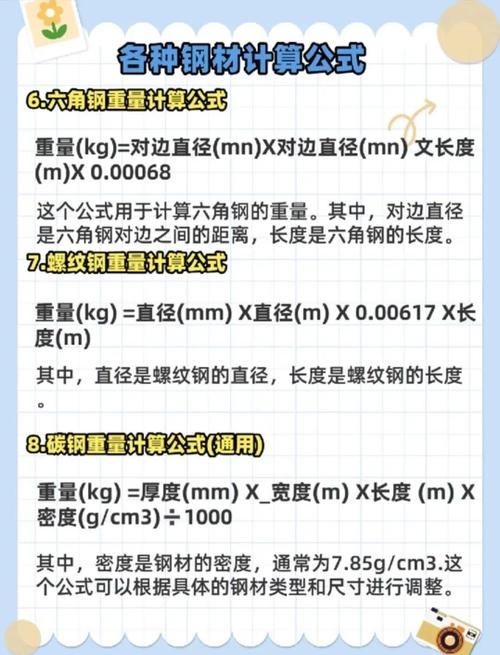
W=0. 00617xdxd
Threaded steel with 12 mm in diameter, per m mass。
Per m weight = 0. 00617 x 122 = 0. 89kg
Square steel (kg/m)
W = 0. 00785 xa xa
A 20 mm wide square steel, per m mass。
Per m weight = 0. 0078 x 202 = 3. 14 kg
Flat steel (kg/m)
W = 0. 00785 x bxd
40 mm wide, 5 mm thick flat steel, per m mass。
Per m weight = 0. 00785 x 40 x 5 = 1. 57 kg
Hexagon steel (kg/m)
W = 0. 006798xsxs
Six-angle steel at a margin of 50 mm, per m mass。
Per m weight = 0. 006798 x 502 = 17kg
Oracle steel (kg/m)
W=0. 0065xsxs
Eight-angle steel at a margin of 80 mm, per m mass。
Per m weight = 0. 0065 x 802 = 41. 62 kg
Quadrilateral steel (kg/m)
= 0. 00785 x
D (2b-d) + 0. 215 (r2-2r2)
= 20 mm x 4 mm each mass of an arctic steel。
Rs of 4 mm x 20 mm per corner steel found in metallurgy product catalogue were 3. 5, r 1. 2 and per m weight = 0. 00785 x
4x (2x20-4) + 0. 215x (3. 52-2x1. 22)
= 1. 15 kg
Peripheral steel (kg/m)
W = 0. 00785 x
D (b+b–d)+0. 215 (r2-2r2)
30 mm x 20 mm x 4 mm equal to each m mass of edged steel。
Rs of 3. 5, r of 1. 2 for edged steel of 30x20x4 range from metallurgy product catalogues = 0. 00785 x
4x (30+20-4) + 0. 215x (3. 52-2x1. 22)
= 1. 46 kg
Tank steel
(kg/m)
Steel (kg/m)
W = 0. 00785 x
Hd+2t(b-d)+0. 349 (r2-r2)
80 mm x 43 mm x 5 mm of tank steel。
From the metallurgy product catalogue, it's t-8, r-8, r-4
= 0. 00785 x
80x5+2x8x(43-5)+0. 349x(82-42)
=8. 04kg
Handwritten steel (kg/m)
W = 0. 00785 x
Hd+2t(b-d)+0. 615 (r2-r2)
250 mm x 118 mm x 10 mm of working steel per m mass。
From the metal materials manual, it was found to be 13, 10 r and 5 r
= 0. 00785 x
250x10+2x13x(118-10)+0. 615x(102-52)
= 42. 03 kg
Steel plate (kg/m2)
W = 7. 85 xd
4 mm thick steel plate, per m2。
= 7. 85 x 4 = 31. 4 kg/m2
Steel pipe (including seamless steel pipe and welded steel pipe)kg/m
W = 0. 02466 x s (d-s)
A seamless steel pipe with an outer diameter of 60 mm wall thickness of 4 mm per m。
Per m weight = 0. 02466 x 4 x (60-4) = 5. 52 kg