Click on the bottom
Numbers and algebras
1. Natural numbers include positive integers and zeros, so the smallest natural number is zero, and there is no largest natural number。
Numbers are: one, ten, hundreds, thousands, 100,000, millions, millions, billions, millions, etc。
3. The rate of progress is 10 per neighbouring two units. It's called the decimal count。
Numbers that can be divided by two are called even numbers. Zero is even. Can't be divided by two numbers called odd numbers。
Five, one number, if only one and the number itself are about two, such numbers are called prime numbers, such as 2, 3, 5, 7, 11, 13, etc.
A number, if there's a number other than one and itself, is called a sum, for example 4, 6, 8, 9 and 10。
The smallest natural number is 0, the smallest prime number is 2 and the smallest combined number is 4. Only two of the public factors are known as cross-mass。
7. For ease of counting, a larger number could be reformulated to be in tens of thousands or millions. The corrected number is the exact number of the original number. For example, 1254. 3 million, the number of units in 10,000 is 125. 43 million, and in millions
1254. 3 billion。
8. Approximations: depending on what is actually needed, we can also omit a larger number, which is the end of a given bit, in an approximate number. For example, the final figure after the omission of 13,24,9015 is 1. 3 billion。
Rounded: if the maximum number of finals to be omitted is 4 or less, remove the final number; if the maximum number of finals is 5 or greater, then round the final number and move forward to its predecessor 1。
10. Business as usual: in division, the number and number of divisions expand or decrease by the same number at the same time, business as usual。
11, nature of decimals: add zero to the end of decimals or remove zero decimals of the same size。
Basic nature of fractions:
The molecules and denominators of the fractions are multiplied or divided by the same number (except zero), and the size of the fractions remains unchanged. The product is a two-digit penultimate of one. The countdown of 1 is 0, no countdown。
13, scale, scale, percentage cannot be carried in units。
Method
1 same level, left to right. (plus and minus first level, multiplied and divided by second level)
2 two-tier calculations, multiplied by priority, plus or minus。
3 a hybrid operation with brackets: first the one in small brackets, then the one in brackets, and finally the one outside brackets。
Law of operations
1 plus-equivalent: two-digit additions, where they add up, and they remain unchanged, i. E. A+b=b+a
A combination of three numbers, plus the first two plus the third; or a combination of the latter two plus their sum and the first plus their sum, i. E. (a+b)+c=a+(b+c)
3. Multiplication swap: two numbers multiplied by the same amount of their position as the exchange factor, i. E. Axb=bxa
4- multiplier combination: three digits multiplied by the first two and then by the third; or the latter two multiplied by the first and their accumulation, i. E. (axb) xc=ax (bxc)
5 multiplication law: two numbers multiplied by one, multiplying the two plus numbers by two cumulative numbers, i. E. (a+b) xc=axc+bxc
Nature of operation
1 nature of subtraction: a number of consecutive numbers from a number from which the sum of all subtractions can be subtracted, with the same difference, i. E
A-b-c=a-(b+c)
2. Nature of dichotomy: the number of consecutive numbers to be removed from a single number can be removed from the sum of all denumerations, which is the same, i. E
A ÷b÷c=a÷(bxc)
3 decline - minus = difference, divided by ÷ factor。
Patterns and equations
Equations containing unknown numbers are equations such as x+5 = 6
2. Steps for the solution of the equation:
One to the denominator
Two to the brackets
3 moves
4 merge the same items
5 to 1
3. Steps for the application of the formula:
1 question, with x as unknown. "as usual, it's what you ask."
2 find equivalence, column equation. This is the most important step
Three equations。
4 test and write the answer。
Common volume
1. Conversion of length units
1 km = 1,000 m
1 m = 10 m
1 minute = 10 cm
1 metre = 100 cm
1 cm = 10 mm
2. Area unit conversion
1 square km = 100 hectares
1 ha = 10,000 m2
1 m2 = 100 m2
1 sqm = 100 sqm
1 square centimetre = 100 square mm
3. Conversion of volume units
1 cubic metre = 1,000 cubic metres
1 cubic metre = 1,000 cubic centimetres
1 cubic metre = 1 litre
1 cubic centimetre = 1 ml
1 cubic metre = 1,000 litres
4. Conversion of weight units
1 ton = 1000 kg
1 kg = 1000 g
1 kg = 1 kg
5 rmb conversion
1 dollar = 10 cents
1 angle = 10 minutes
Dollar = 100 minutes
6. Time unit conversion
1 century = 100 years
1 year = december
Month (31 days): 18 months
The month is 49
February 28th, february 29th
365 days a year, 366 days a year
Year: 4 years, 100 years, 400 years. (e. G. 2008 is the year, 1900 is not the year, and 2000 is the year. I'm not sure
1 day = 24 hours
0100 = 6000
1 minute = 60 seconds
1:00 = 3600 seconds
Geometry, area, volume formula
1 the perimeter of the rectangular = (long + wide) x 2
C=(a+b)x2
2. Quarters of squares = border length x 4
C = 4a
3. Size of rectangular = length x width
S=ab
4. Area of square = length x side long
S=a. A=a2
Area of the triangle = bottom x high thorium2
S=ah÷2
6. Area of parallel quadrilaterals = bottom x high
S=ah
7 area of ladder = (upside + bottom) x high ÷2
S=(a+b)h÷2
8. Diameter = radius x 2
D=2r
Radius = ÷2 in diameter
R=d2
9. Round's perimeter = circle rate x diameter = circle rate x radius x two
C=d=2πr2
10. Area of round = circle rate x radius x radius
S=r
11. Size of rectangular = long x width x high
Formula: v=abh
Volume of rectangular (or square) = floor area x high
Formula: v=sh
12, volume of square = prism x prism long
Formula: v=aaa=a3
Formula for cylinders and cones
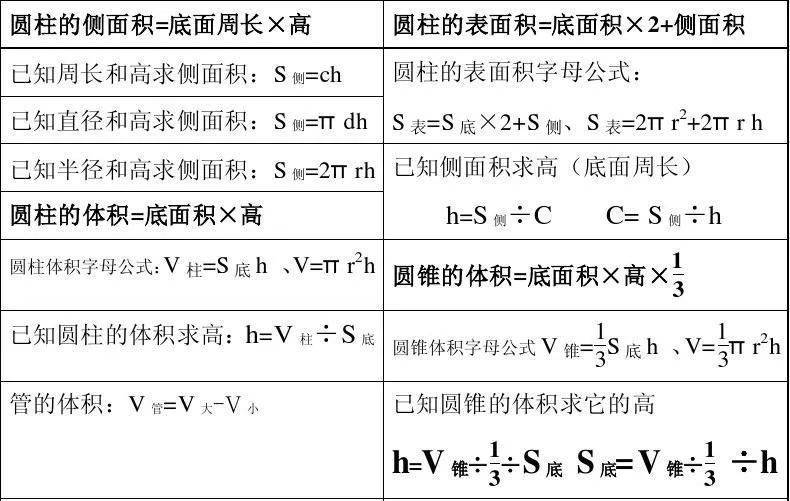
1 cylinder: the two bottoms are the same circles, with numerous heights, and the side is extended by a rectangular or square。
Cones: one bottom is a circle, only one is high, and the side spreads in a sector。
3 if a cylinder is so high as the base of a cone, then the cylinder is three times the volume of the cone, which is one third of the volume of the cylinder。
Positive, negative
1 and 12 words: positive: positive: positive; negative: positive. (basis of judgement)
General:
Positive ratio: y/x=k or y=kx (k for sure)
Inverse: xy=k or y = k/x (k for sure)
3. Images:
Positive ratio: one line
Inverse: a curve
4. The basis for the determination is whether the ratio or product of the two related cascades is certain or, if so, positive; if so, inverse; and if both do not match, disproportionate。
10
Scale
1. The ratio of distance to actual distance on the map is the scale. No units on scale。
2, 1:100 means: 1 cm on the map represents the actual distance of 100 cm。
3 and 3 formulae:
Scale = physical distance on the map
Actual distance = distance scale on map
Figure above = scale x actual distance
Direction 4: up north, down south-southwest right east
Five additional "0" in centimetres and five "0" in centimetres。
6. The problem of scale is resolved by unifying into lower units and by familiarizing the three formulas of scale。
7 the scaling down of the graphics: we can zoom in on the small maps, or we can narrow down the big ones, but only if we zoom in on the long and wide or reduce the same number. (e. G. 3:2=6:4=9:6 etc.)
Eleven
Looking for patterns
Watch the merchant, see the squares or cubics of a number, look apart, grouping, etc。
12
Lines and corners
1. Line unendable, non-measureable; one end point of a ray, not measurable; two end points of a line, measurable。
2. The vertical segment is the shortest from a point outside the line to the line segment. This vertical segment is called the distance from point to line。
3. Sharp angles: an angle less than 90 degrees
Arc: an angle equal to 90 degrees
Passive angles: an angle greater than 90 degrees and less than 180 degrees
Angle: an angle equal to 180 degrees
Round corner: an angle equal to 360 degrees. The inner angle of the triangle and 180 degrees。
13
Statistics and probability
1. Three statistical charts:
Bar chart (expressing the amount of each volume)
Lined statistical charts (meaning quantity, reflecting increase or decrease)
A sector statistical chart (indicating the relationship between part and whole)。
2 average: quantity and number divided by quantity
Median: the average of the data from large to small or from small to large, the middle or the middle。
Numbers: most frequent in a set of data。
There are three types of situations in which things happen:
The first is the inevitable: it's bound to happen and the probability is one
The second is unlikely: there will be no incident, with a probability of zero
The third is random events (also known as possible events): events that may or may not occur, with a probability of greater than 0 less than 1。
Learning to play cards
Come on, tell chief. Are you doing the right thing