Numbers and algebras
Natural numbers, including positive integers and zero, are fundamental concepts in mathematics. Of these, the smallest natural number is zero, while the range of natural numbers is unlimited and there is no so-called “maximum natural number”。
Count units are a basic concept in mathematics, which includes units of one, hundreds, thousands and thousands. The rate of progress between these units is 10, which is known as the decimal method。
Even and odd are two basic concepts in mathematics. Even numbers are those that can be divided by two, while odd numbers cannot be divided by two. Notably, 0 is also considered even。
The prime and the compound numbers are another classification of numbers. A prime number is the number of only one and its own two approximate numbers, e. G., five; a combined number is the number of others other than one and itself。
In numerical comparisons, we often need to recast a larger number into tens of thousands or millions of figures to make comparisons easier. This redraft does not change the actual size of the original number。
The approximation is based on the concept of actual need. When we need to simplify a larger number, we can omit the number behind a given bit and express it in an approximation. For example, the final figure of 13,24,9015 could be omitted and simplified to 1. 3 billion。
Rounding is a common approximation method. When the highest number of tails to be omitted is four or more hours, we can just drop the last number; when the highest number is five or five, we need to move to the last number and move forward to its first。
The constant pattern of commerce is an important character in the operation of the division. In the dichotomy, if the dichotomy and the dichotomy expand simultaneously or reduce the same multiple at the same time, the commercial will remain the same。
The character of decimals means that the size of decimals does not change when zero is added to or zero is removed at the end of the decimals. This is an important aspect of decimals。
The basic nature of the fraction is that the fraction size does not change when the molecule and denominator of the fraction are multiplied or divided by the same non-zero number. It's a basic rule in fractional calculations。
The size of the fraction remains the same when the fraction molecule and denominator are multiplied or divided by the same non-zero number. In addition, two numbers with a multiplier of 1 are inversely negative, such as one per se and none。
In math, we follow certain algorithms and laws of operation. For example, the same level of operation usually runs from left to right, while the multiplier priority is higher than the plus or minus. In addition, operations in brackets take precedence over operations outside brackets。
At the same time, we need to understand some of the basic operational properties, such as the nature of the subtraction that allows us to subtract multiple numbers from the numbers, or the nature of the division that allows us to divide multiple numbers from the numbers, without altering the results。
Also, equations are equations that contain unknown numbers, and we can find the value of unknown numbers through equations. In solving practical problems, we usually first set up unknown numbers, then find equivalence and list equations, and finally solve the equation and test the answers。
Finally, length unit conversion is a basic skill in mathematics. For example, we know that 1 km equals 1,000 m, 1 m equals 10 m, 1 m equals 10 cm, etc. These conversion relationships help us to be more accurate and efficient in dealing with issues related to length。
One centimeter equals 10 mm。
Next, we convert the size units:
One square km equals 100 hectares
One hectare equals 10,000 square metres
1 square metre equals 100 square metres
In this way, we can obtain:
1 square metre equals 100 square centimetres
1 square centimetre equals 100 square mm。
The conversion of volume units:
One cubic metre equals 1,000 cubic metres
One cubic metre equals 1,000 cubic centimetres
At the same time, one cubic metre equals one litre
And one cubic centimetre equals one millimetre
So, a cubic metre equals 1,000 litres。
The following is the conversion of weight units:
One ton equals 1,000 kg
And 1 kg equals 1 kg, or 1,000 grams。
In addition, we also have the conversion of renminbi units:
One dollar is 10 cents
One corner is 10 points
So the dollar is 100 points。
Finally, the conversion of time units:
One century equals 100 years
One year and 12 months
Of these, 7 were for months (31 days), in december
The month (30 days) was four, in november。
In addition, 28 days in february and 29 days in february of the same year. As a result, 365 days are available throughout the year, compared to 366 days in the year. It should be noted that the rule for the determination of a year is four years, but not if the year is 100 years, unless the year is 400 times. For example, 2008 was the year of the year, while 1900 was not. At the same time, we have some common time-unit conversion formulas: if one day equals 24 hours, one hour equals 60 minutes。
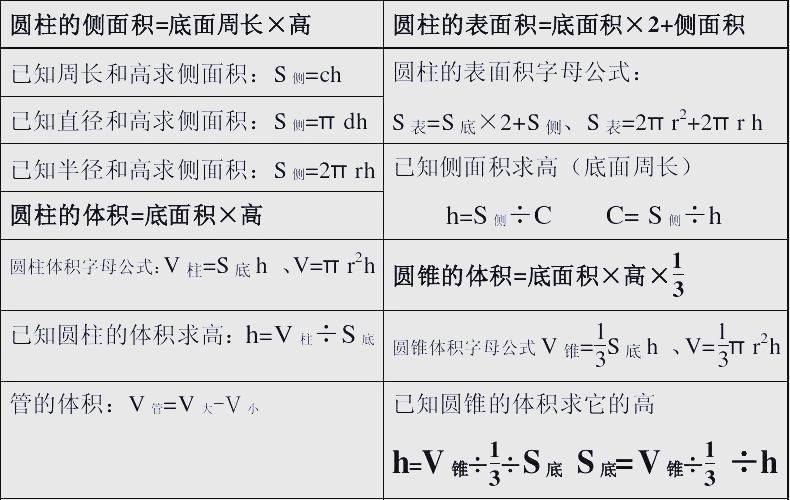
The cylindrical column has two identical circles at the bottom, and it has numerous heights, and the side spreads into a rectangular or square。
The bottom of the cone is a circle, with only one high, and the side spreads in a fan。
When bottoms such as cylinders and cones are high, the column is three times the size of a cone, and vice versa。
Here's the positive and negative:
The positive ratio is characterized by a certain margin, while the inverse ratio is characterized by a certain multiplier. This is the basic basis for positive and negative proportionality。
The normal pattern of the positive ratio is y/x=k or y=kx (where k is a constant), while the negative pattern is xy=k or y=k/x (also, k is a constant)。
On the image, the positive ratio is a straight line, while the inverse ratio is a curve。
It is important to determine whether the two associated volumes are proportional to their value or product. If the margin is certain, then they are positive; if the multiplier is certain, they are inversely proportional。
Then look at the scale:
The scale is the ratio of the distance on the map to the actual distance and it is not united. For example, the 1:100 scale means that one centimetre represents the actual 100 centimetre on the map。
In addressing scale-related problems, it is essential to harmonize units and to master the scale formula。
In addition, there are ways to find patterns, such as observation of margin, commercial, square or cubic. And knowledge points on lines and angles, such as straight lines, rays, characteristics of the segment and the size of the angles。
Finally, we have statistics and probabilities:
They include applications of three statistical maps and basic concepts of probability。
The contours are used primarily to show the volume and reflect the increase or decrease, while the sector charts are used to reveal the relationship between part and whole. In addition, we need to understand the concepts of averages, medians and numbers. The average is the number of numbers and the number divided by the number; the median is the average of the data, sorted, in the middle or the middle; the number is the number that appears most frequently in a set of data. In addition, it can be divided into three types of event: an event of necessity, with a probability of 1 being an event of necessity; an event of impossibility, with a probability of zero, with a probability that it will not occur; and a random event or a potential event, with a probability greater than 0, with a probability that it may or may not occur。