Look at the two pictures below. What do you think you're gonna do
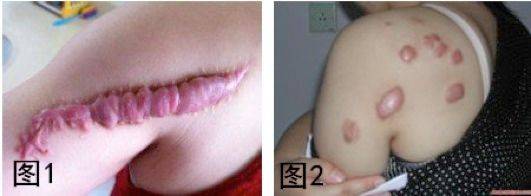
In clinical work, do patients with this skin damage, expressed in the form of "bumps " , are diagnosed with an amplified scar or a scar? Are the two different aliases of the same disease or are they fundamentally different
Scars are a synonym for changes in the appearance and tissue pathology of normal skin tissues caused by various kinds of trauma and inflammation. It is an inevitable product of the process of healing the human body, divided into physical scars and rational scars。
Physical scars are not discomfort, do not affect beauty, do not function, and generally do not require treatment。
Reasonable scars are caused by trauma, inflammation, surgery, etc., and fibrous metabolic diseases that are characteristic of the human skin area, characterized by overproduction and sedimentation of a large constituent matrix, such as glue, include mainly hypertrophtic scars, hs, and keloes. While the skin damage is similar, there is a clear difference between the mechanism of morbidity and the prognosis, so that it is essential to know the points of identification for guiding treatment and judging the prognosis。
Linkages and distinctions
1. Infectious scars
(i) the scarring is significantly higher than the normal skin in the surrounding area, the local thickness is hardened and the skin is limited to the damaged part
(2) is good for the stretching of the joint or the direction of the skin to the skin tension
(3) early haemorrhages in the capillary veins indicate red, damp or purple on the surface, accompanied by itching and pain. After months or years, increased scarring is reduced, the colour of the surface fades, the scar becomes softer, flater, the itching is reduced so that it disappears
(4) incremental scarring occurring in non-functional areas generally does not cause serious functional impairments, whereas large tracts of the joints can cause functional impairments due to their thick and rigid plating. (b) an amplified scar on the surface of the joint, with a more visible contraction in the later stages, resulting in significant functional impairments such as neck binding
(5) the scars are often healing and healing in january, increasing within june and shrinking after 1 year
(6) may occur between races of colour
(7) there is no family genetic tendency
(8) organisational pathological characteristics: presence of musculoskeletal fibre cells and α-sma in skin loss, dominated by type iii glue protein
(9) ethylene 1 (cycloxygenase 1, cox 1) superexpression
(10) excision is not easily repeated。
Scars
(1) is generally shown to be a continuous growing lump above the normal surrounding skin, beyond the original damage, which is harder and less flexible
(2) good for earlobe, shoulder, chest, neck
(3) small and solid red rash, slowly increasing in circular form. Ellipse or irregularity rises when the skin stretches out in the form of crab feet and the surface is smooth and bright. (b) early onset of skin-depletion red, which can be accompanied by a cavity-heavy expansion on the surface; and static period skin-depletion colours, physical rigidity and less conscious symptoms
(4) pumps are generally not convulsed and generally do not cause functional impairment, except for a few joints where light activity is limited
(5) leather loss does not recede on its own, usually after 3 months and after the scar has formed, there is an unlimited increase
(6) the incidence of scarring in the dark is significantly higher than in the light
(7) have a certain family genetic properties and, according to research on the scarlet family, there is no significant difference in morbidity rates between men and women, supporting the epichromosomal heritage
(8) organisational pathological characteristics: creamic fibres are thicker than biogenic scars, dominated by gelatinic proteins of type i, and lack of musculostrocellular cells and α-sma
(9) epoxy enzyme 2 (cycloxygenase 2, cox2) superexpression
(10) high rate of post-cutting relapse, often in june - 2 years after the operation, with internal injection of sugary hormonal skin or radiotherapy
(11) there are also studies related to type a blood, high ige syndrome, high estrogen levels, etc。
Table 1
Features
Ignorant scars
Scars
Incidence
Higher
Lower
Race
No variance
It's so dark
History of trauma
Not necessarily
Nice hair
Any part
It's common in earplugs, shoulder, chest, neck
Growth range
Within the scar
Beyond the scar
The spontaneous retreat
Most
After surgery
The convulsion is related
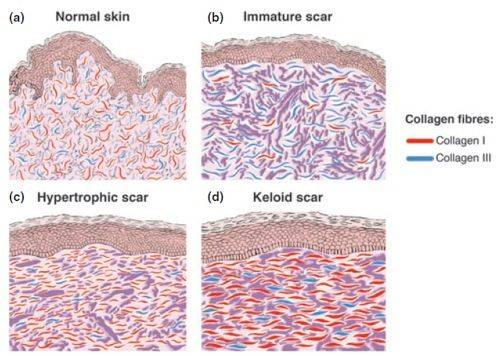
Ignorant scars compared to the type of piston protein
(a) normal skin; (b) premature scars; (c) amplified scars; (d) scar creeping, collagen i: gelatinic protein; (b) scarbone i。
Returning to the two previous pictures, according to the text, figure 1 diagnoses amplified scars, figure 2 diagnoses scars。
Treatment
Given the marked differences in their clinical performance and their organizational characteristics, different treatments are needed。
The purpose of the operation is to narrow the range of the plasters and to make them follow loNger tension lines are aligned. Surgeon treatment is the preferred method of treatment for biotransformations, especially when accompanied by functional impairments or morphological changes
The rate of recurrence of oscillations is 45% to 100%, and the average rate is more than 50%. This is due to the fact that the operation stimulates the synthesis of gelatin proteins, which tends to create greater scarring. Surgery is usually used in conjunction with other treatments, such as the injection of sugar cortex hormones or the combination of early irradiation therapy in the vicinity of the epitome。
Stress therapy by reducing the supply of blood oxygen and nutrients in the scar; downward metallic protein enzyme 28 (matrix m)E2-activated prostate enzyme (pge2) to inhibit adhesive synthesis. Stress treatment has now become the standard and preferred method of treatment for post-burn hyperplasia。
Sugar cortex hormonal therapy, which began in 1960, has used sugar cortex to treat rational epidemiology, and is now recognized as a second-line method of treating epidemiology。
Hormonal treatment of rational lesions of the disease may be based on inhibiting the growth of fibrous cells in the disease's rational scarring, inhibiting adhesive protein synthesis, increasing the generation of adhesive enzymes and reducing the level of adhesive inhibitors。
A variety of hormones can be used for treatments, such as pines with hydrochloric acid, caponeylons, disemisons, etc., most commonly curanide (10-40 mg/ml), injected within the scar of a single or joint lidoca. Some scholars have pointed out that after partial curnad treatment in surgical excision, repeated injections were repeated at intervals of 2 to 5 weeks, and continued injections were effective for 4 to 6 months。
Laser therapy the application of lasers to the treatment of amplified gills and gills has been going on for more than 20 years, and lasers of different wavelengths are increasingly being used. Carbon dioxide (co2) lasers and beryllium lasers have a high rate of re-emergence after treatment and do not generally advocate simple applications. Pulse dye lasers (polised dye laser, pdl) 585-595nm, an vascular speciality laser, are a first-line cure for good healing, especially to prevent regenerative scars。
Radiotherapy ionizing radiation is an effective way of treating the creeps. Surgery combined electronic beam short-range radiotherapy is the most effective treatment for acute scar creeps. The main disadvantage is that there is a risk of malignant tumours but the incidence is rare。
Other treatments include local injection of anti-oncological drugs in scar tissues, antitamine drugs and cytogen-related drugs。