Intellectual property sounds abstract, but it's not far from us. In the case of the television show the people's name, which had been broadcast during the previous period, it had achieved a very high ratings and audience recognition. The television drama was supposed to be a good thing, but it has not been finished yet, and there is an entire pirated television show online. While the action was criticized and boycotted by the online community, a joint media statement was issued by the theatre and television stations to combat cyber-absorption。
As consumers, we enjoy the intellectual fruits of other people's creation at all times in our lives, ranging from reading books, watching films, listening to music, to flying planes, high trains and subways, with countless intellectual property rights. So, what's an ipr specialty? What does it study
Click on [professional homepage] to see [open school]
I. Professional analysis
Intellectual property (intellectual property, known as intellectual property in our taiwan region) refers to property rights over the fruits of their intellectual labour. The results of intellectual work are very broad and relate to any aspect of human civilization, including, in particular, works, inventions, practical innovations, visual designs, trademarks, geographical indications, commercial secrets, the design of integrated circuit maps, new varieties of plants and other types provided for by law. In fact, we are exposed to intellectual property every day. For example, the books we read, the articles we write, the games we play on the internet are about works; the goods we buy, the mobile phones we use, etc., are about trademarks, inventions, practical novelties, visual designs, the design of integrated circuits, etc.; the food we eat, the cotton we use in our clothes are likely to involve new varieties of plants。
Since all types of intellectual work are intangible, property protected by intellectual property is intangible. Intellectual property, also referred to as intellectual property law, was a synthesis of all laws protecting intellectual labour outcomes. Of these, the three most basic laws are copyright law, trademark law, patent law, etc。
The openness and ease of access to information in the web age and the increasing integration of domestic and international markets have led to a weakening of the competitive advantage of natural resources (tangible property) and a growing competitive advantage of intellectual property rights as intangibles. Developed countries, such as the united states, have long claimed that the future of human market competition is necessarily a competition for intellectual property rights. In the present and in the long term, intellectual property rights are necessarily the gold key to protecting intangible property and thereby enhancing the overall competitiveness of enterprises and countries。
Intellectual property is a substantive profession
In accordance with the laws of intangibles themselves, intellectual property includes four components: creation, management, application and protection。
In terms of the world's intellectual property professional setting, there is a broad division between intellectual property management and intellectual property (or intellectual property law). Among them, the management of intellectual property is primarily concerned with the management of the creation, application and protection of intellectual property by enterprises or states. As a result, intellectual property management is an integrated profession based on management, with a balance between legal, scientific and technological knowledge; given the high demand for a platform for intellectual property management, it is currently available only at the postgraduate level。
The subject of intellectual property is primarily concerned with the legal conditions and procedures for the protection of intellectual labour and how it is applied and protected. At the same time, the creation and management of intellectual property rights should be balanced. Thus, the intellectual property profession is dominated by law and combines a combination of managerial and technical knowledge. In the 2012 edition of the catalogue of undergraduate professions in general higher education, the subject of intellectual property belongs to the legal category, with a bachelor of laws degree and an ad hoc specialization in the legal category. As a result, the curricula for the intellectual property profession are extremely rich: first, core basic courses in law and, second, core courses in intellectual property. Among them, the core basic courses in law include jurisprudence, civil law, commercial law, civil procedure law, criminal law, criminal procedure law, administrative law, administrative procedure law, environmental and resource law, labour and social security law, public international law, private international law and international economic law. The core courses in the intellectual property profession include general intellectual property rights, copyright law, patent law, trademark law, commercial secrecy law, competition law, computer software protection, intellectual property licensing, intellectual property administration, intellectual property evaluation, patent applications and examination, patent documentation and use。
Developing strong hands-on talent
First of all, intellectual property is a subject of law, and the aim is to develop people with legal qualifications. Therefore, the profession emphasizes the development of skills in external communication, logical thinking, writing, etc。
Second, the internationalization of the intellectual property profession is evident and requires relatively high levels of foreign language proficiency in order to develop professionals with an international perspective. The paris convention for the protection of industrial property of 1883 and the berne convention for the protection of literary and artistic property of 1886 set minimum requirements for member states; the agreement on trade-related aspects of intellectual property rights, the trips agreement, is one of the three main legal frameworks of wto, regulating intellectual property in international trade. The existence and requirements of these international conventions tend to integrate the basic rules of intellectual property law in all countries and regions of the world. As a result, students should be better equipped to use foreign languages, to access and follow up on up-to-date national and international professional information and to keep abreast of recent developments in the field of intellectual property rights at home and abroad。
Third, there should be a high level of integrated research capacity. With the development of science and technology and network technologies, there have been alarming changes in business competition patterns. The number of intellectual property disputes is increasing in all countries and regions of the world, with emerging and difficult issues attracting attention and higher levels of tort compensation. Thus, the intellectual property profession trains people with greater curiosity, creativity and the ability to combine knowledge in different fields of law, management, science and technology to solve complex problems。
Ii. Professional and employment
In the age of popular entrepreneurship and mass innovation, our country has increasingly attached importance to intellectual property rights. As a direct result, since the promulgation of the national intellectual property strategy programme in 2008, the state council has adopted a series of policies, such as the opinions on accelerating the construction of intellectual property power in the new situation, issued by the state council in 2015, and the joint inter-ministerial meeting on the implementation of the state council's intellectual property strategy, reissued the plan for the further implementation of the national intellectual property strategy to accelerate the construction of intellectual property power. In response, the provinces, municipalities and autonomous regions of the country have adopted policies that meet local conditions. It is clear that the importance attached to intellectual property rights at the national and local levels has naturally given rise to a strong demand for intellectual property protection and intellectual property professional service providers, while undoubtedly placing high demands on the quality of intellectual property talent。
As can be seen from the extensive data reports on intellectual property abuse cases published by the supreme law, the number of intellectual property disputes continues to rise, and the combined effect of these factors is that the demand for intellectual property talent in the market is clearly rising and tends to increase。
In view of the strong market demand and the recent three years of employment of undergraduates in intellectual property, the employment of graduates in this specialty is characterized by “high employment rates, high job quality and high job satisfaction”. For example, about 15 per cent of graduates of the university of political science and law in china chose to pursue a master's degree in the country, about 20 per cent chose to go abroad for further studies, about 10 per cent entered the government and the judiciary, and about 55 per cent entered prominent law firms, intellectual property professional firms, businesses and banks. Among directly employed graduates, 75 per cent of the jobs and intellectual property professions are closely related, which is characterized by a high degree of employment orientation and professional relevance。
In general, higher levels of foreign language and a solid legal base are well received by employers, while graduates with a certain scientific or managerial background are favoured by the market。
There are two main types of institutions offering intellectual property
According to data from the sunshine information platform, more than 60 institutions across the country currently have intellectual property specializations. Of the more than 60 institutions, two are more distinctive, as are culture. One is an intellectual property specialisation in law-based higher education institutions, such as the university of political science and law in china, and the other is an intellectual property establishment in polytechnic colleges, such as the university of technology in china and the university of hong kong。
In the case of the university of political science and law of east china, for example, the independent institute of intellectual property has a large pool of highly qualified teachers, with a core course on intellectual property, and has integrated intellectual property undergraduates into the system of excellence in the legal profession, making full use of shanghai's geographical advantages and social forces to continuously strengthen students ' international vision, research and practical capabilities. After more than a decade of experience, this model has matured and has trained a great number of intellectual property professionals for the state and society。
The opening of an ipr specialty in polytechnics makes full use of their technical and technical professional advantages, while offering a second specialty, encouraging students to cross-professional selection, and, while improving students'scientific and technical literacy, strengthening the application and examination of students ' patents, the examination of the qualifications of patent agents, etc., provide a good platform for future technical-related ip professions。
You better have a good foreign language base
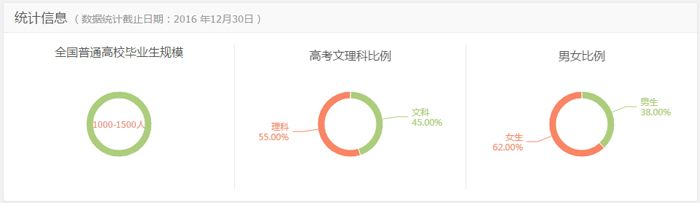
Candidates may apply for an intellectual property specialty, provided that they are in good health, which has no restrictions on gender, subject, etc. There are no restrictions on the achievement of the higher examination examinations, in particular by searching the statutes of the relevant institutions for admission, in accordance with what is published in the statutes of admissions to each school. Due to the international nature of the intellectual property profession, candidates are advised to have a sound foreign language base。
I'd like to suggest a second degree
Since the intellectual property profession is a cross-cutting discipline involving various fields of literature, art and science and technology, employment may also lead to a rich and diverse range of work, possibly in legal and non-litigious business, management of business, internal law of the enterprise, administration of intellectual property, management of technology, patent agency, etc. Thus, in the course of the study, each person may systematically study, and even study, the fields of management, economics, polytechnics, etc., in accordance with his/her own interests and preferences, as circumstances permit. As a legal profession, it places great emphasis on the development of external communication and practical skills of students。
Professional recommendations
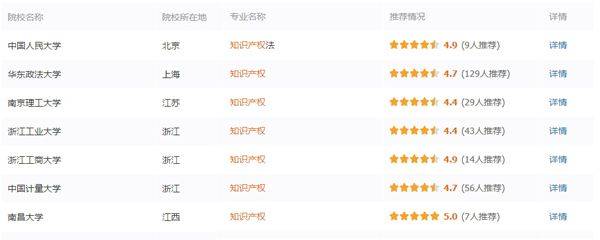
The recommended specialization is derived from the actual recommended data for students in higher education. The cumulative number of votes cast now exceeds 3. 73 million. In the case of students or graduates of the higher grades who are registered by their real names, voting is conducted on the basis of the performance of the various fields of study in the school, recommending the dominant or specialty. The figure below shows only some of the professional recommendations on intellectual property in higher education, with the asterisk as the recommended index. Click a picture to see more professional recommended data。