How can computer-visual research be done to embrace broader future career development and be applied to the development of their own neurological networks and computer-visual applications? The course will be structured around the most common rcnn image recognition algorithm in computer vision, ranging from mathematical theory, modelling framework to practical exercise, allowing you to acquire basic knowledge and learning methods for in-depth learning in a short period of time, from theory to practice。
Purpose: to master the underlying principles of the neural network, and to know why (from mathematical practice to proficiency in code);
Means: scientific methods. An analysis of theory to practice;
• results: mastery of basic computer visualization methods to respond to challenges in practice。
Curriculum:
Phase 1 image pre-processing
Lesson 1: opencv and image processing foundation
Knowledge point: image processing, greyscale extraction, histogram extraction
Lesson 2: opencv step: image filtering, feature extraction and matching
Knowledge point: sift, visual and image transformation, edge detection algorithm, etc
Lesson 3: practice: handwritten character recognition using knn algorithms and opencv
Stage 2: create your own image recognition neural network
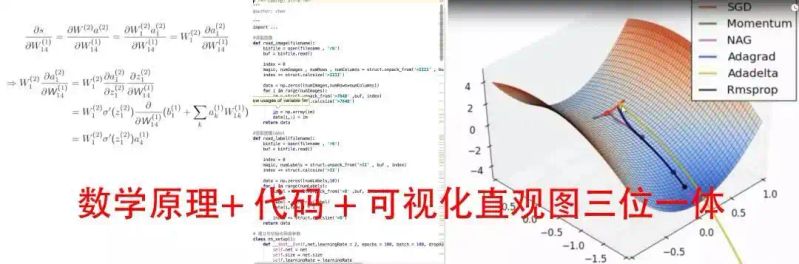
Lesson 4: to understand the forward and reverse transmission of the nervous network and its physical significance
Knowledge point: losfunction, cross entropy cost function, gradient drop-in guide
Lesson 5: train your own network, focusing on some of the skills used in participation and work
Knowledge point: losfunction, cross entropy cost function, gradient down
Lesson 6: application of the volta neural network (cnn) in image classification recognition (with python programming and algorithm analysis)
Knowledge point: data input layer, volume computation layer, incentive layer (sigmoid, tanh, relu, elu), pool layer, full connectivity layer, batchnormalation, learning rate
Lesson 7: practice, training in hand-written character recognition of a neural network that belongs to you without using any toolkit
Series 3. Depth condensed neural network progress
Lesson 8: different types and applications of nervous networks
Knowledge point: inputs to basic skills, vector point accumulation
Lesson nine: the principles and practice of deep-volume neural network
Knowledge point, neurological network migration learning techniques
Lesson 10: build a photo search system to understand tripletlos and his training skills
Lesson xi: practice: using tensorflow/keras to build a neural network to classify images
Phase 4: target testing and lstm labelling
Lesson 12: target detection algorithm
Knowledge point: fastrcnn, fastrcnn, yolo, ssd
Lesson 13: lstm labeled learning
Lesson xiv: practice: target testing on data sets using tensorflow/keras
Teaching hours:
The course will begin on 19 june 2026 and last approximately 16 weeks。
Target audience:
Computer visualization is one of the three main applications of artificial intelligence in the future and is a leader in the direction of the application of artificial intelligence technology and is widely used in areas such as face recognition, security and unmanned driving. There is a growing pool of artificially intelligent unicorns in the country, and there is a large talent gap across europe and the united states. The next decade will be a decade of computer-based visualization and application of well blow-outs. This course is aimed at industrial future artificial intelligence and imparts some of my personal experience。
Expected harvest:
Knowledge of the basics and algorithms of computer visual image recognition and learning to solve problems encountered in practice。
Presentations by lecturers:
Daniel, graduated from the university of science and technology of hong kong in 2011, with a teacher from the signal processing prof. Oscar chan, back brigade law. Worked in france for many years on computer visual related work and is now a computer visual algorithm researcher at ensta-paristech. I am also in charge of recruitment and are willing to share with participants work opportunities in overseas work experience and computer visual algorithms。
National unified counselling line 136 1033 4399
Introductory discussion group: 303917420