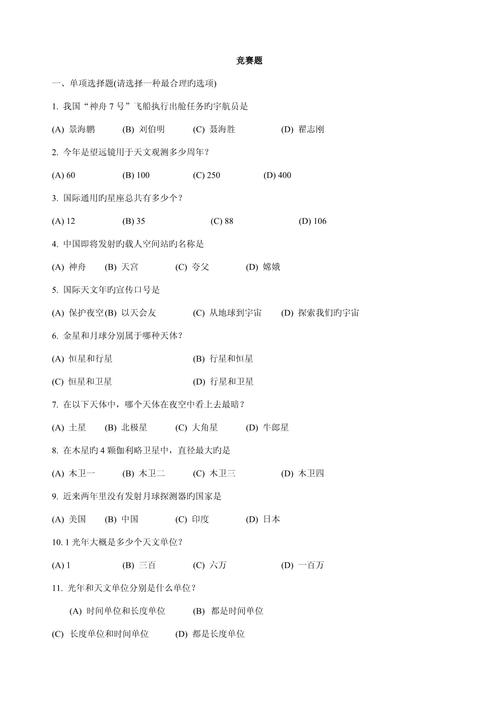
Question 1 of the national astronomical competition for secondary school students (with answers) i. Individual choice questions (2 points per question, totalling 40 points). 1. Which of the following constellations is one of the most visible in the northern hemisphere's spring night sky? A. Orion b. Leo c. Scorpion d. Aquarius answer: b. The distinct constellation of the spring sky is leo, orion is a remarkable winter constellation, scorpion is a summer constellation, and aquarius is relatively less prominent in the winter sky. The largest planet in the solar system is () a. Earth b. Jupiter c. Saturn d. Mars answer: b. Jupiter is the largest planet in the solar system. 3. The cycle of the moon around the earth is approximately () a. 1 day b. 1 month c. 1 year d. 1 year answer: b. The lunar cycle rotates around the earth for approximately 27. 32 days (stellar moons) and the lunar cycle from earth for about 29. 53 days (spanning moons), usually for about one month. 4. Which of the following astronomical phenomena is caused by a reflection of light? () a. Sun-eat b. Hae-chae (astronomical-related atmospheric refraction) d. The meteor shower answer: c. The solar and moon eclipses are masked by the positional relationship of celestial bodies, meteor showers are a phenomenon of meteoroids entering the earth's atmosphere to burn, and sea-city towers are a reflection of light in the atmosphere at different densitys. 5. Which of the following objects does not belong to the small bodies of the solar system? A. Asteroid b. Comet c. Meteoroid d. Neptune answer: d. Neptune is one of the eight planets of the solar system, and asteroids, comets and meteoroids belong to small bodies of the solar system. What we usually call "cowstar" is located in () a. Concert b. Condor c. Scorpion d. Scorpion answer: b. Braunstar is located in skyhawk and weasel is located in tianqin. 7. The energy of the sun comes mainly from () a. Chemical reaction b. Gravity shrinks c. Nuclear fusion reaction d. Nuclear fission response answer: c. The nuclear fusion reaction of hydrogen fusion into helium continues within the sun, releasing huge energy. 8. Which of the following satellites is the natural satellite of the earth? () a. Quest i. B. Myon v. C. International space station d. Moon answer: d. The lunar probe is ours, the mystic canoe 5 is a manned spacecraft, the international space station is a man-made space facility, and the moon is a natural satellite of the earth. 9. Astronomical units are the units of length commonly used in astronomy, and an astronomical unit equals () a. 150 million km b. 384,000 km c. 9. 46 x 1012 km d. 3 million km answer: a. 1 astronomical unit equals approximately 1. 496 x 108 km and approximately 150 million km; 384,000 km is the average distance of the ground month; 9. 46 x 1012 km is the distance of 1 light year; and 300,000 km/s is the rate of light spreading in a vacuum. Which of the following constellations is easier to see in the autumn sky? A. Concubine b. Orion c. Leo d. Scorpion answer: a. The autumn sky represents a constellation of fairies, and so on, orion is a winter constellation, leo is a spring constellation and scorpion is a summer constellation. The return cycle of the khare comet is approximately () a. 76, b. 100, c. 150, d. 200 answer: a. Harley's comet returns are about 76 years old. 12. Which of the following astronomical phenomena is caused by earth rotation? () a. Changes in the length of day and night b. Four seasons to replace c. By d. Sun and moon: c. The alternation of day and night is due to the rotation of the earth, the change in the length of day and night and the change of seasons is due to the rotation of the earth, and the solar and moon eclipse is due to the position of the celestial bodies. 13. Of the following constellations, not related to the zodiac, is the answer of () a. Viper b. C. C. Crab d. Double fish: a. The zodiacs include white sheep, golden bulls, geminis, crabs, lions, virgins, scales, scorpions, archer, capricorns, aquars, double fishes, which are not in the traditional zodiacs. 14. The closest star to earth currently discovered by humans is () a. Sunb., a neighboring star, c. Sirius d. Weaver answer: a. The sun is the central object of the solar system, the nearest star to earth, and the nearest star to earth except for the sun. 15. Which of the following are the famous radio telescopes? () answer to the a. Hubble space telescope b. Guo jiu-chon telescope c. China sky eye (fast) d. Galileo telescope c. The hubble space telescope (hst) is an optical telescope observation device in space; the guo jing kwok telescope is an optical telescope; the chinese sky eye (fast) is a radio telescope; and the galileo telescope is an early optical telescope. 16. When the moon runs between the earth and the sun, and the three are almost on the same line, () a. Sun eats b. Moon eats c. Meteor shower d. Auroral answer: a. The solar eclipse is formed by the moon blocking the light from which the sun goes to earth; by the earth blocking the light from which the sun goes to the moon; by meteor showers entering the earth's atmosphere; and by the interaction of solar charged particles with the earth's magnetic field. In the following case of venus, it is wrong to say that (a) venus is the only planet in the solar system with a reverse rotation, b. Venus, with very high surface temperature c. Venus looks bright in the night sky and has many satellite answers: d. Venus does not have a satellite, it is the only planet in the solar system to reverse its rotation, with a dense atmosphere on its surface leading to high temperatures and very bright in the night sky. 18. Which of the following objects is a earth-like planet? (a. Jupiter b. Saturn c. Mercury d. Neptune answer: c. Earth-like planets include mercury, venus, earth, mars, jupiter and saturn are giant planets, and neptune is a distant planet. 19. Constellation is divided according to the answer to the color of () a. The actual distance of the star from b. The brightness of the star. The constellation, which connects stars in the sky with imaginary lines and gives mythological images, is based on the projection of stars on the planet. Which of the following observatories is located in china? () a. Greenwich observatory, b. Purple mountain observatory, c. Arecibo observatory, d. Paloma observatory answer: b. The greenwich observatory is in britain; the purple mountain observatory is in nanjing, china; the aresybo observatory is in puerto rico; and the paloma observatory is in the united states. Which of the following phenomena are related to solar activity? () a. Auroral b. Magnetic storm c. Shortwave communication interrupts d. Meteor shower answer: abc. The electrical particle currents released from solar activity can interact with the earth's magnetic field to produce auroral and magnetic storms, as well as to disrupt the earth's ionosphere, resulting in short-lived conditions. Wave communications were disrupted and meteor showers were caused by meteoroids entering the earth's atmosphere, unrelated to solar activity. 2. A. Pluto b. Venus c. Uranus d. Neptune answer: bcd. Pluto was reduced to a dwarf in 2006, and eight planets of the solar system include mercury, venus, earth, mars, jupiter, saturn, uranus and neptune. 3. What are the following common astronomical observation tools? () a. Telescope b. Starchart c. Astronomical software d. Microscope answer: abc. Telescopes are used for the direct observation of celestial bodies, astrographs help to identify constellations and celestial positions, astronomical software can simulate stars and provide celestial information. Microscopes are tools used to observe micro-objects and are not related to astronomical observations. 4. With regard to meteor showers, it is correct to state that () a. Meteor showers are b. Meteor showers, which are formed by meteoroids that enter the earth's atmosphere in large quantities, usually with fixed radiation points c. There are multiple meteor showers of d. Meteor showers each year from the comet's broken substance answer: abcd. The meteor showers are formed by the massive influx of meteoroids into the earth's atmosphere, with fixed radiation points, with multiple different meteor showers occurring each year, many of which originate from material left by comets. 5. Which of the following constellations are famous in the summer sky? A. Scorpio b. C. Swan d. Golden cave answer: abc. Scorpio, zodiac, and swan are more famous constellations in the summer sky, and the taurus is the winter constellation. 6. The following statement of the moon is correct: () a. The surface of the moon has a number of circular mountains b. The moon has no atmosphere c. The gravity of the moon is smaller than the earth d. The moon is always facing the earth with the same face: abcd. The surface of the moon is covered with a circular mountain of meteorite impact, with almost no atmosphere, gravitational about one sixth of the earth, and the moon is always directed towards the earth with the same face as the tide locks. 7. What are the following key performance indicators for astronomical telescopes? () a cal. B. Focal length c. Amplified d. Color answer: abc. The larger the calibre of the astronomical telescope, the greater the concentration of light; the size and quality of focal-impact imaging; and the magnification factor, which is an important indicator of observations, the colour is not the main performance indicator of the astronomical telescope. 8. With regard to stars, it is true that () a. Will light and heat b. Stars of different colours. C. Stars will eventually turn into black hole d. The larger the mass of the star, the shorter the answer: abd. Stars are a spherical luminous plasma condensed by gravity, which glows itself, with different colours, high-mass star fuel consumption and short life。the ultimate evolution of stars is in the form of white dwarfs, neutron stars, black holes, and so on. 9. Which of the following astronomical phenomena can be directly observed on earth with the naked eye? () a. Sun-eat b. Moon-eat c. Meteor shower d. Venus lent answer: abc. Solar eclipses, eclipses and meteor showers can be observed directly in the eye, and venus lent day needs tools and methods to be observed, and direct eye observations are dangerous and difficult to see. 10. What are the fields of research in modern astronomy? (a) a. Astronomy b. Astronomy c. Astrophysics d. Astronomy answer: abcd. Modern astronomy includes the study of the origin, evolution, etc. Of the universe in cosmology; the study of the structure, formation, etc. Of galaxies in galaxies; the study of the physical nature and processes of celestial bodies in astrophysics; and the study of celestial bodies through radiowaves in radio astronomy. The only planet in the solar system that has reversed its rotation is . Answer: venus 2. What we usually call the beidou seven is in the constellation of . Answer: large bear 3. 1 light-years refer to the distance that light transmits in a vacuum. Answer: 4. Daily food is divided into total daily food, daily diet and . Answer: solar eclipse 5. The surface of the moon is covered with meteoric impacts. Answer: the cycle of solar black activity is around . Answer: 117. The famous messier object m31 refers to a galaxy. In the ancient chinese era, the sky was divided into “two hundred and twenty-eight parts” in which the word “triple” referred to purple microbes, taste and . Answer: the orbit in which planets orbit around the sun is . Answer: ellipse 10. The most distant type of object in the universe currently known to mankind is . Answer: the quasar iv, short answer (10 minutes) briefly describes the principles that shape the eclipse and the eclipse. Answer: the eclipse is due to the moon