


Foreword

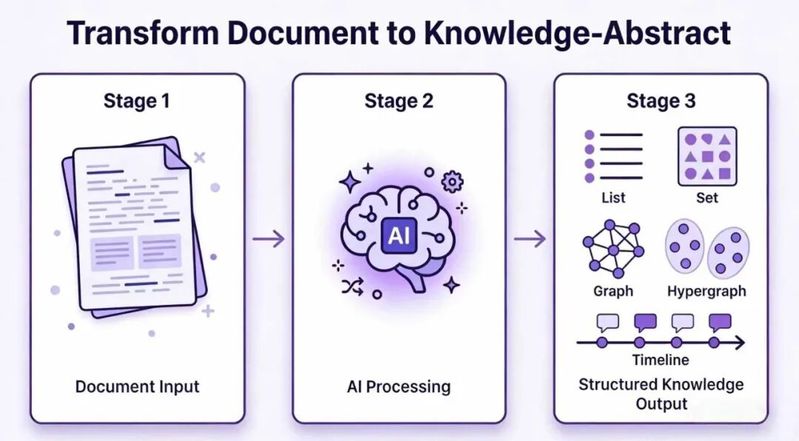
If a knowledge base can only answer “what is written in this phrase”, it is simply a retrieval system. What's really hard is what's in the document? What is the relationship between entities? What information changes over time? What relationships are not ordinary dualist relationships, but complex structures that combine a set of events, roles, locations
Hyper-extract wants to solve the problem. It is not a simple document solver, but a llm driven knowledge extraction and evolution framework: convert highly unstructured text into sustainable, searchable, cocoa visual, exportable knowledge abstracts。
The official description of the project is: smart knowledge exchange cli. To put it more simply, it attempts to synthesize "read documents, draw entities, build maps, do searches, visualize, export notes, call agent" into a command line workflow。
What can it do
The core competencies of hyper-extrac can be summarized as five things。
1 extract structured knowledge from documents
It can extract articles, financial reports, biography, industry files, medical/legal/chinese medicine, etc., from the structure of lists, collections, pydantic models, knowledge maps, supergraphs, time-series maps, spatial maps, time-space maps, etc。
1 template to lower extraction threshold
The project contains an 80+yaml template covering areas such as finance, legal, medical, tcm, industry, general. The user does not need to draw the template quickly from a zero-written schema。
1. Support multiple knowledge extraction methods
Readme refers to its support for graphrag, lightrag, hyper-rg, kg-gen, cog-rag, etc. In other words, it is more like a unified portal to the method of extraction of knowledge than a single algorithm。
1 supports incremental evolution
The knowledge base is not a one-off product. Hyper-extrac supports the continued feeding of new documents so that existing knowledge act is extended, supplemented and refined。
1 support query, visualization, export and agent access
The results of the extraction can be gypsy-referenced through his search, he shows visualization, and can be exported as obsidian vaault, making the spectro node a taped markdown note. The new version also supports mcp server, which can search claude desktop or ide agent for abstract knowledge through his-mcp。
Readme original map
The following figures are taken from the project readme, which maintains the original map and allows for a direct understanding of the product pattern that the official authorities want to express。
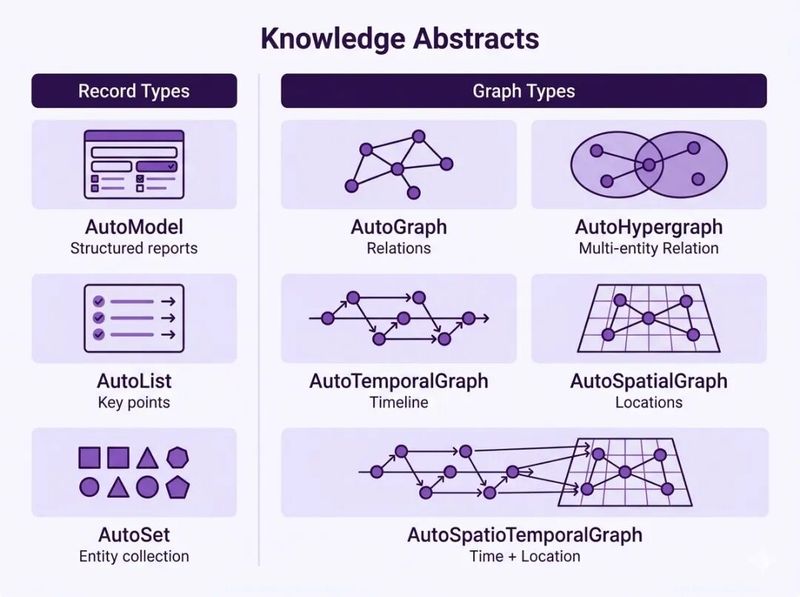
This map shows the knowledge structure supported by hyper-extrac. It does not only draw on entities and relationships, but also continues to advance the complexity of the structure upwards: from ordinary model/list/set to graph/hypergraph, to temporal, spatial and spadio-temporal graph。
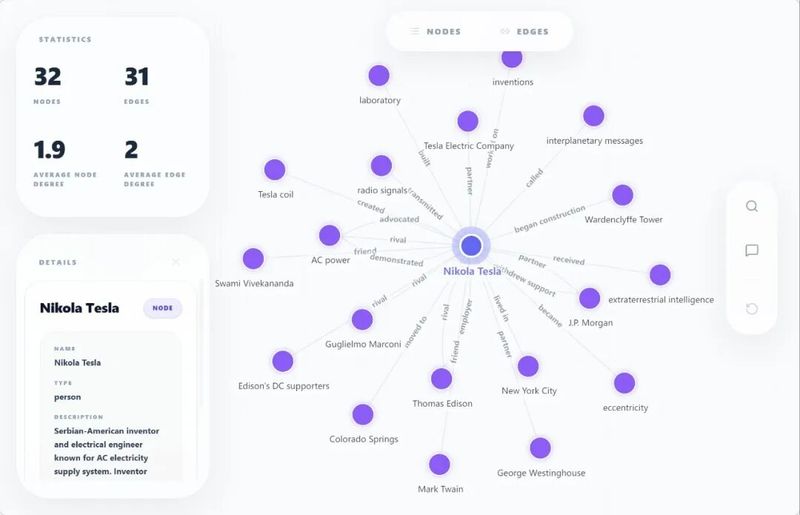
This figure shows autograph visualization. For materials such as research papers, person biographies, corporate financial statements, mapping means turning “information scattered in paragraphs” into a navigable network of relationships。
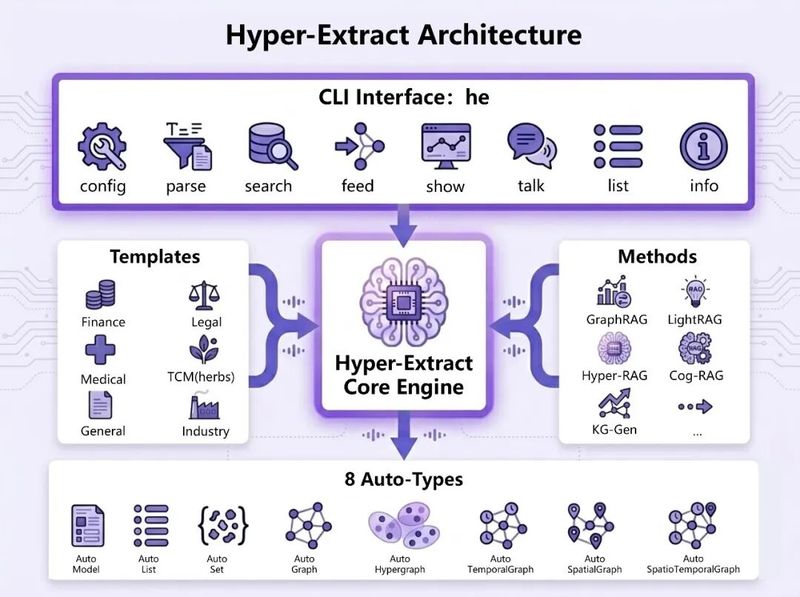
The official chart splits hyper-extract into three layers: auto-types, methods, templates. This layer is critical: the data structure defines what to draw, the method determines how to draw, and the template allows users to land without writing codes。
Functional chart
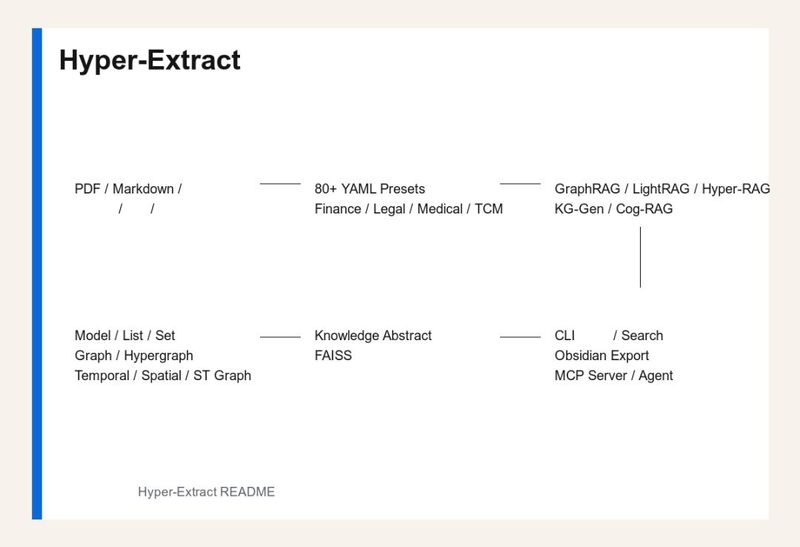
From an engineering point of view, hyper-extract can be understood as six layers。
• level of input: receipt of unstructured content such as PDF, markdown, general text, research papers, financial reports, industry information, etc。
• template layer: define target structures, fields, physical and relationship identifiers through 80+yaml presets。
• graphrag, lightrag, hyper-rag, kg-gen, etc., to transform the text into a structured output。
• structural layer: carrying 8 powerful types of knowledge structure, including graph, hypergraph, temporal graph, spatial graph, spacio-temporal graph。
• storage retrieval layer: generate knowledge abstract and perform semantic searches in conjunction with faiss / embedding。
Consumer layer: provide cli queries, visualization, obsidian exports, and mcp server calls to agent。
The advantage of this structure is that the user can start with what i have, not with "i'm going to design the entire map database myself " 。
Use flowchart
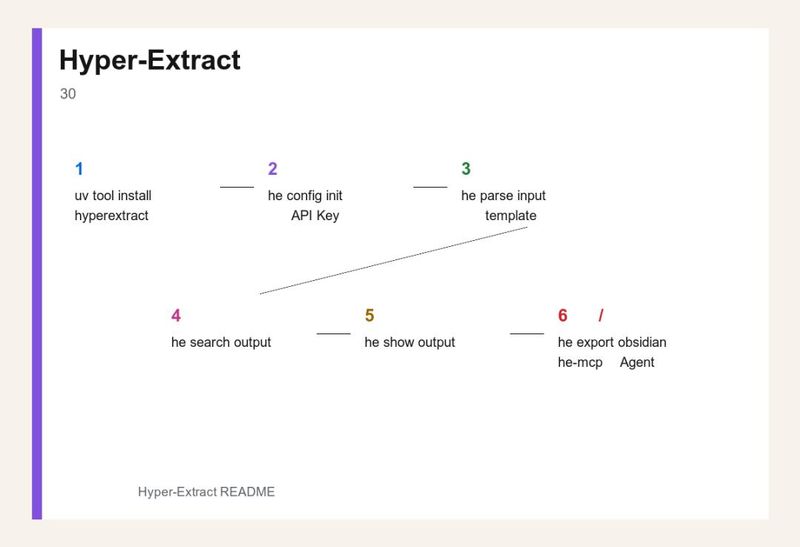
Readme gives 30 seconds to start very directly。
"language-bash"
He co{\chffffff}{\ch00ff00} nfig init-k your openai api key
I'm sorry, i'm sorry
"what are tesla?"'s major appointments?"
He shows..
He export obsidian
This link corresponds to the installation of tools, the configuration of api key, the selection template extraction, the questioning of results, visualization of results, and the export to obsidian。
If you want to use python api, you can also directly create templates and parse text:
"language-python"I'm sorry

= template. Create("general/biography graph")

With open as f:
Result = k. Parse (f. Read)

I don't know, rest
Platforms and models supported
Hyper-extrac relies on the structured output of the model, i. E. Json schema or function calling。
The validated models listed in readme include:
• openai: gpt-4, gpt-4o-mini, gpt-5
• anthropic: claude-opus-4-8, claude-sonnet-4-6, claude-haiku-4-5
• ali yunpun: qwen-plus, qwen-turbo, deepseek-r1
• local vllm: qwen3. 5-9b (gptq-marlin)
The embedding model is used for semantic search and supports any type of openai-compatible endpoint, such as text-embeding-3-small, text-embeding-v4, local vlm bge-m3。
It needs to be noted that claude is used only as llm, and anthropic does not have embeddings api at the moment, so it needs to match openai-compatible embedding program。
"language-python"I'm sorry

Llm, emb = crime client
Ilm is anthropic,
== sync, corrected by elderman ==
I'm not sure
A few typical scenarios
Researcher: turning papers into knowledge maps spectrum
Enter a 20-page paper to extract key concepts, authors, references and generate interactive maps。
- /paper kb/
He shows
Financial analysts: extract entities and relationships from financial statements
Automatically identify companies, management, financial indicators, risk factors and their relationships。
Okay, okay, okay
"what are the key risk actors?"
Localized deployment: data not available online
Run local models through vlm, e. G. Qwen3. 5-9b and bge-m3。
"language-python"I'm sorry

Llm, emb = crime client
Ilm = "vllm: qwen3. 5-9b6a9955" #c586c0" @http://localhost:80000/v1",
@c586c0" @http://localhost:8001/v1",
Api key = "dummy,",
I'm not sure
Distinction from common graphrag projects
Readme uses a functional comparison between hyper-extract and graphrag, lightrag, kg-gen, atom. This is how it is understood:
• general knowledge mapping: these types of tools are generally supported。
• temporal graph: graphrg, atom, hyper-extract support。
• spatial graph: only hyper-extrac supports the readme comparison。
• hypergraph: only hyper-extract supports the readme comparison。
• domain templates: only hyper-extract provides an internal field template in the readme comparison。
• interactive cli: graphrag and hyper-extrac support in the readme comparison, not supported by lightrag, kg-gen, atom。
• multi-language: graphrag and hyper-extrac support in readme comparison。
Therefore, the difference between hyper-extract is not “can also make a schematic”, but rather it places maps, hypergraphs, spatial and temporal structures, templates, clis, search, visualization and export in a product chain。
The technology vault and the real entrance
From pyproject. Toml, hyper-extrac is a python 3. 11+ project with a package name hperextract, version 0. 3. 0. Core dependence includes:
• langchain/langchain-openai: llm call and structured output links
• faiss-cpu: semantic index and vector search
• oNhome/ oNtosight: knowledge memory and visualization-related capabilities
• semhash: semantic hashi/direct related capabilities
• typer / rich: cli command line and terminal presentation
• python-dotenv: local configuration load
The project provides two command entrances:
• he: master cli, for operations like config, parse, search, show, export, clean
• he-mcp: mcp server for opening knowledge abstract to claude desktop or ide agent
Options include:
• hyperextract
I'm sorry, anthropic
• hyperextract
• hyperextract
• hyperextract
This suggests that project positioning is not a single saas, but a local/developer-friendly knowledge extraction toolkit。
Star history
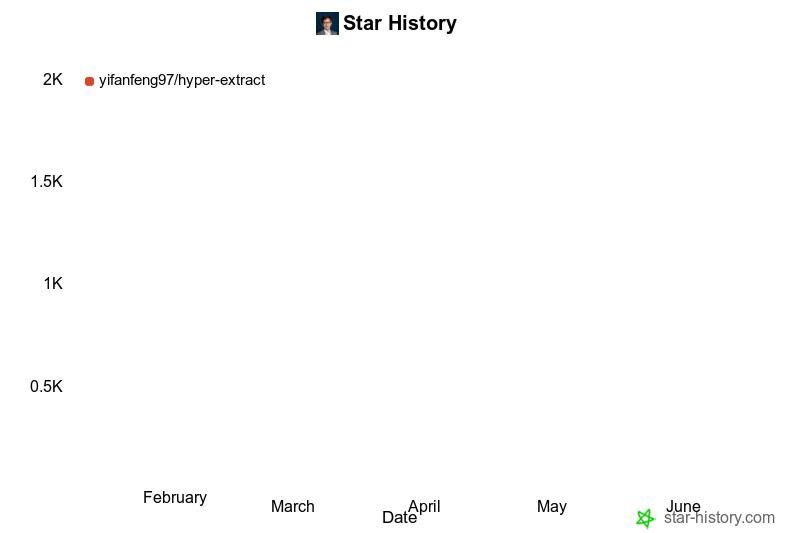
Star history, from the bottom of readme, shows that the project's recent interest is increasing. For such tools, heat per se is not a conclusion, but it suggests that knowledge extraction, graphrag, and the available knowledge base for agent are receiving renewed attention from more developers。
For whom
Hyper-extrac is suitable for the following categories:
• developer of rag / graphrg / knowledge base system
• seeking to transform papers, financial statements, legal texts, medical information into researchers or analysts of structured knowledge
• individuals wishing to import knowledge maps into obsidian as long-term knowledge management users
• trying to get claude desktop, ide agent to look for local abstract agent project developers
• teams that need to be locally deployed and do not want sensitive documents to leave the intranet
Risks and boundaries
It is still in alpha phase, pyproject. Toml's classifier labeled development status #3 - alpha. This means that api, templates, cli behavior may change。
In addition, hyper-extrac relies on llm's structured output capability. The weaker the model, the more messy the input, the more complex the template, the more volatile the extraction quality. When actually used for production, additional results validation, template version management, manual clearance and regression testing are required。
Finally, the value of the complex chart structure comes from the subsequent use of the scene. Normal chunk + embedding may be enough if it is simply a question-and-answer exercise; if the target is physical relationship analysis, time-series tracking, event attribution, and domain knowledge is deposited, the structured route of hyper-extrac is better。
Engineering principles observation
• kiss: cli links are clear, parse →search → show → export is user-friendly。
• yagni: if a simple document is a question-and-answer, no super and temporal maps need to be used at the outset; the value is first validated using a template。
• solid: three levels of division of labour between auto-types, methods and templates, with structures, methods and configurations。
• dry: field templates are reused to reduce duplication of schema design costs。
• potential breach points: there are many extraction methods and many templates, and a high-value document type should be selected for close-ring validation to avoid “complex and complex” team landings。
Statement: this paper is organized by hills: hyper-extrac github repository. If it will help you, please show some praise, attention, collection. Thank you
References
Hyper-extract: https://github. Com/yifanfeng97/hyper-extraction
Hyper-extrac github repository:
Https://github. Com/yifanfeng97/hyper-extraction



