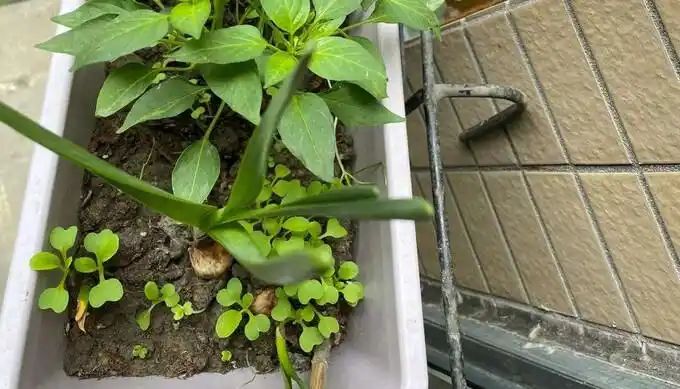
Today, we share the details of the steps and the attention that must be paid to the cultivation of cuisine, which requires attention。
Specific methods of planting cilantro。
I: fit for growth
Temperature:
Cold, intolerant, with the highest temperature of 15-20 °c (coast resistant to temperatures ranging from 1 °c to 2 °c and slow growth exceeding 30 °c)
Light:
Highlight, east, west and south towards the balcony, the balcony, the roof
3. Humidity:
It is not appropriate to water too much during the seeding season, and if the water is overwatered, some root diseases can occur. Up to 10 cm, the plant grows well and should be watered and wet on the surface of the soil。
Soil:
Water-protected soils
5. Insects and diseases:
There may be pests like aphids, fungi, ashilosis. When growing cuisine at home, it is sufficient to take into account the temperature of the current planting environment, the suitability of the light, and to observe during planting processes such as humidity, soil, etc。
[ii: preparation tool]
1 spaniard seeds
2. Cultivated packagings (approx. 20 cm deep)
3. Water-protected soils
4, shovels, canteens, etc。
Remarks:
(b) plantation containers: the containers are fine at a deeper depth (preferably with drainage holes at the bottom)
(b) soil culture: it is possible to acquire, on a web-based basis, nutrientable soil suitable for the planting of cuisine, or to produce it on its own; it is necessary to sterilize the soil before planting it and to prevent the occurrence of pests and diseases。
Iii: cultivation
Cultivation with earthbreed or kippe。
Method i: cultivation with fragrance seeds
Method ii: cultivation of the root of the spice
Vegetables can also be grown with water, but individuals do not recommend it because of the relatively high complexity of hydroponic techniques and the fact that the nutrients used are essentially fertilizers. Not much
[iv: specific planting steps]
1, varieties selection:
There are large and small leaf varieties。
(a) the high level of leaf cultivation, the large size of the leaves, the fragrance and the high level of production
The little leaves plant is shorter, small, fragrance, fragrance and adaptability, but production is low, and i usually choose the little leaves。
Seed treatment
The fragrance seeds have a tougher shell, and unless the shell is broken, the seed is slow to absorb water and has a high resistance。
1, find tools such as a bigger plank, and put the fragrance seeds on the plane, and squeeze the seeds slightly, so that the shell can be split (and hand rubbing if it is strong)。
Note: seeds cannot be squeezed with small area tools to prevent the seeds from being crushed。
2. When the fragrance seeds break their shell, they are immersed directly in warm water, or they can be wrapped in gauze and then immersed in warm water. The immersion time should be within 48 hours of 24 hours or more, to the extent possible。
3. Smash the seeds, wash them with fresh water and dry them for subsequent planting。
Three, sowing
(b) dig a hole in the soil with a finger and place it in five to seven fragrance seeds and then cover a thin layer of soil (0. 5 to 1 cm, with soil mixed with base fertilizer pouring into the soil before planting)
Note: before seeding, care should be taken to avoid high temperatures and sunlight, and if the sun is too toxic, the sun should be properly covered; if seeded in cold weather, the membrane can be properly covered with temperature protection. The soil surface temperature is maintained at about 20 degrees, not below 10 degrees and not above 30 degrees celsius, or the seedling is poor。
Four, teeth and sapling
The seeding will take place in about a week or two. Vegetable seedlings grow slowly, soil is wet enough and water is overstretched。
When the seedlings are almost ready, some of the weaker ones are uprooted, leaving strong plants to grow (about two per nest)。
Note: some friends use this method: when the vegetables are almost ready to grow, they eat them first, then they fertilize them and then they grow and eat them。
Five, go after fat
It is not appropriate to water too much during the sapling season. When seedlings grow to about 10 cm, the cuisine grows more abundant and should be watered and wet on the surface of the soil。
Watering is accompanied by the pursuit of organic nitrogen fertilizer one to two times, depending on the actual situation, including slow growth. "t. B.'s search for the "eco-governance of shitshell" can buy organic fertilizer."
Note: if the surface of the soil is plated, the pine soil may be properly made, which will facilitate the growth of the seedlings。
6. Picking
The cilantro is not very long for long, and is usually collected for about 60 days (up to 15-20 cm). Largest plants are usually harvested first, leaving small amounts of continuous growth, while care is taken to pursue one run-off of curing organic nitrogen fertilizer. "t. B.'s search for the "eco-governance of shitshell" can buy organic fertilizer."
The root seeding method
1. Choosing rooted cuisine
The fragrance with roots can be bought from supermarkets or flower farming markets, and it is easier to live with a small amount of dirt on the roots。
2. Treatment of cuisine
All the fragrances are cut off from the surroundings, just a little fragrance。
Cultivation
Pack the earth in the planting containers, mix the base fats, plow the earth with chopsticks or branches, plant the cuisine into the hole, and crush the cuisine with clay, then pour water。
Remarks:
1. There is a gap between cassavas of approximately 3 to 5 centimetres to allow for the need to grow space
Two, the fragrance will be unstable when you water it, and you can get it right with your hands
4. Work
It'll be on the balcony for 2-3 days in the dark! Fertilizer can be properly followed according to the circumstances (a search by tb store for “eco-governance of shitshell” allows the purchase of organic fertilizer)。
Comment: daily maintenance is based on the method of management in method i。
5. Collection
They can be collected as long as 15-20 cm and can be uprooted or collected continuously at a distance from the root。
Note: the harvest should be followed up in time to ensure the growth of the fragrance。
[v: special reminder]
1. Collapse, i. E. No continuous planting of the same soil。
Ii. The fragrance is less demanding than the light, but the sun is good enough for growth, and the light is weak and can lead to a long life。
3. If seeds are to be harvested, they may be collected after the fragrance has matured, and they are not much recommended for collection by individuals, after all, mainly for fragrance and not necessarily with a high seed gerontization rate。
The spices are cold and slow to grow at 15-20°c and above 30°c。