Identification of structural damage: reverse retroactivity from appearance to mechanism

Water trawler bridge conservation company
Bridge detection vehicle lease, rubber support
Open 100 degrees app
Scanning now
Call immediately
The starting point for the bridge maintenance reinforcement works is not the construction itself, but the precise identification of the structural damage. This process has moved away from a simple list of phenomena and instead has adopted a reverse-retroactive logic: from visible “images” of cracks, stripping, deformation, etc., the reverse induces the hidden path of mechanical and material degradation behind them. For example, horizontal cracks at the base of concrete beams are usually associated with a convulsive hyperdrive, while tilt-directed cracks may point to a lack of cutting capacity. This analytical model of “causes” from “effects” requires detection techniques not only to record damage patterns, but also to quantify their level and rate of development。
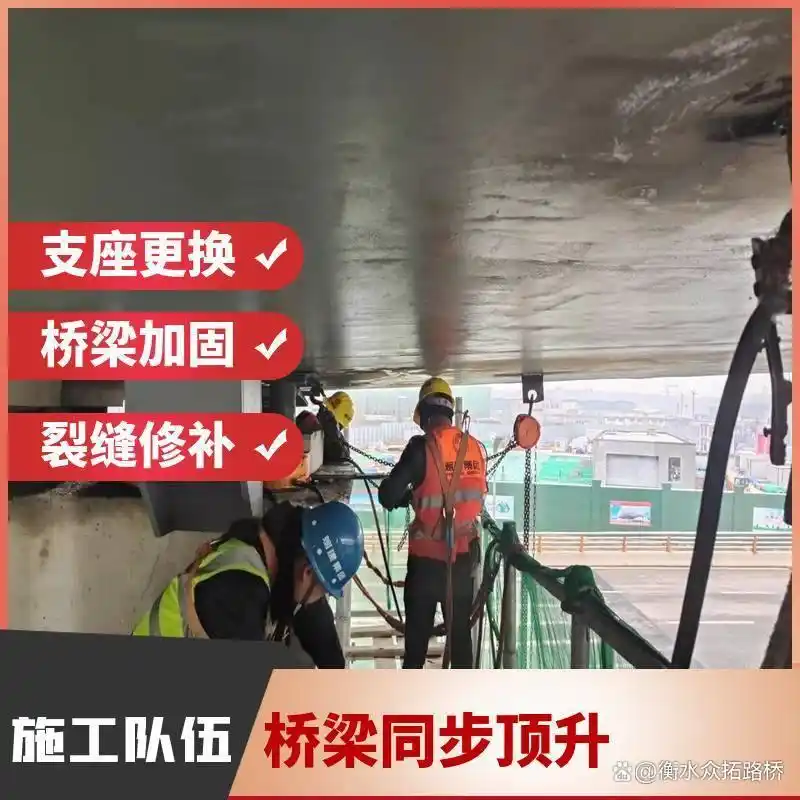
Modern identification techniques combine many tools. Traditional manual inspections and knock tests reveal clear empty drums and stripping. More sophisticated non-destructive detection techniques, such as ultrasound detection, radar scanning and infrared thermal imaging, can detect, in a non-destructive manner, internal defects, the position of steel corrosives, and the enzyme density of pre-receptions, as can be done for bridges. The introduction of a structural health monitoring system, through the installation of sensor networks at key locations, has resulted in the long-term continuous collection of parameters such as resonance, retroactivity, shift, vibration, etc., and the upgrading of injury identification from static “cracker” to dynamic “video”, thus capturing the true response of the structure under a specific load (e. G., heavy vehicle passing, temperature mutation), providing direct data support for the determination of the activity and risk of damage。
Recovery and upgrading of material: re-engineering of interface effects
When the mechanisms for damage are identified, the core of the restoration work shifts to the material level. The key technical challenge here is not simply “filling” or “covering”, but how to re-establish a stable and reliable interface between old and new materials, between damaged and intact. The interface is the key area for stress transfer, deformation coordination, and its failure is often the cause of the failure of the repair works。
For the restoration of concrete structures, high-pressure spraying or high-pressure water current technology is used to completely remove loose, degraded concrete until a solid, clean bone interface is released. They are then repaired using polymer-modified sand, epoxy resin or fibre-enhanced composites. Not only are these materials of their own high intensity, viscosity and permeability, their key characteristics are the ability to work in synergy with the original structure through infiltration, condensation and chemical bonding with transitional areas where old concrete formation performance is better than the old concrete essence. For the treatment of corrosive corrosives of steel, stain retardants are coated after rusting, and new alkaline protection is formed through new concrete or slurry to prevent the continued occurrence of electrochemical corrosives。
Screech reinforcement principles for fibre composite materials
In terms of enhancing the carrying capacity of the components, external adhesion of fibre composite material technology reflects another approach to material performance enhancement. High-performance materials such as carbon fibre sheeting and aromatic fibre sheeting are adhesived through specially designed resins to beamed areas or tolled areas. The principle of enhancement is not simply “fixing patches”, but rather the formation of a layered structure: fibres, as the main stretching element, bear part of the pull that the original steel bars cannot bear because of rusting or insufficient transects; and resin rubber layers are responsible for effectively transmitting stress from concrete base to fibre material. The success of the system is highly dependent on the quality of base treatment, the performance of the glue and the precision control of the construction process, and the defects of any link can lead to the separation of the interface, which makes the enhancement less effective。
Adjustment and optimization of the system of mechanics: active internal intervention
In cases where internal distribution is seriously unreasonable due to structural deficiencies or long-term overloading, only partial material repair is often done to cure the symptoms. At this point in time, there is a need for technology that can proactively intervene in the internal state of the structure, with a holistic adaptation and optimization of the mechanics system。
In vitro pre-resilient techniques are typical representatives of such technologies. It adds pre-responders outside the beams and imposes an extra force on the beams by turning blocks and anchoring devices that are contrary to the original load effect. This process is essentially a proactive redrawing effort within the structure: through precise calculations and zhang pull control, it can significantly reduce, or even close, the cracks, reduce the bends and shears that the transects of the components bear, and thus significantly increase the structure's rigidity and carrying capacity. In vitro stressors are easily checked, maintained and replaced compared to traditional in vitro stress, providing manageable conditions for long-term safety of bridges。
Another mechanics adjustment technique is a structural change. For example, the leung liang bridge has been transformed into a partial continuous or continuous liang bridge through additional connectivity, thereby reducing the number of positive and medium-verteers and optimizing internal distribution. For example, in cases where the bridge is not carrying enough capacity, the addition of steel casings or condensed concrete caps could be used, not only to increase the cross-section area, but also, more importantly, to place the former pillars in a state of three-directionally pressured favourable stress, thereby significantly improving their resistance to pressure and deformation. Such technologies redistribute load paths at the system level to upgrade the overall security reserve。
04 re-engineering of environmental and durability barriers: upgrading of defence systems
The damage to bridges is due mostly to the combined effects of environmental erosion and the ageing of materials. The plurality of maintenance enhancements involves the re-engineering of structural durable defence systems, which constitute the cornerstone of long-term security. The key to this phase of technology is to move from passive patching to active protection and to establish multi-channel defence lines for the structure。
High-quality lines of defence are the repair and improvement of water and drainage systems. Water-proof concrete or water-proofing agents are used for the repair of the surface layer of the bridge and to ensure the smooth flow of the ramp and discharge hole, with the aim of rapidly removing water sources and avoiding infiltration of water into beams. The second line of defence is a corrosive coating system. On a steel-structured bridge, heavy preservative coatings, metallic thermal spraying (e. G. Zinc spray, aluminium spray) are used to form long-acting protection layers. For concrete structures, coating of permeable or membrane protective paints at key locations prevents intrusion of harmful media such as chlorine ion, carbon dioxide, etc. The third line of defence is the cathode protection technique, which is used primarily for steel condensers in a harsh corrosive environment, keeping the steel band level in a non-coercive zone by applying external currents or sacrificing the anode, and stopping the development of rust from the electrochemical sources。
Defense design concept based on performance
Modern durability protection has shifted from “experience-designated” to “performance-based design”. That is, based on the level of corrosion in the environment where the bridge is located, and the design of the use-year extension target, a quantitative determination of the performance indicators to be achieved by the protective system (e. G., the reduction of the chlorine-ion diffusion factor, the coating tolerance period, etc.) is required to select the matching material and process combination. This concept ensures that protective measures are clearly targeted, testable and life-sustaining, moving durability from vague concepts to quantifiable and controlled engineering technology components。
Precision control of the construction process: physical conversion of technical intent
All design concepts and computing models ultimately depend on precision control of the construction process to achieve their technical intent. This phase is the key converter for transforming drawings and programmes into physical security increments, with the core being the fine-tuning of responses to process parameters, environmental conditions and structures。
For example, the effect of crack pressure slurry depends not only on the performance of the slurry material but also on the control of the pressure, rate and sequence of the slurry. The pressure is too low to ensure that the plasma is filled with fine cracks, while the pressure is too high to allow it to expand. When adhesing fibre composite materials, the temperature humidity of the environment, the operational time of the glue, and the flatness and strength of the voltage exhaust directly affect the final bond mass and thickness. In vitro pre-resilience works, the stretching, stretching and synchronization of each bar of steel nodes are diversified and theoretically calibrated, and any deviations may cause the internal distribution of structure to deviate from design expectations。
Modern construction controls rely heavily on digital tools. The construction parameters are recorded in real time by portable data acquisition equipment, which uses sensors to monitor stress variability in key areas during the construction process, even comparing the structural shapes before and after the construction with three-dimensional scanning techniques. This fully manageable and data-retroactive construction model reduces uncertainty in human operations to innovative limits and ensures that each key technical measure is put in place accurately and in its entirety, thereby translating the design phase security upgrade objective into a real security build-up for structural entities。
The modern bridge maintenance consolidation project is an integrated technical system that integrates reverse diagnosis, interface re-engineering, internal intervention, system protection and precision conversion. Its core value lies in the fact that it is not simply a patchwork of old structures, but a deep “functional re-engineering” and “life-renewal” of existing structures using modern engineering science. The consolidation of each successful maintenance involves the transformation of security hazards into predictable and manageable technical objects through rigorous technical logic and fine engineering controls, thereby safeguarding the basis of public traffic security over the continuous length of the service life of the structure. The process itself is a central manifestation of the continuous evolution of the bridge engineering discipline to address the ageing challenges of infrastructure in a more intelligent and economical manner。