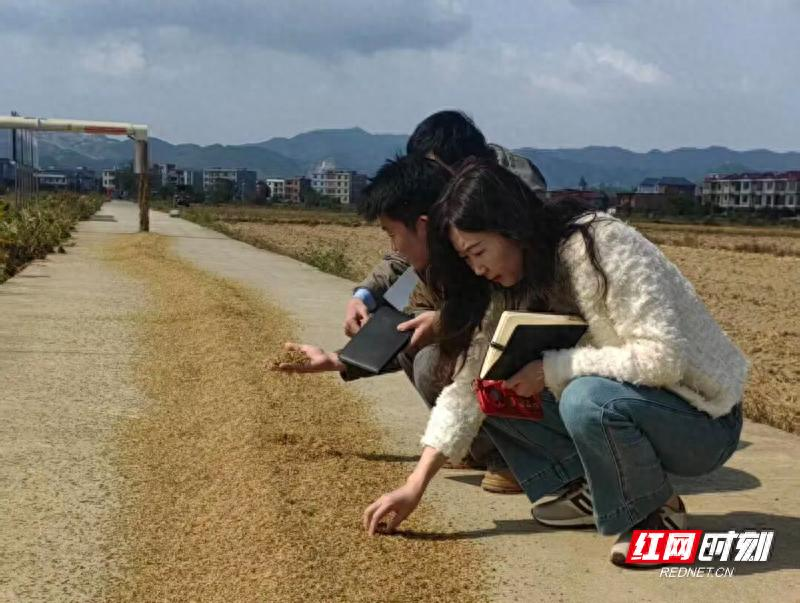
On november 4th, the red net news service (rongzhou news), liu yang luyatin, was high on november 1st, during the autumn season, with more than 30 participants from the heads of the relevant departments of the shanghai city department of ecology, heads of departments and representatives of youth commandos from the city and 11 substations coming to the village group and field of anin county to carry out research on the theme “studying the path of straw, co-drawing the ecological rolls”, and to explore local cropping patterns, the use of farm equipment, rural crop replacement and the integrated use of straw。
The team first came to the 9th group of the anjin district building, the village of shinko village, where the stench disposal model was the “high-water storage” model. The village's 200-acre rice field, which takes advantage of the availability of local water sources, uses a high-harvesting pattern (with 20-30 cm straw) where the whole field is built and water is flooded with straw and then replanted after 15-30 days of natural decomposition. The village books introduced the members to the idea that this model, which does not require complex equipment, low cost and suitable water-supplied field ecology, can be both a substitute for incineration and improve soil fertility, as well as an effective solution to the problem of pests and diseases and is well suited to the local rice-growing industry。
The team in the village of the village of the village of toshikawa learned that the 300-acre rice field was based on the “low harvest to shred” model. The model is for the local cooperative to move the farm machine in a unified manner during the harvest season, with a low harvester (retention)
At the third stop, anping town, where the team saw various agricultural machines working like fire in the paddy fields, it became clear to the team that the “low harvest, crushing deep tilling” pattern was “high (low) harvesting back tilling”. These models, which are used for 239 acres of demonstration, provide precise coverage of three types of crops, namely, roasted smoke, double-season rice and oilseed, and meet the replacement needs of farmers. The team was also informed that the synergy between policy support and grass-roots engagement, which allowed the technology to be successfully put on the ground, with 23 harvesters equipped with shredders in accordance with the policy of acquiring farm machines and supplementing them with operational incentives, is being promoted through the implementation of safeguards at the town, village and group levels, a multi-stakeholder model that provides solid guarantees for wide-scale extension。
At the last stop, the team came to the village of grand duang, china, and learned of the “low harvests and bundling” and the “strawling of food fungi” patterns. A new technology has been introduced in the village, represented by a 10-acre plume planting demonstration, which is directly tied out of the village. An open-air seeding of red laxity, with no need for complex pre-treatment, with a 10-acre demonstration field capable of treating 300-acre farm straw and effectively addressing the problem of treatment of straw. At the same time, acre production of 3000-5,000 pounds and acre production of about 30,000 yuan has led to employment for poor households and ecological conservation and livelihood improvements。
In the study, the youth commandos interacted face-to-face with village cadres, growers and farm crews, asking in detail the advantages and disadvantages of various models, the availability of subsidies, problems and ways to address them. It has been said that the key to the “defunctness” of the tuning lies in local and multifaceted exploration, the choice of different modes of straw harvesting based on different cultivation needs, both on the basis of agricultural production and on the preservation of the environment and the needs of the people, so that the concept of “people-centred” can be truly implemented and accepted by farmers。
As a next step, the youth commandos will take stock of the findings of this study and, taking into account previous experiences of barter-free publicity and inspection efforts, further follow-up advocacy efforts on the integrated use of straw and precision burning will be carried out, with a view to promoting localized and low-cost cropping models among farmers, eliminating burning hazards at source and contributing to the city-wide blue sky war。