The key to teaching children about traffic safety lies in translating abstract rules into everyday habits, through games-based experiences, the teaching of critical skills and the teaching of parental speech. The new semester begins with traffic safety as the “first line of defence” for children to learn about their lives, which requires parents to assume parental responsibility for ensuring that safety is truly internalized。
Game: let the rules play in the heart
For children, boring speech is of limited effect, and interactive games can significantly increase participation and memory. For example, in kindergarten teachings, “drivers and pedestrians” are commonly used: “roads” and “zebra lines” are posted on the ground with tape, allowing children to play different roles and understand the rules in the simulation of red lights and green lights。
This role-playing game is not only fun, but also helps children to strengthen their memory through multi-sensor experience. - experiments have shown that children's memory of traffic signals can be extended to 2. 3 seconds after a game-oriented teaching, much higher than the 1. 1 seconds of traditional teaching。
The way forward includes making traffic signs manually, explaining the role of each sign during a hand-in-hand exercise, or sharing traffic safety stories around them, leading children to discuss dangerous behaviour in cases. These activities have naturally lowered the learning threshold by moving security knowledge from “remember” to “want to participate”。
Key points: age red line and avoidance skills
As children grow up, safety education needs to focus on specific risks and legal boundaries. First and foremost, the age requirement is that persons under 12 years of age may not travel by bicycle or by electric bicycle. This is not only a rule, but also a protection - premature riding is prone to accidents due to inadequate response and requires strict parental supervision。
In terms of walking and driving, core skills can be summarized as follows:
These skills are not one-off indoctrination, but they are practiced over and over again during daily trips, so that the child becomes a conditional reflection。
Parents ' list: the power of words and words
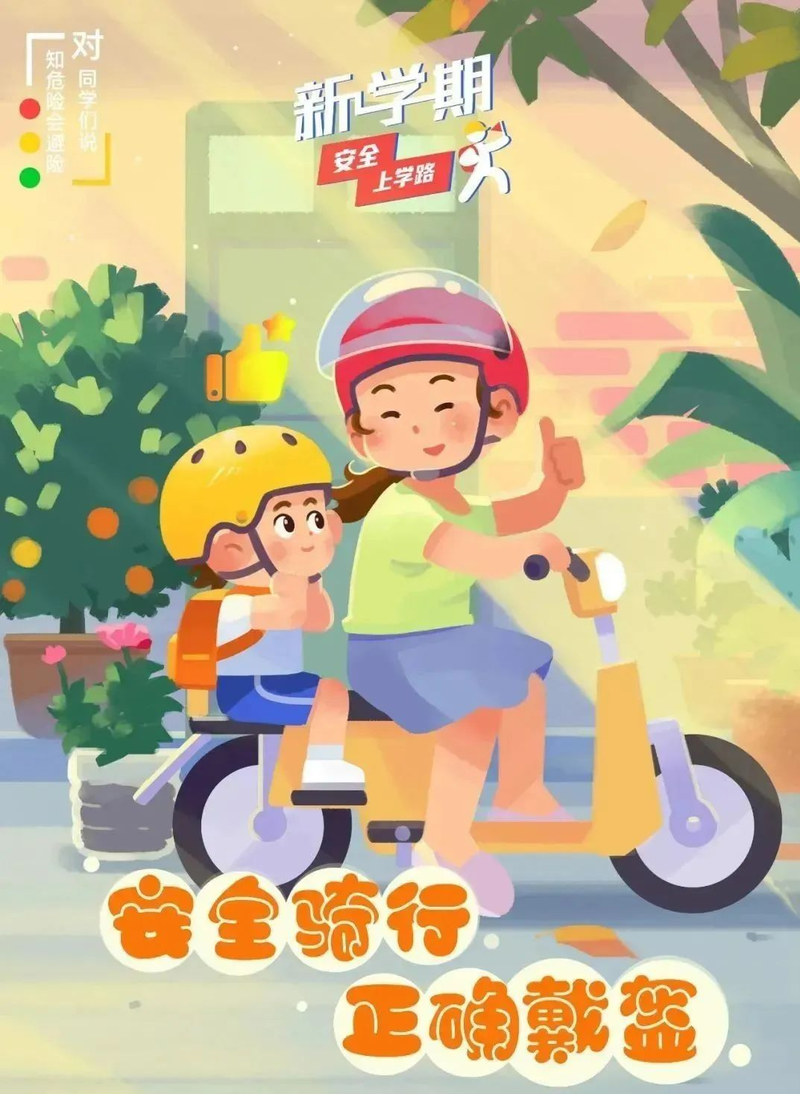
The behaviour of the child is largely imitated from the parent, so each time a parent adheres to the rules is the most vivid educational material. Both adults and children should wear their safety helmets properly when carrying their children on electric bicycles; when driving, they should wear their seat belts, i. E., stop or leave school doors open. If the parents break the red light or look at the cell phone on their own, the child subconscious thinks the rules can be broken。
More crucial is the integration of security education into daily dialogue. For example, when the light is red, we can talk about it: "how dangerous was that uncle to break the light, and we'll go when the light is green." seeing the courtesy of the vehicle, it was confirmed in time: “the driver is doing the right thing, and we must thank the courtesy.” this immediate feedback helps children to build the right safety values. Parents perform guardianship duties, not only to protect, but also to teach their children how to protect themselves。
In the end, traffic safety education is not an examination, but a daily practice requiring the participation of schools. From games to rules, from skills to habits, every step paves the way for the safe growth of children。