In 2026, when we revisited the word "search" it was no longer the blue hyperlink list。
For businesses, a silent crisis is spreading: your network may still be number one in google, but in chatgpt, deepseek, or copilot, your brand is “disappearing in the air.” this is not just a technical shift, it is a deep game about “user attention distribution rights”. Today, we are going to move away from the obscure lines, to read in depth the nature of the difference between seo and geo, and the paradigm recasting that business must face in 2026。
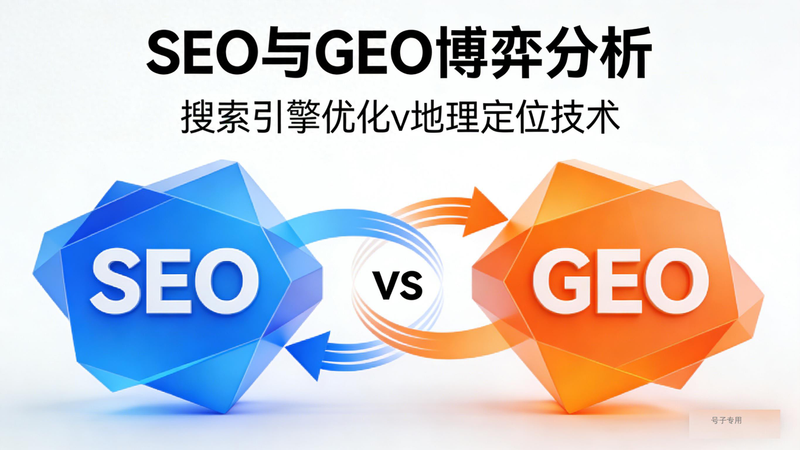
I. Two logics: competing for “click” and taking “the answer”
To understand the current change, it is important to first understand that the search engine and the working logic of the generation ai are fundamentally different。
The classical era of seo:
The internet for the past two decades has been a “flow supermarket”. The central question of the search engine (e. G. Google, 100 degrees) is: "so many web pages, which point does the user enter?"
Thus, all of the tactics of seos — the density of keywords, the construction of outer chains, the duration of stay — point to one ultimate target: the rate of hits. What we did was optimized the "show logic on the shelf" to get users into your shop。
The awakening years of geo:
And the core issue of the creative search, represented by chatgpt, perplexity, kimi, was: “how can i tell him directly if users want answers?”
In this mode, ai does not care if the user clicks on your link. It only cares about three things: can your content be understood by it? Is there enough credibility? Can it be broken into pieces
"seo is looking at web pages for search engines, geo is looking at semantic structures for large models." — we are moving from “competing for access” to “dominating the answer”。
Ii. Data shocks: irreversible flows
In 2026, no marketing editor-in-chief could ignore the following two sets of data, which represent “crisis” and “opportunities”。
First, the traditional search “flow landslide”。
According to cnnic, by june 2025, the size of our search engine as a whole had fallen to 69. 2 per cent of the internet users, a significant decline compared to data from previous surveys. At the same time, gartner predicts that access to the global search engine will drop by 25 per cent in 2026, and that the “zero click search” where users can obtain answers without a link has become mainstream。
Second, the "indexed growth" of the ai portal。
Although the current base figure varies (data show that traditional seo flows are still about 34 times the volume of geo flows), ai is growing at an alarming rate. Chatgpt's weekly active users jumped from 200 million to 800 million in just over a year. More crucial is quality: the bene consultancy study shows that chinese consumers have more than 30 percentage points of confidence in ai's individualized recommendations. This means that the ai recommended = trusted。
Microsoft framework: the three technical pillars of geo
If the seo era is based on experience, then the geo era is based on engineering thinking. Microsoft has decoded the underlying logic of the ai-recommended system in its official "from discovery to information" guide。
Microsoft believes that the a. I. Recommends your product to be tested on three levels:
Technology foundation (seo): helping products to be found. This is the foundation, and structured data (schema markup) and feeds remain essential. Aeo: help ai clearly explain your product to users. This requires that the content be clear and modular so that ai can easily extract it. Geo: help ai trust you and eventually recommend you. This requires authoritative signals, consistent brand information and credible third-party endorsements。
Simply put, before deciding whether to say your name, ai will look like a dedicated investigator to see if your semantics are complete, whether logic is closed, and whether the chain of evidence is solid。
Operational guidance: 2026 content “structure of answers”
In the face of this technological core, our content strategy must evolve from “writing to readers” to “writing to readers as well as to machines”. In the context of the current mainstream geo practice, the editor-in-chief suggested that the team introduce the following "four-dimensional content optimization":
1. Structural optimization: preconclusion
Ai likes the total score structure. Instead of drawing conclusions at the end of the article, the core answer should be placed in the first paragraph. For example, by writing “how to select running shoes”, the opening section gives “a three-step selection based on weight, bow and road conditions”。
Semantic optimization: speaking in data
The vague adjectives such as “good taste” and “good quality” are discarded. Change to specific data: “as a result of laboratory tests, the product continues to sail 20 per cent higher than the previous generation” or “based on 320 user evaluations, 95 per cent of the guests think ...”. The data is the central chain of evidence for ai's judgement expertise。
3. Optimization of authority: building evidence chains
(c) the principles of e-e-a-t (experience, profession, authority, credibility) as proposed by google. Reference is made to industry reports, author qualifications, and real user cases. In particular, microsoft emphasized that “validated comments” and “references to authoritative media” were key signals in determining whether ai recommended them。
4. Intent optimization: simulation questions and answers
It's not just an article, it's an answer. Study how your users will ask ai questions (e. G. “the japanese store near beijing, suitable for bringing a baby”), and use this question directly as a subheading for your content, and then give a clear and concise answer below。
V. Concluding remarks: branding is the answer
At this time of 2026, i suggest that all marketing colleagues revisit our kpi. In the past, we have focused on uvs (independent visitors) and pvs (page views), and in the future we may need to focus on “ai reference rates” and “response occupancy rates”。
The rise of geo does not mean the death of seo. Instead, seo is the foundation of geo and geo is the extension of seo. Their relationship no longer replaces, but evolves。
The future brand competition will no longer be more beautiful than whose website is built, but more rigorous than whose knowledge base, whose semantic structure is clearer, and who can be the “default answer” to a question in ai's mind。
If your brand is not in the answer, not in the user's choice。
Seo and geo live together
Ten years of experience with internet keyword promotion