In order to help people learn and understand about hepatitis and to prevent hepatitis in science, this document provides information on hepatitis prevention and treatment for all, with a view to improving the level of awareness and self-protection skills of public science in the prevention and treatment of hepatitis, leading to voluntary testing and the regulation of treatment, and actively promoting a favourable climate for community participation in hepatitis prevention。


World hepatitis day 12, 28 july 2022. The theme of this year's campaign is “preventing hepatitis, healthy you and me”. Hepatitis is one of the most devastating diseases in the world, as well as one that can be prevented and treated, and is easily accessible at the primary health-care level. In recent years, the sustainable development goals related to hepatitis b have been achieved with the concerted efforts of countries, and the number of people receiving treatment for hepatitis c has increased ninefold, reversing the rising mortality trend for the first time。

What's the type of hepatitis
Hepatitis can be classified as acute and chronic, depending on the length of its course, which generally takes more than six months. Hepatitis can be classified as non-virus hepatitis and viral hepatitis depending on whether the virus is infected or not。
Alcohol, drugs, self-immunization, fat hepatitis, among other factors, are among the most common causes of non-viral hepatitis, which can also occur when bacterial, parasitic, congenital metabolic abnormalities, disease in the whole system and the liver are exhausted. To some extent, non-virus hepatitis is generally not contagious. And most of what we usually call hepatitis in our lives is viral hepatitis, which is the most dangerous. Of course, the recent global multi-country reports of unspecified cases of acute hepatitis among children have also given rise to widespread social concern, as of 26 may, in 34 countries, 650 cases and 14 deaths。
What is viral hepatitis and children's unknown cause of hepatitis
The types of viral hepatitis detected and made public by national and international scholars include nine types, namely, type a, type b, type c, type d, type e, type g, type ttv, type cen and unknown cause hepatitis. The virus prefers liver abuse, hepaticity and clinically most common hepatitis types, mainly a, b, c, d and e. The main causes of the disease and the means of transmission are unknown to children, who, according to the nhs data, have not so far been identified with acute hepatitis。
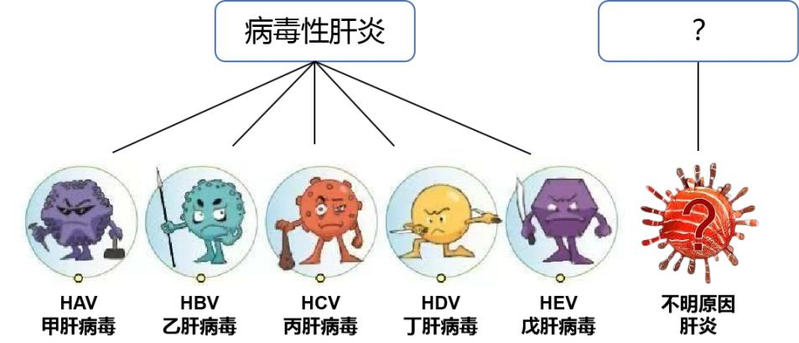
In addition, nearly half of the world's deaths from hepatitis cancer are chinese, chronically infected persons bear a heavy burden of disease, nearly 85 per cent of chronic hepatitis b or c patients are not treated effectively, most infected persons (mainly hepatitis c) are not aware of their own infection status, and much remains to be done to combat hepatitis。
What are the characteristics of various types of viral hepatitis and of children with unknown causes
The table below shows how different types of hepatitis spread, clinical characteristics and hazard characteristics。

How to combat viral hepatitis
Different types of viral hepatitis are treated differently. In the case of hepatitis a and e, the main route is to cut off the excreta-port transmission; in the case of hepatitis b and d, the vaccination rate for hepatitis b; and in the case of hepatitis c, the control of transmission outside the intestinal tract (e. G. Through blood)。
(1) hepatitis vaccination
The prevention of viral hepatitis and vaccination against hepatitis are among the main means at present. Hepatitis a, b and e have been officially introduced to date。
(2) avoidance of misconduct
Hepatitis a and e are mainly infected through faeces and prevention is based on hygiene。
(a) to change clothes, bathe and bedding
(b) personal effects such as toothbrush should be avoided
Special efforts should be made to improve dietary hygiene, such as out-of-pocket meat cooked foods, which must be fully heated before eating, free of raw water, wash hands before eating, and prevent the ingestion of diseases。
(2) hepatitis b and c are transmitted through blood, sexual and vertical transmission from mother to child, with vigilance:
(a) careful use of blood products to avoid treatment in informal clinics
(b) the use of single syringes is mandatory when injecting drugs
(c) when medical equipment is used, it must be strictly disinfected
To avoid consumption in irregular tattoo shops or beauty parlours
(b) individual use of personal effects
In the case of pregnant women infected with hepatitis b virus, the use of anti-viral drugs during pregnancy to interrupt mother-to-child transmission may be selected on the basis of the amount of the virus in the body
7 men who have sex with men and multiple partners should use condoms and undergo regular screening
8 adolescents need proper sex education。