Automated extranal defense, aed. Do you know it? Today, we need to learn not only to know it, but also to learn to use it。
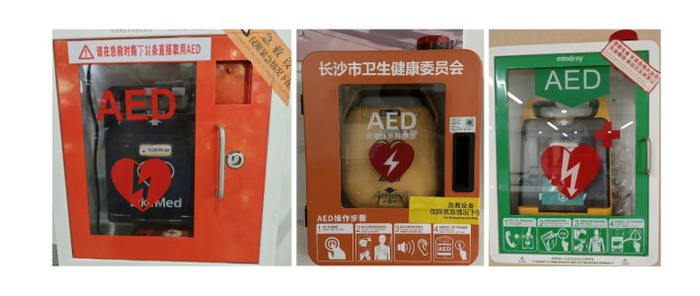
Aed。
Aed is a technique for ending cardiac abnormalities (e. G., room tremors, no pulsed room speed) by releasing low-pressure direct currents to help restore the taccardia. It automatically recognises life-threatening rapid heart disorder and can defibrillate with aed without any specific use training. According to data released at the fifth china emergency relief congress, up to 760,000 people die every year from heart disease, more than 90 per cent of them outside hospitals. The rate of out-of-home cardiac arrest is less than 10 per cent. Nearly 70 per cent of patients with cardiac arrest have hysteria, but only 21. 5 per cent is currently used on site. CardiopulmoNary recovery, cpr is the cornerstone of life-saving cardiac arrest, and the strong association of cpr and automatic defibrillators is the key to saving patients ' lives. Upon death, the cpr was implemented, with a survival rate of over 67 per cent and a rate of 10 per cent for each minute of delay; the restoration of the autonomous pre-hospital cycle was 1. 57-2. 28 times greater than that of the cpr coalition aed, when compared to mere cpr recovery, and the rate of discharge was 1. 73-2. 21 times greater than the former's and 2. 12-2. 85 times higher than the good neuropregnosis. 02 cpr and aed, which priority? If the patient is found unconscious/irreactive, the combined respiratory state is abnormal or non-respiratory, and the heart is considered to have stopped. Before aed comes, a cardiac arrest must be cpr! Remember the cpr survival chain outside the hospital, the first three steps: activation of the emergency response system, cpr, defibrillation. Step one: start the emergency response system and start the cpr immediately. Second: high-quality extra chest pressure. C-a-b cycle, c-compression. Patients lie down and lie down on hard surfaces. The rescuer's hands overlap, with the root in the middle of the two nipples line, with a vertical pressure of 5-6 cm (adult) with a frequency of 100-120 times/minute, evenly applied and 30 times continuous. Open airways (a, airway), the removal of oral foreign objects (dentures, vomiting, etc.) are generally used to open airways by bowing. Anthropogenic (b, breathing), after opening the air channel, squeezes the patient's nose for two mouth-to-mouth artificial respirations (without leakage), each of which is about one second, with a slight rise in the abdomen. Third: aed “aed is here, hurry up”. "continue with cpr, prepare for aed, defibrillation." aed uses step 1. On-line models that vary, either by opening the front of the hood, automatically or by clicking. Once on, aed auto-alert voice alert operational step. 2. The electrode is attached to the top of the patient's right chest (under the collarbone) and to the left nipple on the left side of the patient's right chest according to the image on the electrode tablet to ensure that the skin is dry. According to aed, the heart rate is being analysed with the following one: “no contact with the patient.” 2 if electric shock is required, the voice tip “presses the blinking defibrillation key”, everyone does not contact the patient, press the decentralized button and resumes the cpr immediately after the shock. If the patient's heart rate analysis results in a non-power-shocking heart rate, the voice hint “does not recommend electric shocks” continues with the cpr. The 3 electrodes are kept in the chest and do not close aed because aed monitors the pace of the heart and automatically starts the next defibrillation. Cpr continued to observe patients ' consciousness and breathing until the emergency group arrived at the scene。
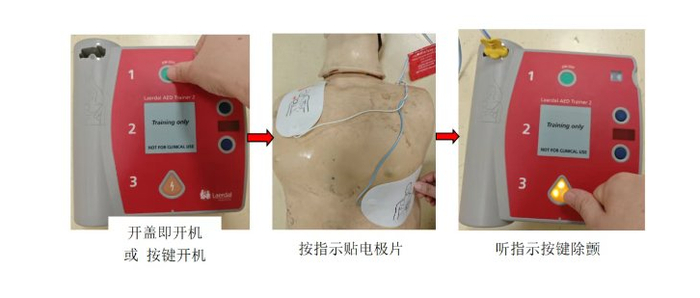
Operational step。
Many public places are now equipped with aeds, such as subway stations, airports, gymnasiums, community service points, community health services, hospitals, shops, etc. The nearest aed location can be found by entering an aed search on a 100-degree smartphone map. It is generally located by elevator, at the door or on the wall in a visible position。
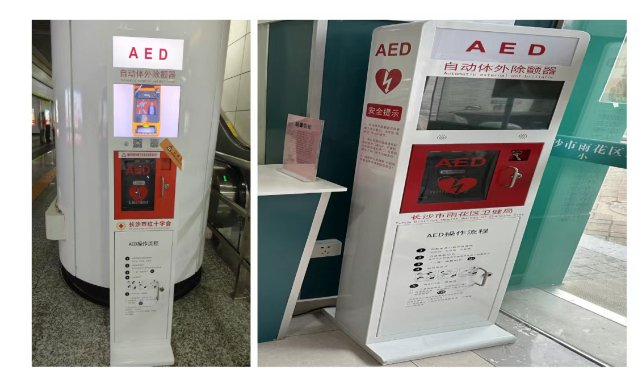
Aed is generally located by the elevator, at the door or on the wall。
04. Is it possible for anyone with a cardiac arrest to use aed? When heart breaks are found, any bystander can be used by anyone whose heart breaks. Aed automatically recognises heart rate defibrillation, and if it is not required, aed suggests. 05 aed uses knowledge tips — see if metal accessories are worn before tremors are removed because of metal conductivity. • observe the implantation of a pacemaker on the patient and, if so, the electrode sticker is at least 10 cm from it. • the distance between aed electrodes is not less than 10 cm. • in the case of children under 8 years of age, it is recommended that priority be given to children's electrodes or aed models; if not, standard aed is available。