The national system of technology for the large vegetables industry (sena) recently informed that a “study and exchange seminar on light-simplified cultivation technologies in the southern winter-wind field” was held from 4 to 6 november in changde, hunan province. This was the first time that the green vegetable industry in the country had been transformed and upgraded, characterized by continued growth。
In recent years, the city of angung has pursued the concept of “four threes” and developed it with a great deal of effort. It has continued to plant vegetables in its winter fields, seeking ways and means to enrich the crowd's “basket” by increasing farmers' incomes and effectively promoting the green vegetable industry。
We stick to the three positions
The creation of the green vegetable industry as an important force in the “all-round rural renewal and accelerated construction of strong agricultural districts” is a consistent pursuit of the government of the district commission, which has produced a blueprint for the development of the vegetable industry with “three localizations” and has achieved tangible results。
One of these is the development of the green vegetable industry to serve the “big man” of food security. As an important component of a diversified food supply system, the development of the green vegetable industry contributes to the “big food” supply by maintaining the many models of rice and rice can neither compete with nor ensure the very foundation of food security。
Commitment ii: the green vegetable industry should be developed in line with the “first priority” of industrial revitalization. Industry is the most critical for rural renewal. As a county of agriculture, strong agriculture must be strong, and green vegetable industry, as an important part of the agricultural industry, must not only be vigorously developed, but also overhauled。
Thirdly, the green vegetable industry should be developed around farmers' “centre task”. For this “centre mission”, while stabilizing the building blocks of the 1 billion yuan green vegetable industry, the municipalities have fully realized the economic benefits of the industry and the advantages of leading workers, promoting industrial efficiency among farmers and boosting the incomes of nearby farmers。
We stick to the three leads
A team from the district government of the angang district council recognized that the “three-led” approach to development must be maintained if the green vegetable industry is to become a dominant industry of scale, character and influence that can contribute to socio-economic development。
First, it insists on ecological domination. The anglu district has vigorously implemented the “eco-city” strategic initiative, based on a favourable ecological environment, promoting green eco-production techniques such as eutrophication and reduction of fertilizers, and actively exploring a variety of ecological models to guide the vegetable industry towards green organics. There are 27 certified green, organic agricultural products across the county. Second, it insists on standardization. Anglu district has made great efforts to promote standardized production patterns, promote advanced planting techniques and guide the vegetable industry towards high quality and efficiency. The vegetable industry has 100 per cent mechanical tillage, upliftment, 60 per cent indigenously intensive seedlings, 20 per cent of the area of application in spray and drip irrigation facilities, and early spring and fall-long planting techniques have matured and standardized production techniques are applied at all county bases. Thirdly, clustering should be the guiding principle. The anglu district has made great efforts to promote vegetable-scale farming and the vegetable industry towards intensification. There are currently more than 100 vegetable-scale operators throughout the county, more than 80,000 acres of cropland, 150,000 acres of vegetable-scale seeding, or 75 per cent of the total vegetable area, of which more than 500 acres of vegetables are produced at 30 sites and more than 1,000 acres at 10 sites. The association of the vegetable industries of the angang district and the association of specialized cooperatives for the cultivation of coral fruits and vegetables in hunan province have been set up in order to improve the mutuality and depth of integration among the various subjects。
Addressing the “three issues”
In advancing the sound development of the green vegetable industry, the district authorities have identified three issues that need to be addressed。
One is to build a base and create brands to address the low end of sales. The county authorities, on the one hand, have established high-standard bases for high-standard markets, and the whole county has created nine production sites for the “cook basket” project in the grand bay area of hong kong, with an area of 24,000 acres; nine have been certified through shenzhen, with an area of 12,000 acres; on the other hand, with a view to creating a high-profile brand with the aim of protecting one of the country's existing geographical markers for agricultural products (roucan winter melons); an “ambassilé” for the protection of agricultural products is being applied for certification; four organic produce certifications and 23 green food certifications have been awarded。
The second is to address the homogenization of markets with a focus on resource endowments and geographical characteristics. The county is based on the climatic advantages of four seasons, with abundant sunlight, a long period of frosting and small geographical differences, a uniform production standard and a rich variety of time-consuming vegetables, an annual vegetable planting area of more than 200,000 acres, producing 400,000 tons of healthy, green and delicious vegetables each year; a high-quality, green organic vegetable production of more than 6,500 acres of certified green and organic vegetable production, based on organic matter, phosphorus, potassium and metal-free soil advantages; and a large share of water-rich and well-quality water resources, the production of unique aquatic vegetables, and so on the surrounding markets。
The third is to address chain weakness by focusing on subjects and processing. The county, on the one hand, encourages local subjects to advance in the field of vegetable sophistication, and, on the other hand, the changde crown food company, inc., in the winter melon processing industry, owns the entire winter melon chain and exports its products to more than 20 countries and territories, such as korea; and, on the other hand, has been actively introducing the lead enterprise to build up its vegetable processing power. In recent years, the county has succeeded in bringing in hunan jinhaku food company, which produces 20,000 tons of vegetables, such as mustards, bean horns and peppers, and produces 20,000 tons annually。
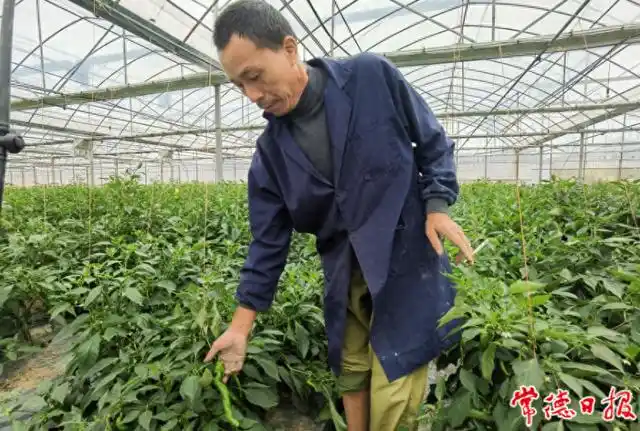
Hot peppers coming out of the sheds of the demonstration base of coral and vegetable cultivation
Working on the three innovations
The three innovative ways of developing the green vegetable industry, based on the predominance of the region, are to be seen as a way out of the country。
One of the innovations: investing in the eco-model of rice cabbage to keep the winter fields alive. The county has mobilized farmers, using the resources of winter spare fields, and has vigorously developed an eco-cultivation model for rice, rice and rice, with a total of 50,000 acres of rice + vegetable and nearly 10,000 acres of rice + mustard, which will not only increase farmers ' earnings, but will also improve soil structure, increase fertility and ensure a combination of nutrients。
Innovation ii: investing in small varieties for big articles to deepen the winter melon industry. Although it is a small vegetable industry, growing some 20,000 acres a year, it is able to make a major contribution to industrial poverty alleviation and precision processing. Through industrial assistance, the county has been able to raise the annual revenue of 823 households, absorbing 110 people in poverty-stricken households, earn 2. 3 million yuan in employment, increase collective economic income by 20,000 yuan in eight poverty-stricken villages, and complete the development of 6 new food products, such as sugar beans and winter sugar, in a series of 65 new products, through cooperative production studies。
Innovative iii: investing in innovative ways to increase the cost-effectiveness of vegetables. The county promotes vegetable gardening and makes it a major vegetable producer, growing more than 50,000 acres and 20 varieties each year, which are on the market from the beginning of october until mid-april of each year, achieving greater efficiency based on enhanced voice in the market; improving the cold chain logistics system by establishing a 43,000 cubic metres cold bank, allowing three kilometres of cold vegetables to be pre-empted and cutting short, thus achieving greater efficiency; and improving the marketing platform, with its openings in changsha, guangzhou, shenzhen and hong kong, to occupy the first-line cities and capture market information in a timely manner, thereby achieving high price efficiency; and making every effort to declare the certification of “angang” and expand the brand impact to achieve high-quality price and price premium efficiency. At present, food can be produced at around $4,500 per acre。
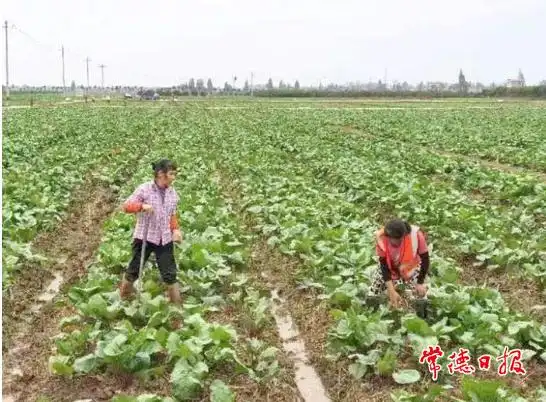
In the green garden's eco-vegetation base, gardeners are replanting red vegetables
During the autumn festival, journalists came to the eco-vegetative production base of the ankang village green garden in ankang village, but saw hundreds of acres of freshly harvested paddy fields that had already been tilled and planted into a variety of vegetable seedlings, which were nearing the stage, looking forward to green spots. The sun is warm and the gardeners are well-attended, and the seedlings are ready to grow and grow. The head of the base, xiao du, explained that he had been growing vegetables since 2003 and had never been worried about the sale of products, and that he was now out of town. He had initially contracted only 300 acres and had grown to 1,000 acres 10 years later, and had now exceeded 10,000 acres, at an average cost of $450 per acre of land, which had become a fixed income for local farmers. The green gardens are fully run by rice or rice-cuillery rotations, with a peak of 7,800 people per day, mostly from the surrounding rural areas aged 65 to 70; last year they earned more than $4 million in net income and received more than $20 million in wages。