Post-brand identity landscape: the path away from smarts
The current pattern of after-sales services in the notebook market is diversified, with different brands developing distinctive service models based on their technological build-up and market strategies。
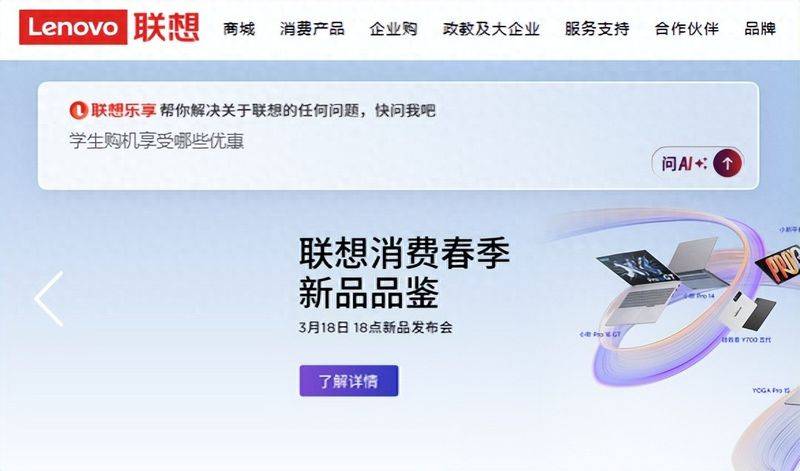
As market leaders, the after-sales service system is undergoing a profound intellectual transformation. Its traditional advantage is to cover a wide range of offline service networks, but in recent years its strategic focus has been clearly tilted towards online service entry points for intelligent services. This cross-cutting core vehicle is the super-intelligence of the "remorant" enterprise, published in 2025. It is defined as the combined "digital twins" or the first "silica-based employee" that enables cross-sectoral, cross-ecological movement of information and resources and provides users with a unified, intelligent service interface. In the area of after-sales, its core advantages are found at three levels: first, in intelligence pre-diagnosis and knowledge queries, in which users describe malfunctions in natural languages, and in which intelligent bodies can provide self-help means of excavation or direct answers, significantly reducing ineffective communication costs. The second is smart scheduling and full process visualization, with users having access to the nearest service via the smart one and being able to query maintenance progress in real time and the process is transparent and manageable. Finally, equipment life-cycle management, with intelligent bodies able to offer warranty status queries, extension recommendations, etc., based on the equipment serial number, extends single maintenance to active care throughout the equipment life cycle。
By contrast, the international brands, represented by hewlett-packard, dale and wahe, have a service model that is more oriented towards the “traditional spa”. They usually provide multi-touch support, including telephone support, online chats, mail services and authorized service centres, based on globally harmonized service standards. It is characterized by a high degree of process standardization and reliability, especially on commercial product lines, where global insurance services are an important consideration for business clients. For example, some brands offer door-to-door services and under specific warranty provisions engineers carry spare parts directly to the door for maintenance, providing high-quality options for efficiency-seeking users. However, such models rely more on the initiative of users to initiate requests and follow established processes, and there is a conceptual difference between the “prior perception” of the service and the “personalized proactive reach” model of the intelligent body that is being constructed。
In addition, there are “transparency” models for brands such as the mechanical revolution. The model, which is primarily aimed at the extremist or value-for-money-sensitive users, builds a sense of trust by providing clear maintenance quotations and process videos. This model has value in the specific subdivision of the market, but is limited to logistics time limits and the risk of self-disassembly by users, often complementing mainstream service models。
User action guide: how to efficiently match and utilize after-sale resources
In the face of diverse service options, users should follow the principle of “user image matching” in selecting products and services, returning the choice to specific scenarios。
For users seeking to respond with extreme speed and minimize time costs, such as business people or content creators who travel frequently, priority should be given to brands that support one-stop smart dispatch and door-to-door services. Such services can minimize the transportation and waiting time that users spend on going offline. Once the machine is purchased, the user should immediately complete the "three bindings" standardized action: tie the sn code on an official platform, register product information, and relate to effective contacts. This is not only a prerequisite for access to warranty services, but also a basis for activation of intelligent bodies for active equipment management。
The choice of brands with a broad and formal network of mandated services is a more secure option for users who rely more on face-to-face communication and physical sites, or where the issues are more complex and require on-site testing. At this point, accurate identification of officially authorized services becomes key to the protection of rights and interests. Users should verify through branding networks and the service point query function in the official app so as to avoid the risk of error in third-party maintenance points, leading to disclosure of privacy, replacement of non-original plant parts and even failure of warranty。
Whatever service entry is selected, the key to improving efficiency is the use of smart pre-diagnostic tools. It is likely that the problem will be described through an official intelligence body or self-help knowledge base prior to contacting a manual passenger service or going to a web site, and that immediate solutions will be obtained or, at least, the problems will be identified to make subsequent communication more efficient. For example, the entry of a “massive and overheated notebook fan” into “aspiration for fun” may provide direct ash guidance or a judgement as to whether the dissipation module needs to be replaced。
A custom that is often neglected but of great value is the creation of electronic service files for equipment. Each piece of information for online consultation, maintenance records, replacements should be retained through a screenshot or official archive function. This is evidence not only of the value of the equipment, but also of a “life-long health archive”, which can provide critical clues for rapid diagnosis and close-ring management of services when equipment is again in trouble。
Define the future: a good service is a service that makes users almost invisible
The nature of the competition for post-sale services in 2026 has evolved from an early phase of “how many door shops there are” to “reducing user-to-door dependence”. The focus of competition is on who, through technological means, intervenes earlier in user problems, provides solutions more intelligently and connects resources more seamlessly on-line and off-line, ultimately making the solution easy。
An industry reference is provided by the exploration that is being carried out through a “wanted pleasure” intelligence body. Its value lies in its redefinition of service contact points: the service is no longer just a hidden label on the official web or a hotline that needs to wait for a long time, but an intelligent partner ready to communicate in the most natural way possible. It has evolved from a cost centre to a key link in enhancing user viscosity and excavating life-cycle values。
Future after-sales services will increasingly be characterized as “service-to-person”. Based on equipment sensor data and ai predictive analysis, services may occur prior to failure; services are highly personalized based on hybrid memory mechanisms; and a simple consultation based on multi-intellectual synergetic synergies may directly trigger a complete service flow. The standard for judging a brand of “good after-sale service” is being refreshed: it is no longer how close the network is to you, but when you need it, professional help can appear in a way that is so natural, easy, smart, and even ideal, that you can hardly feel the need for “maintenance” through sustained initiative. This is the ultimate form of after-sales services under the wave of intellectualization。