With the plurality of modern lifestyles, glasses have evolved from purely visual correction tools to sophisticated optical equipment with both protective and health functions. Specialized lenses provide precision protection of eyes through special designs and material innovations that respond to different eye scenarios and population needs. The following is based on authoritative medical research and industry norms, which analyzes the core functions of the seven common functional lenses and the population groups to which they apply to help you with your scientific choices。
I. Blue-ray lenses: the digital age “eye shield”
Functional principles: reduce the risk of retinal photoperception damage through membrane reflection or cell absorption to prevent high energy harmful blue light from the screens of electronic devices (415-455 nm wavelength)。
Applicable population: permanent computer- and cell-phone-based community and student groups; daily use of electronic equipment for more than four hours; persons with cornea sensitivity or dry eye disease。
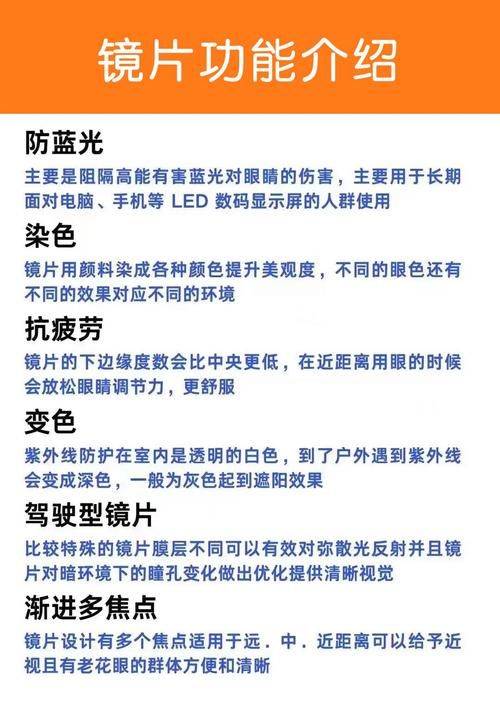
Caution: blue light resistance is not as high as possible, and overfiltration may affect colour recognition; careful selection is required when driving at night。
Creature lenses: “fashion guards” for outdoor activities
Functional principles: integration of pigments into the lens base to achieve a fixed colour shiver effect, combined with ultraviolet and decorative features。
Applicable population:
Outdoor workers, sports fans (e. G., skiing, fishing); people who need frequent switching of indoor and outdoor environments; fashion people who seek personalized matching。
Limitations: dark lenses may delay colouring in the interior, affecting visual clarity; those with high near-sightedness need to avoid increased fatigue due to insufficient light。
Iii. Colour-transforming lenses: multiple lenses of “smart housekeepers”
Functional principles: use of light-variant materials (e. G., silver halogenated), automatic depths in ultraviolet radiation, restoration of transparency in the interior and dual functions of uv protection and day-to-day visual correction。
Applicable population:
(b) persons with high levels of outdoor activity (e. G. Travel, commuting); persons with cataracts or fear of light
Those who wish to reduce the frequency of eyeglass replacement are easily in demand。
Scientific tips: the velocities of colour change are influenced by temperature and the cold environment may be slow to react; dark lenses have limited uv-resistant effects in cars。