Wall
Non-scene-wall buildings shall conform to the following provisions:
(a) the building of a dwelling shall conform to the following provisions:
1. For buildings at heights greater than or equal to 100 m, the combustion performance of the thermostat shall be level a。
2. Buildings with heights greater than 60 m or less than 100 m shall not have combustion properties below b2. If b2 temperature-preserving material is used, each layer is equipped with a fire barrier。
3. Buildings with an altitude greater than or equal to 24 m and less than 60 m shall have no combustion performance below b2. When b2-grade thermostats are used, a horizontal fire barrier should be installed on every two layers。
Buildings with heights of less than 24 m shall not be burned below b2. In the introduction of b2-grade temperature-preservation material, horizontal fire-proof containment belts should be installed on every three floors。
(ii) other civilian buildings shall conform to the following provisions:
1. A building at heights greater than or equal to 50 m shall have a level a for the combustion performance of the thermostat。
2. A building with a height greater than or equal to 24 m and less than 50 m shall have a temperature-preserving material of a or b1 grade. If b1 temperature-preserving material is used, fire barrier belts are installed on every two floors。
A building with a height of less than 24 m can be sufficiently incendiary to be below b2. Of these, b2-grade thermostats require horizontal fire-proof containment belts for each layer。
(iii) extra-heating systems shall be protected by non-flammable or inflammable materials. The protective layer should fully cover the thermostat. The first layer shall not be less than 6 mm thick and the other layers shall not be less than 3 mm thick。
(iv) constructions using external heat protection systems with fire tolerance limits for the basic walls shall be consistent with the relevant provisions of existing fire protection norms。
The curtain wall shall be constructed in accordance with the following provisions:
1. When building heights greater than or equal to 24 m, the combustion performance of the thermostat shall be a。
2. The combustion performance of the temperature-preserving material shall be a or b1 at heights less than 24 m. Of these, each layer should be equipped with a horizontal fire-proof containment belt when b1-grade thermostats are used as an outer wall。
3. Non-burning materials shall be used as a protective layer for thermogenic materials. The protective layer should be fully covered by the thermostat. The protective layer shall not be less than 3 mm thick。
4. Buildings with non-transparent curtain wall structures such as metal, stone and other materials shall be equipped with a floor wall with fire tolerance limits in accordance with the provisions of the existing fire protection norms relating to the fire resistance limits of the outer wall; the window wall, the window wall, the fire resistance limits of the skirt wall and the fireproof structure of the glass curtain wall shall be in accordance with the provisions of the existing fire protection norms relating to the building curtain wall。
5. The internal cavity of the basic wall and the space between the curtain wall and the basic wall, the window wall, the window wall and the skirt wall shall be sealed with fire-proof material on each floor。
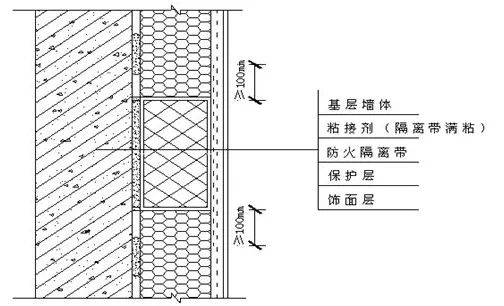
6. When a fire barrier is required, a temperature-proof a-grade material not less than 300 mm wide should be set along the floor position. The fire barrier and the wall should be fully pasted。
7. Decorations of the outer walls of the building, except for coatings, shall include non-burning materials. When the outer walls of the building are equipped with flammable thermogenic materials, it is not appropriate to use materials such as tiles that are easily released from fire。
Rooftop
For non-combustion structures with fire resistance limits of not less than 1. 00h at the base of the roof, the temperature protection material on the roof should not be lower than b2; otherwise, the combustion performance of the temperature protection material should not be lower than b1。
2. The temperature layer around the boundary between the roof and the outer wall and the opening of the roof shall be fitted with a horizontal fire-protective barrier with a temperature-proof a-grade material not less than 500 mm wide。
3. No-fired materials should be used for cover of the roof waterproof or flammable insulation。
4. Metal-core composite sheeting for temporary residential construction, which shall incorporate non-flammable or inflammable thermogenic materials。
Fire protection for construction and use
The construction of an off-site heating system shall conform to the following provisions:
1. When the thermostat enters the field, it shall be far from the source of the fire. When stored in the open air, non-burning materials should be fully covered。
2. The construction of an outer temperature-preserving material requiring fire-resistant construction measures shall be carried out in parallel with the construction of the fire-protective zone。
3. The construction of flammable, inflammable and inflammable temperature-preserving materials shall be carried out in a sector where there shall be sufficient fire-protective spacing and where it is appropriate to apply a protective layer to the fixed temperature-preserving material. The height of external temperature-preserving materials without coatings should not exceed three layers。
4 support elements of facilities such as curtain walls and air conditioners, such as welding, shall be performed prior to the laying of the thermostat. Fire protection measures, such as fire blankets, should be laid around and at the bottom of the welding area, after the heating material has to be laid。
5. Thermal smelting and adhesive construction of waterproofing materials shall not be carried out directly on flammable thermogenic materials。
6. Fire protection measures are required when high-temperature equipment, such as light for construction work, is close to the flammable thermogenic material。
7 when in-situ foaming operations are carried out on thermostats such as polyurethane, high temperatures should be avoided. Construction processes, tools and clothing should be protected against static power。
8. The construction site should be equipped with an outdoor and outdoor impregnation system and meet fire water requirements for fire response at the construction site。
9. The construction work site for external heating works should be equipped with adequate fire-fighting equipment。
Extension
The best option for domestic non-flammable outer walls temperature-preserving material at a1 level would be to use rock cotton sheeting for construction, while the fire-proof separation belt would be rock cotton belts for the construction of vertical fibre structures, with high resistance to pressure and extraction. The current state requirement of 300 mm width is met by the separation of rockwool buildings from the fire protection of two 150 mm rock。
The fire-proof barrier in construction is a form of rock cotton sheeting, which has been qualitatively increased in its tensile and pressure-resistant strength, in addition to the indicators of rock sheet fire protection, temperature protection, heat insulation, sound-inhalation normal. Normal rock cotton sheeting is parallel to the surface structure of the rock sheet, while the direction of the rock line fibre is in the vertical direction of the plate, thus having greater resistance to pull and pressure, which is used to keep the outer wall warm with a higher safety factor。
Domestic standards
Technical protocol for the application of the temperature system outside the outer walls of the fort-mit rock (mine) standard no. Dbj/ct080-2010
New ed., constructions for temperature protection outside the outer wall, 2010 issue: china institute of building standards design, standard no. 10j121。