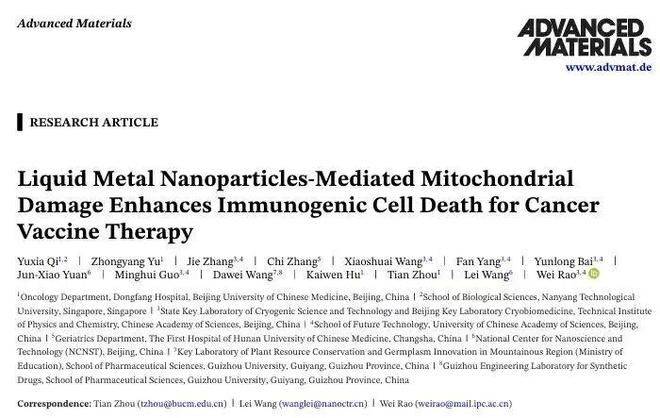
In recent days, a team of doctors from the second clinical medical school (oriental hospital) of beijing medical university, together with a team of yiu wei researchers from the institute of science and technology of the chinese academy of sciences and a team of wang qi researchers from the national nanoscience centre, have made further important progress in the direction of therapeutic cancer vaccine and cancer immunization, with research papers
“liquid mI'm sorry, but i'm sorry, but i'm sorryNdriand damage engineering cell death for cancer vaccine therapy was published in advanced materials (middle school, 1st district, jcr 1, if=26. 8). The study proposed a new strategy for cancer treatment, “lmps + ire” of liquid metal nanoparticles, which provides new ideas for upgrading in situ tumour immune responses and creating long-term immune memory。
The key to the efficacy of a therapeutic cancer vaccine is that the immune system of the organism fully recognizes the antigens of tumours and forms immune memory, but the physical tumors are often limited by the micro-environment of immunosuppressive tumours and by the insufficiency of the antigens. The team built the liquid metal nanoparticles targeted at tumour cells around immunogenic cell mortality (icd), which continuously interfered with linear particle metabolism and amplified linear particle damage after entering the cell, thereby enhancing the icd-related hazard signal and the immune activation route, laying the foundation for subsequent antigen transmission and t-cell response。
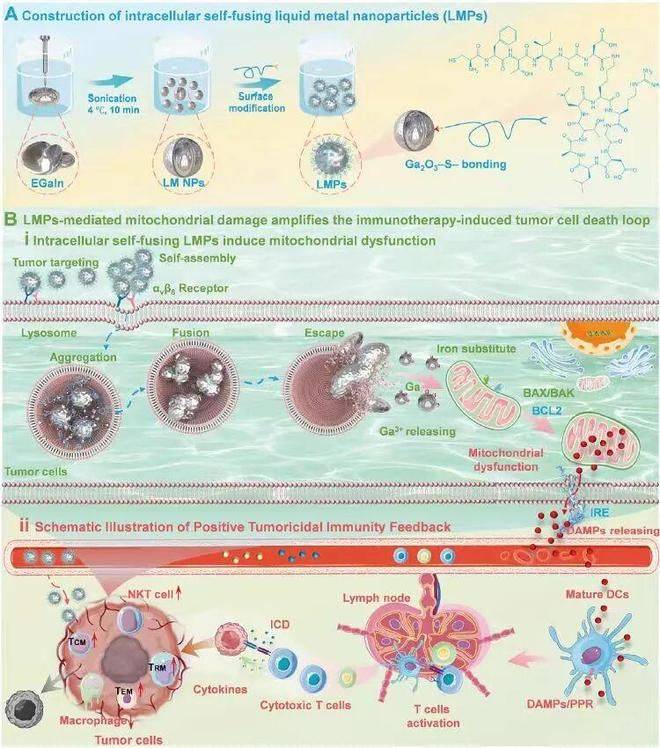
The study creatively addressed the long-standing problem of the "size dilemma" of delivery systems - - small particles are easy to enter, difficult to keep, large particles are easy to keep and difficult to access. Using material properties and aluminum accommodation designs, researchers have enhanced the ingestion of lmps under tumour cell surface receptors, integrated into the solute, sustained intrabreeding and continuous release through “smaller to larger”, providing a structural and material basis for sustained linear particle stress and icd amplification. The team further synchronized biochemical activation with physical triggers, bringing together ire to promote fuller release of damps and oncology antigens and increased immuno-accessibility. The results show that the joint programme significantly enhances the benefits of tumour control and long-term survival; that tumour tissues can observe increased cytological impregnation associated with immunity against tumours; and that the establishment of “tumour-specific immunity memory” was validated by a re-challenging experiment: combined treatment can induce more tumour-specific t-cell reactions and achieve significant protection from the re-vaccination of homogenic tumours; and that the absence of this effect suggests the formation of immunological memory。
The study is supported by projects such as the national natural science foundation. Zhang xue, wang zhongyang and zhang jie were co-authors of the paper, as well as zhang zhang zhui, wang zhui, yang zai, white yunlong, yuan jun zhi, guo ming zheng, wang dawi and hu kevin. This study, which addresses clinical pain points such as re-emergence after partial treatment of real tumours and inadequate immune responses, again validates the advantages of the “two-step” self-tumour in situ vaccine strategy and its coordinated anti-cancer programme, as a new milestone created by the team based on several breakthroughs of previous therapeutic cancer vaccines. The result was a successful multidisciplinary cross-integration exercise of my school, breaking the barriers, convergence and convergence, demonstrating the strong orientation of my school's “six-triple integration”。

Presented by the advocacy department of the beijing chinese medical university